Salesforce's annual revenue reached $34 billion in fiscal year 2024, cementing its position as the world's #1 AI Customer Relationship Management (CRM) platform. Organisations across sectors rely on it to simplify operations, strengthen customer interactions, and drive sales performance. For most enterprises, Salesforce is no longer a departmental tool — it is the Single Source of Truth for revenue, service, and customer data.
Yet many businesses struggle to convert that platform investment into commercial advantage, because they lack the internal skills to manage it. Research from Mason Frank International identifies this as the leading obstacle to Salesforce success:
43% of organisations surveyed encountered implementation challenges stemming from a lack of internal skills. — Mason Frank International, Salesforce Implementation
Before you read on: ask whether your organisation treats Salesforce as strategic infrastructure or as a maintenance line item. If your team resolves the same tickets repeatedly, delays releases to avoid breaking integrations, or cannot say with confidence who owns data quality, your organisation is carrying technical debt rather than reducing it. When you are ready to assess this honestly, explore your Salesforce environment with Think Beyond.
Salesforce managed services exist to close that gap. A properly resourced managed services partnership identifies and resolves risk before it disrupts workflows or revenue. Organisations that build this kind of partnership consistently:
- Optimise day-to-day operations and platform performance
- Strengthen security protocols and data governance
- Build stronger, more consistent customer relationships across every touchpoint
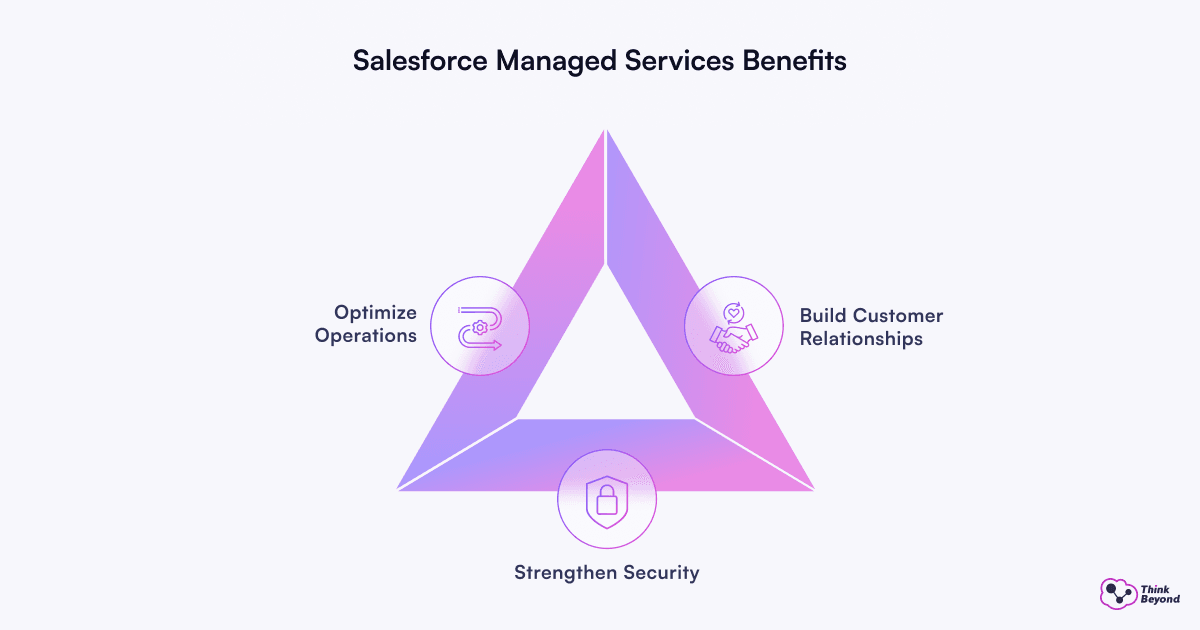
These outcomes apply to organisations of every size — but the path to achieving them differs by sector, which is the strategic case this article makes.
At a Glance: Why Industry-Specific Managed Services Matter
| Challenge | CRM Response | Outcome to Measure |
|---|---|---|
| Skill gaps slow releases and increase risk | Certified administrators, developers, architects, and consultants on demand | Reduction in resolved-ticket backlog and release cycle time |
| Incidents surface outside business hours | Round-the-clock monitoring and 1st/2nd/3rd line support | Mean time to resolution (MTTR) and system uptime |
| Sector-specific processes (CPQ, CTI, portals) go unsupported by generalist teams | Industry-aligned specialists who understand sector workflows | User adoption rate and process cycle time by department |
| Fragmented vendors create accountability gaps | Single accountable managed services partner across support, development, and integration | Vendor consolidation and total cost of ownership |
| Legacy configuration accumulates as technical debt | Structured audits, coding standards, and CI/CD discipline | Volume of resolved technical debt and org health score |
Why Does Your Business Need Salesforce Managed Services?
A complex Salesforce environment requires specialised knowledge and constant attention. Organisations increasingly turn to industry-specific Salesforce managed services to protect their CRM investment and reduce strain on internal resources — a decision that supports both operational efficiency and long-term organisational integrity.
Salesforce Expertise for Complex Environments
87% of organisations either have or expect skill gaps in the next three years. Salesforce managed services providers close these gaps directly. They give organisations access to certified experts across the full Salesforce product suite — an approach that costs less than maintaining an expensive internal team with limited coverage. Companies gain developers, administrators, and consultants with the right skills exactly when they need them.
24/7 Assistance and Incident Resolution
System problems rarely respect office hours. A Salesforce managed services provider monitors and supports the platform around the clock, so critical business functions do not stay down for long. Dedicated teams identify and resolve potential problems before they affect operations — a discipline that protects business continuity and preserves customer trust.
Set-Up Strategies for Fast Deployment
Expert teams design Salesforce solutions that match specific business goals. They apply proven methods to accelerate deployment while building the foundation correctly from day one. This approach prevents common failure points — business disruption or configuration errors that cause system outages. Professional deployment plans include sandbox environments, change set verification, and precisely timed implementations.
Operational Support for Ongoing Optimisation
Managed services extend well beyond initial set-up. Continuous monitoring, scheduled updates, and data quality checks keep the Salesforce instance efficient while it absorbs new features as they release. Structured system checks surface bottlenecks early, and regular data cleaning keeps information accurate and compliant with governance requirements.
Broad Range of Services from One Provider
A single Salesforce managed services partner removes the need to manage multiple vendors. Providers of this kind typically deliver:
- User management and troubleshooting support
- Administration and application management
- Release and change management
- Development and integration capabilities
- Reporting and dashboard creation
This consolidated model simplifies communication and holds one team accountable for the entire Salesforce ecosystem — a structural safeguard for data sovereignty and platform integrity.
Agile Approach to Evolving Business Needs
Business requirements change constantly, and an agile operating model allows organisations to adapt without depending on a fixed internal team. Teams respond to shifting processes or user needs through incremental development and regular feedback cycles, which keeps the solution aligned with evolving strategic priorities.
What's Available in Think Beyond's Salesforce Managed Services?
Think Beyond's managed service offering covers several core areas that work together to keep the Salesforce platform performing at its best, meeting both immediate operational needs and long-term strategic goals.
Support Services: User Management and Troubleshooting
Support services form the foundation of any managed services engagement. Think Beyond delivers comprehensive 1st, 2nd, and 3rd line support tailored to each client's specific business requirements. Whether a client needs full coverage or targeted assistance at a single level, the team identifies root causes and resolves issues to minimise system downtime.
Administration and Application Management Tasks
Think Beyond's team handles the daily administration tasks that keep a Salesforce org healthy. The team runs regular system backups, removes duplicate data, optimises storage, and maintains field configurations. It also schedules automated retrievals for security audits and compliance checks — a discipline that becomes essential once multiple users make daily changes across the organisation.
Release and Change Management for New Features
Think Beyond's Salesforce Managed Services incorporate structured release management to ensure seamless, reliable deployment of updates. Clients benefit from scheduled release planning — typically 14 to 90 days in advance — dedicated development environments for early testing and verification, and specialised tools (Gearset, Copado, Flosum, and Blue Canvas) that automate and orchestrate deployments.
Development and System Integration Capabilities
Think Beyond's development and integration capabilities rest on years of proven delivery in complex enterprise environments. Unlike offshore providers that compete primarily on low cost, Think Beyond delivers lasting business value through scalable solutions that connect Salesforce seamlessly with ERP, supply chain, HR, and other mission-critical systems, using a mature, methodical integration approach.
Reports and Dashboards for Business Insights
Reports convert raw data into actionable business intelligence. Think Beyond's experts build custom dashboards tailored to each user persona, designed for speed and relevance, so decision-makers see the metrics that matter and can act with confidence.

Industry-Specific Salesforce Managed Services Delivered by Think Beyond
"The Think Beyond team has been nothing short of amazing when it comes to delivering continuous Salesforce support. I am constantly impressed by their responsiveness, expertise, and attention to detail. They have gone above and beyond to ensure that our Salesforce instance is optimised for our business needs."
— Eva Karnaukh, VP, Business Operations, Virtana
Different industries achieve different results with Salesforce managed services, because each sector's operational priorities require a distinct response. The sections below outline how that plays out in practice.
High-Tech: Focus on CPQ and CTI Solutions
Think Beyond's Salesforce managed services partnership with Virtana illustrates this precisely. Virtana — a Palo Alto-headquartered digital infrastructure management company with 150+ employees worldwide — came to Think Beyond with a legacy Salesforce org dating back to 2011, a long backlog of unresolved support tickets, and low user adoption: sales staff preferred Excel over Salesforce itself.
Think Beyond ran a full org audit covering security settings, critical updates, licence usage, and user adoption patterns, then addressed the most severe bugs and configuration gaps in parallel. Once the platform stabilised, the team implemented CI/CD processes and coding standards to support sustainable future development, and worked with Virtana's operations team to prioritise tasks by business impact.
The partnership now delivers stability, user satisfaction, and long-term B2B sales continuity through:
- Dedicated 2nd and 3rd line Salesforce support, delivered by a team that reacts quickly to issues and functions as an extension of Virtana's internal IT department. This structure sustains operational continuity, minimises downtime, and materially increases user satisfaction by resolving both routine and complex problems efficiently.
- A comprehensive business continuity plan with clear short-, mid-, and long-term priorities, giving the managed services team a framework for stable growth and higher user adoption.
- Ongoing CPQ support, so Virtana's sales teams generate accurate, tailored quotes quickly. This includes regular updates to product catalogues, pricing models, and approval workflows, plus user training to maximise adoption and productivity within the CPQ system.
- Continuous improvement of a CTI solution that integrates Salesforce with telephony systems, enabling click-to-dial, automatic call logging, and real-time access to customer data for both sales and support teams.
Read the full Virtana case study for the complete audit-to-outcome breakdown.
Energy Sector: CPQ and Broker Portal for B2B Energy Sales
For an energy provider, Salesforce managed services deliver significant value by supporting and optimising both CPQ (Configure, Price, Quote) and Broker Portal solutions:
- Ongoing updates and optimisation of a comprehensive product catalogue, including support for multiple tariffs, regulatory requirements (such as ETS), and time-based product validity.
- Continuous development and refinement of the custom CPQ engine, enabling complex quoting for multiple metric points and locations. This includes metric point conflict management and integration of new business logic as energy products and regulations evolve.
- Integration of pricing engines and risk assessment tools that accelerate business risk evaluation during the sales process, ensuring accurate and competitive offers.
- Onboarding and continuous training for brokers and internal users to maximise adoption and correct use of the portal's features, including offer creation, document management, and communication tools.
- Enhancements to the broker portal that support evolving business models, integration with external systems (such as market data providers), and alignment with new product offerings or regulatory changes.
Higher Education: Student Lifecycle Automation
Salesforce managed services play a transformative role in modernising student services at universities. Think Beyond's collaboration with SWPS University demonstrates how expertly managed Salesforce solutions protect operational continuity across every critical touchpoint in the student journey:
- CTI for Student Affairs Centres: Staff make and receive calls directly within Salesforce, with instant access to student records and history for personalised, informed support. The system records every interaction automatically, ensuring complete documentation of student cases, and routes calls to the right advisor or department based on predefined criteria — reducing wait times and improving service quality.
- Handling Student Inquiries and Applications: Student questions submitted via web forms, email, phone, or social media convert automatically into cases and route to the appropriate staff for resolution. Routine tasks — acknowledgements, status updates — run automatically, freeing staff to focus on complex cases. Students track their application status, submit documents, and access FAQs directly, reducing administrative burden and improving transparency.
- Issuance of Student Certificates with Qualified Electronic Signature: The institution issues and signs certificates electronically using qualified signatures, ensuring legal validity and compliance with eIDAS regulations. Students request and receive signed documents online, eliminating in-person visits, while the institution stores signed documents securely within Salesforce with legally compliant electronic archiving.
- Appointment Scheduling with Advisors and Queueing System Integration: Students book appointments with advisors based on real-time availability, directly from the university portal or mobile app. Integration with queueing systems ensures fair, transparent appointment allocation, minimising wait times and optimising resource use, while automated reminders reduce no-shows.
This section references regulatory frameworks (eIDAS) for context. It constitutes strategic guidance, not formal legal advice; institutions should confirm compliance requirements with qualified legal counsel.
Nonprofits: Providing Ad Hoc Support
Salesforce managed services offer nonprofit organisations flexible, expert support tailored to their operational needs and resource constraints. Managed services address common nonprofit requirements by:
- Correcting data inconsistencies, duplicate records, and incomplete information, ensuring a reliable database for donor management, volunteer tracking, and programme outcomes.
- Designing and troubleshooting reports that provide clear insight into fundraising, engagement, and impact metrics, supporting transparent reporting to stakeholders and grant providers.
- Automating repetitive processes such as donation acknowledgements, volunteer onboarding, or event registrations, freeing staff time for mission-critical work.
- Connecting Salesforce with email marketing tools (such as Mailchimp or Constant Contact), enabling targeted outreach and automated campaign tracking.
- Integrating platforms such as Classy, PayPal, or Stripe to enable seamless donation processing, real-time donor record updates, and consolidated financial reporting.
Metrics That Prove Salesforce Managed Services Impact
Leaders considering a managed services partnership should track measurable indicators, not anecdotal impressions, to validate ROI:
- Mean time to resolution (MTTR) for support tickets across 1st, 2nd, and 3rd line categories
- User adoption rate, tracked by login frequency and feature usage against pre-engagement baselines
- Release cycle time and deployment failure rate, benchmarked once CI/CD and coding standards are in place
- Resolved technical debt, measured through recurring org audits and health checks
- System uptime and incident frequency, tracked against agreed SLAs
- Total cost of ownership, comparing consolidated managed services spend against a fragmented multi-vendor model
How Think Beyond Helps Organisations Achieve These Outcomes
Think Beyond positions itself as a Strategic Partner in Salesforce management, not a software house delivering isolated fixes. The team supports organisations through:
- Comprehensive org audits and health checks that surface security gaps, licence inefficiencies, and configuration risk
- Access to certified administrators, developers, architects, and consultants across CPQ, Sales Cloud, Service Cloud, and Marketing Cloud
- CI/CD implementation and coding standards that reduce technical debt and support stable, scalable growth
- Business continuity planning with short-, mid-, and long-term priorities aligned to organisational goals
- Data management, integration, and reporting that reinforce a genuine Single Source of Truth
Ready to assess where your Salesforce environment stands? Initiate a Strategic Review with Think Beyond.
What Makes Think Beyond the Right Managed Services Partner?
Whether an organisation requires a single certified expert to close a skills gap, a dedicated team to manage its entire Salesforce environment, or on-demand ad hoc support for time-critical issues, Think Beyond delivers scalable solutions built to fit the business.
This approach gives clients the right level of expertise, when and how they need it, without the overhead of hiring full-time staff. A proven record of technical excellence, high client satisfaction, and deep Salesforce certification allows Think Beyond to help organisations maximise their Salesforce investment, streamline operations, and achieve lasting results.
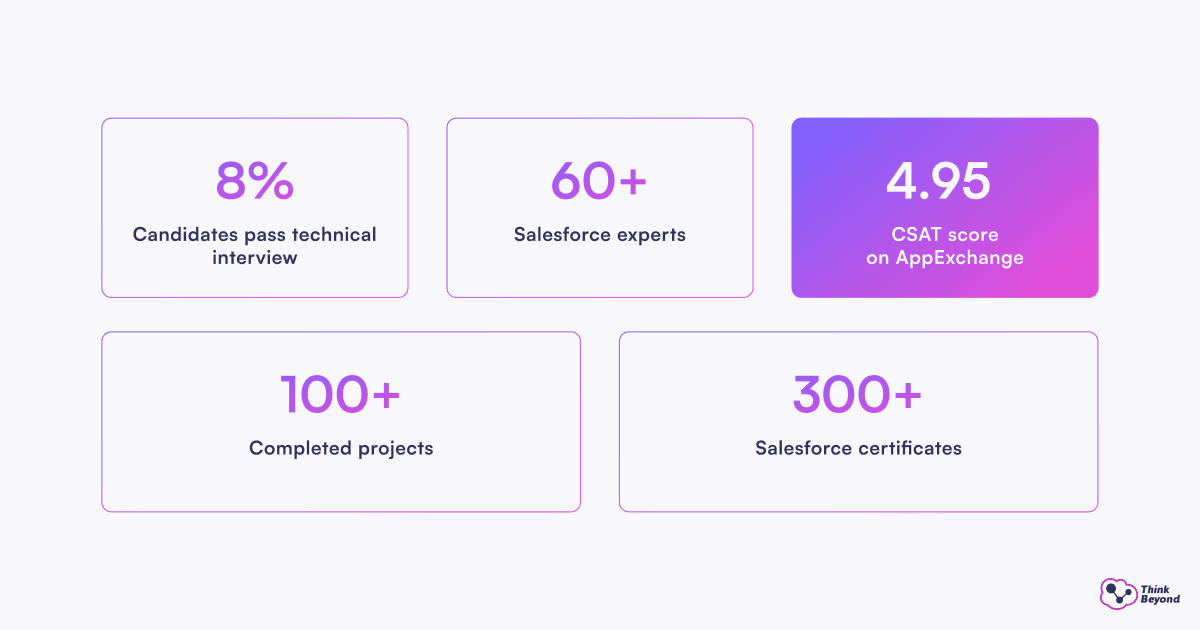
Salesforce managed services mean more than technical support — a strong managed services partner becomes a strategic ally. The figures below show the standard Think Beyond maintains:
- 8% technical interview pass rate. Rigorous hiring standards mean only candidates with proven expertise and problem-solving skills join the team. Clients work with highly skilled professionals who can tackle complex Salesforce challenges and deliver superior results.
- 4.95 CSAT score on AppExchange. This near-perfect client rating reflects a consistent commitment to responsiveness, service quality, and durable partnerships.
- 280+ Salesforce certificates. This certification portfolio spans the Salesforce ecosystem and ensures clients benefit from current best practices, advanced technical capability, and up-to-date platform knowledge.
These figures explain why organisations choose Think Beyond as their managed services partner: a team of top-tier experts, a proven record of client satisfaction, and Salesforce credentials that hold up under scrutiny — all directed towards business outcomes that matter.
Request a Strategic Consultation to define the right managed services model for your industry.
Frequently Asked Questions
What are industry-specific Salesforce managed services?
Industry-specific Salesforce managed services adapt standard support, administration, and development work to the workflows, compliance requirements, and sector priorities of a particular industry — such as CPQ for high-tech and energy, or student lifecycle automation for higher education.
How is this different from generic Salesforce support?
Generic support resolves tickets as they arise. Industry-specific managed services combine that support with sector expertise, so the team understands the business context behind each request and can prevent recurring issues rather than repeatedly fixing them.
Which industries benefit most from tailored managed services?
Any organisation running Salesforce for a sector with distinct workflows benefits — Think Beyond has delivered tailored outcomes for high-tech, energy and utilities, higher education, and nonprofit organisations, among others.
How long does it take to see results from a managed services partnership?
Most engagements follow an initial audit phase, followed by resolution of urgent issues within the first few months, before moving into CI/CD implementation and longer-term optimisation. Timelines vary based on the size and condition of the existing org.
How do I know if my organisation needs managed services rather than a one-off project?
If Salesforce support requirements are ongoing rather than a single implementation, if internal resources cannot cover the full range of admin, development, and architecture skills required, or if technical debt is accumulating faster than it is resolved, a managed services model is the better fit.
Key Public Sources Referenced