

How Higher Education CRM Software Boosts Student Engagement
Fragmented student data slows advisors down and lets at-risk students fall through the cracks. Salesforce Education Cloud gives institutions a single, 360-degree view of every student, so advisors intervene earlier and students get consistent support across every channel. Institutions that treat this as a strategic student journey decision — not an IT upgrade — see measurable gains in retention, self-service adoption and operational capacity.
Student expectations have shifted faster than most university back-office systems can keep pace with. Applicants and enrolled students now compare their institution's digital experience against the banking apps and retail platforms they use daily — and manual spreadsheets, siloed departmental systems and paper-based case files do not hold up to that comparison. For institutions managing thousands of students across multiple campuses, this is no longer a service-quality preference. It is a commercial necessity: retention, reputation and recruitment all depend on it.
This article sets out how Salesforce Education Cloud builds a connected ecosystem around the student journey — strengthening academic advising, accelerating response to student challenges, and using data to support earlier, better-informed intervention.
Before you read on: ask yourself whether your advisors can currently see a complete student record — academic, financial and engagement data — in one screen, or whether they are still switching between four systems to answer one query. If the answer is the latter, explore your institution's data readiness with Think Beyond before reading further.
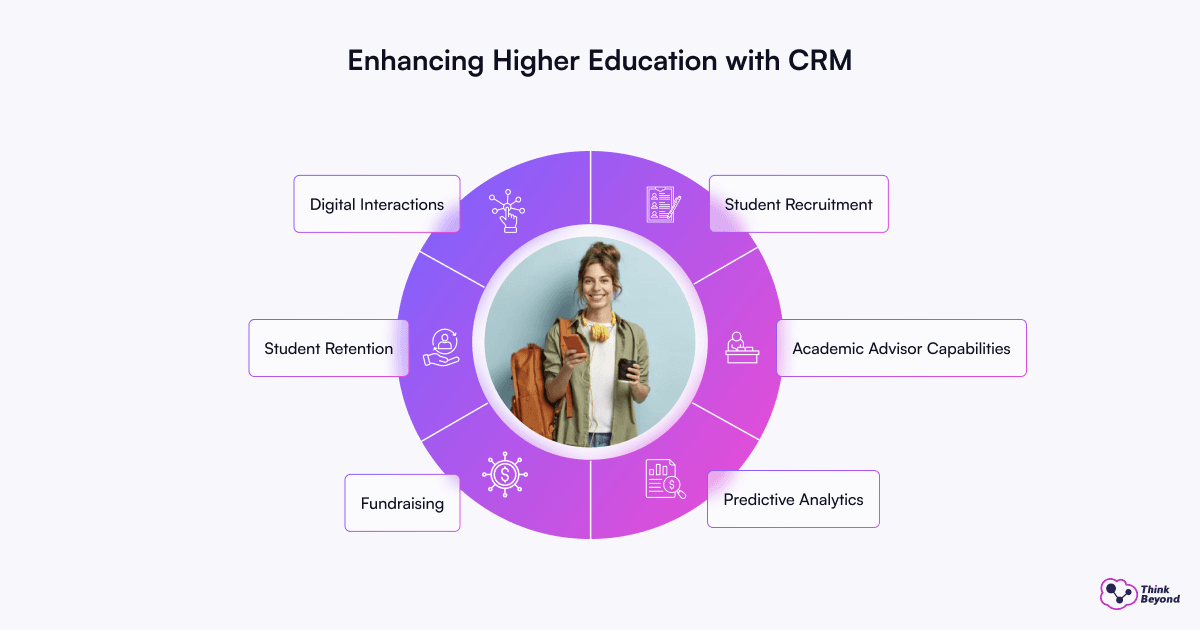
At a Glance
| Challenge | CRM Response | Outcome to Measure |
|---|---|---|
| Student data locked in disconnected systems (LMS, admissions, finance) | 360-degree student profile in Education Cloud | Advisor time-to-resolution per case |
| Advisors and support offices working from different records | Shared case management with automated routing | Case escalation rate, SLA adherence |
| At-risk students identified too late | Real-time alerts and Data Cloud behavioural signals | Early-intervention rate before drop-out risk peaks |
| Inconsistent service across channels and campuses | Omnichannel portal, chat and mobile-first design | Self-service adoption rate |
Empowering Academic Advisors with Unified Student Data
University CRM software removes the data silos that separate academic records, financial information and engagement metrics. When advisors work from one accurate record instead of several partial ones, advising itself becomes more effective — not just faster.
360-Degree Student Profiles in Education Cloud
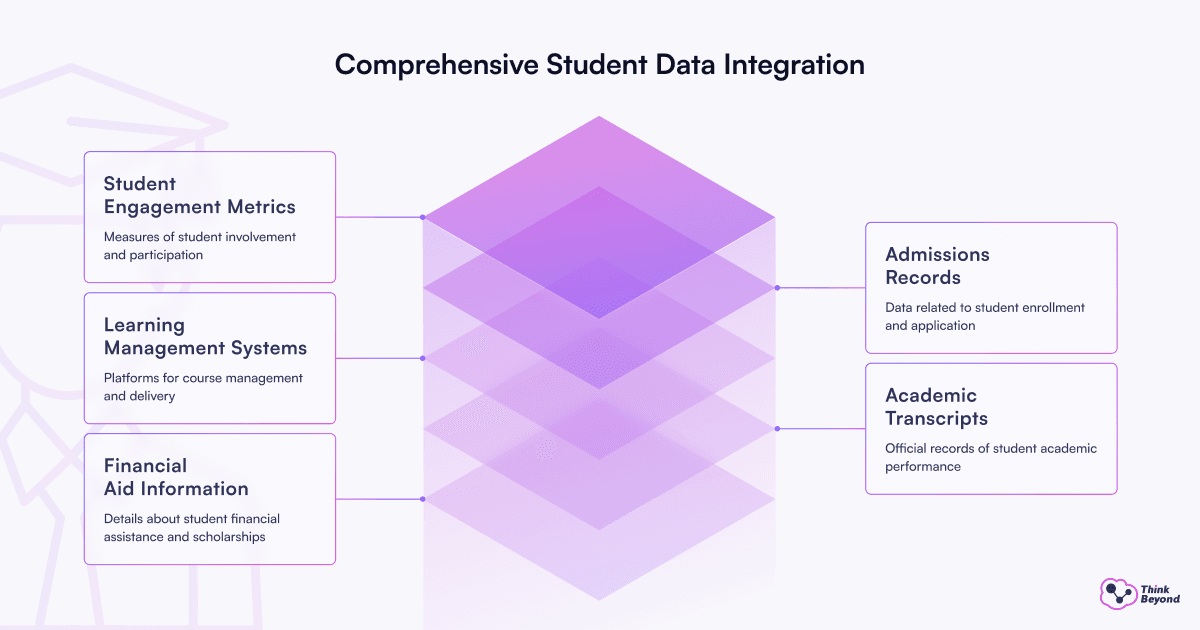
Salesforce Education Cloud brings all critical student information into one secure record. Advisors access academic history, grades, GPA and student holds through a single interface, without switching between systems. This gives them a clear, current picture of each student's academic progress and personal situation. The platform consolidates data from:
- Learning management systems (LMS)
- Admissions records
- Academic transcripts
- Financial aid information
- Student engagement metrics
Streamlined Enrolment and Curriculum Planning
Experience Cloud supports custom student portals where learners manage registration, track programme progress and receive personalised recommendations, with minimal administrative friction. Students find classes, confirm eligibility and register from one place — which frees advisors to spend less time on paperwork and more time guiding students directly.
The platform also helps institutions build and manage programmes of every type, from traditional degrees to micro-credentials, and shows students clearly which skills each programme builds. Salesforce's Skills Generator reviews programme and course content to surface market-relevant skills, helping advisors direct students toward courses that build specific career capabilities.
Advisor Collaboration Across Departments
Education Cloud dashboards let advisors, faculty and campus support staff work from a shared record, supporting coordinated intervention rather than fragmented outreach. This unified approach helps institutions close achievement gaps: teams spot at-risk students earlier and target support before problems escalate.
Rapid Response to Student Challenges Using Service Cloud
Retention strategies depend on support systems that catch issues early. University CRM software gives institutions the operational tools to identify and resolve student challenges before they become serious problems.
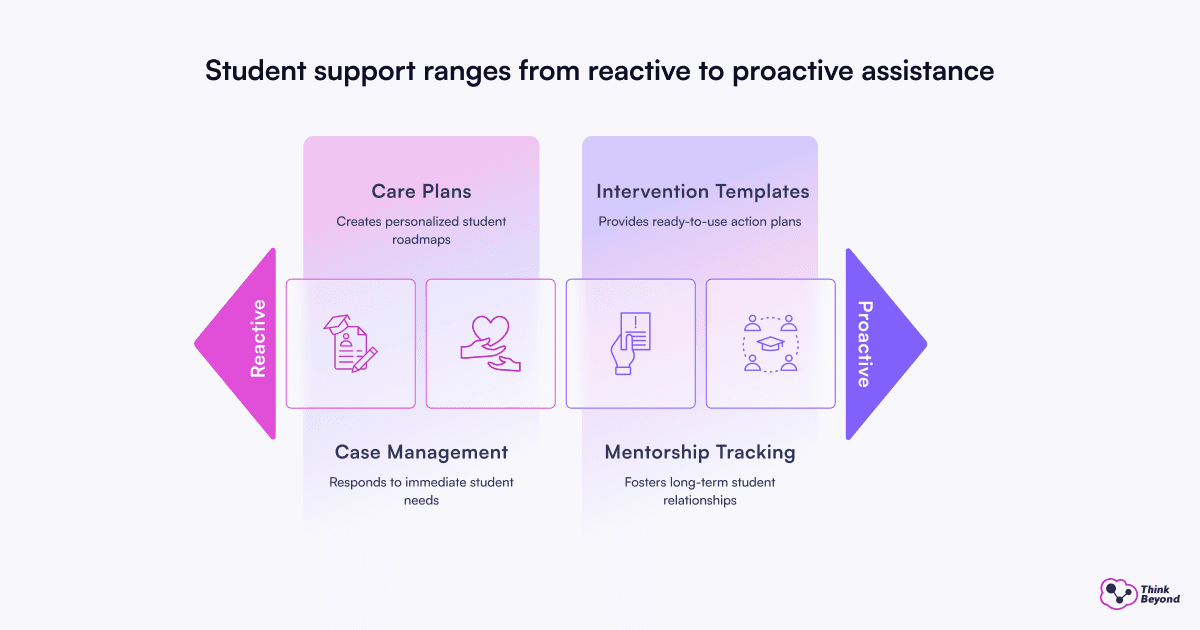
Case Management and Care Plans
Agentforce, tailored for Education Cloud, extends case management so support staff can use unified data to understand student needs at critical points in the academic journey. Support teams can:
- Track interactions with students across multiple support offices
- Coordinate outreach through a single case management workflow
- Monitor progress on active support plans in real time
- Access unified views that improve cross-team integration
The Care Plans feature lets advisors and support staff build individual roadmaps with tasks targeting specific challenges and milestones tied to a student's academic or personal wellbeing. Staff can create these plans individually, or as reusable templates for consistent support across similar cases.
Mentorship Tracking and Intervention Templates
CRM solutions materially improve the management of mentorship programmes. Salesforce's mentorship tools help institutions:
- Match mentors and mentees using skills and needs assessments
- Track mentorship relationships and interactions over time
- Record key meetings through a complete portal experience
- Strengthen alumni participation and long-term institutional relationships
Intervention templates provide ready-to-use action plans that link required interventions to specific problems, goals or care plans — reducing the time staff spend building a response from scratch.
Real-Time Alerts for Financial and Academic Risk
Early detection enables faster intervention. Education Cloud's alert system notifies advisors when students fall behind on key milestones. The platform helps institutions:
- Track student performance against defined success benchmarks
- Trigger alerts when students report specific challenges
- Automate and focus outreach toward struggling students
- Surface patterns that indicate elevated drop-out risk
Faculty feedback flows into the same alert system, so teachers can report academic struggles, behavioural concerns or financial hardship, generating automatic alerts for internal support staff.
Boosting Retention with Predictive Analytics
Institutions increasingly shift from reacting to student issues toward preventing them. Salesforce-powered CRM software supports this shift with predictive analytics that flag struggling students early and route them to the right support.
Continuous Analytics to Identify Struggling Students
Education Cloud analyses student data continuously and updates its recommendations as new information arrives, keeping insights current rather than static. Institutions identify students at risk of dropping out by monitoring attendance, grades and participation together — giving support teams a window to intervene before problems compound.
Data Cloud for Education: Understanding Student Behaviour
Data Cloud builds a complete picture of each student by combining:
- Academic performance and course engagement
- Attendance and participation metrics
- Behavioural patterns and extracurricular involvement
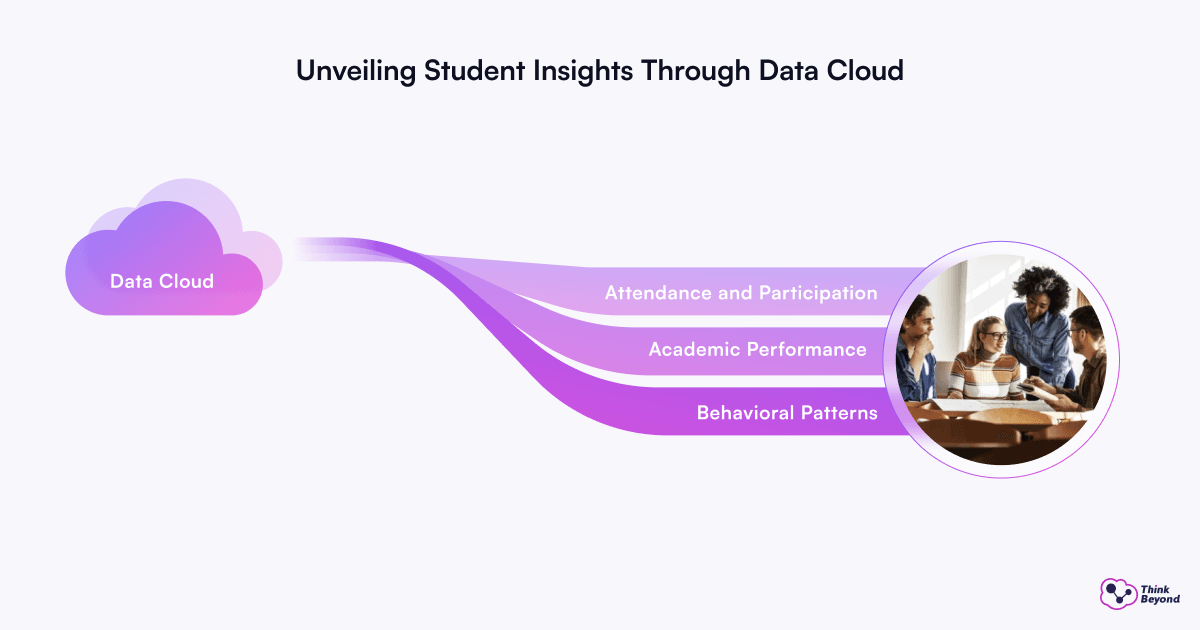
Data Cloud helps institutions understand risk patterns related to drop-out, financial hardship and compliance, moving leadership beyond reporting toward better decisions about teaching and support allocation. Georgia State University demonstrates the scale this can reach: the university contacted students more than 250,000 times based on system-generated alerts, contributing to a seven-percentage-point rise in four-year graduation rates.
Independent research supports the pattern. According to a Forrester Total Economic Impact study commissioned by Salesforce, institutions using Education Cloud reported first-year retention improving by 15%, fundraising growing by 10%, and recruitment increasing by 5.5%.
Smart Outreach Based on Risk Levels
Education Cloud sends targeted messages once it identifies students who need support, assigning each student a risk score — low, medium or high — and alerting staff when that score changes. Institutions then build intervention plans aligned to their own quality and population goals. Forrester's research found that automated messaging reached 20% of eligible students, and 38% of those students went on to request help scheduling appointments — evidence that timely, targeted outreach converts into action, not just awareness.
A Student Success Centre in Practice: SWPS University
Case Study Integration Point
Theory only carries an argument so far — the case for a connected student services platform is best made by an institution that has already built one. SWPS University, one of Poland's largest private universities with 17,500 students across 6 campuses, faced a familiar set of pressures: service requests spread across phone, email, chat and in-person visits, paper-based administrative workflows, and no single view of the student across six locations.
Think Beyond designed a Student Success Centre combining Salesforce Education Cloud with Genesys Cloud Contact Centre — including a self-service Student Success Portal on Experience Cloud, a 360-degree student view, automated case routing, electronic document signing, and a 50-plus-specialist omnichannel contact centre. The result: students gained a single point of access for administrative services with 24/7 self-service capability, and the university strengthened its position as a technologically advanced institution in a competitive market.
As Kamila Dryjańska, Head of Admissions at SWPS University, put it: "Incredible care for the client's needs, a wonderfully supportive implementation team full of willingness to help and patience. Thanks to their commitment and knowledge, the process ran as smoothly as possible."
See the full Student Success Centre case study →
Elevating the Student Journey with Seamless Higher Education CRM
Students expect digital experiences that match the apps they already use daily. University CRM software meets that expectation with mobile-first, unified platforms.
Mobile-First Portals for Course Search and Support
Mobile use among students continues to rise — over 70% of students use mobile apps to interact with course content, and Salesforce Education Cloud puts mobile-first design at its core. Mobile-first portals let students:
- Access academic information anywhere, anytime
- Book advising appointments from a phone
- Check degree progress and upcoming requirements instantly
- Receive custom alerts about approaching deadlines
The mobile student portal functions as a central hub: students connect with success teams, manage appointments and track care plans from any location.
Intelligent Degree Planning Tools
Students and advisors map academic paths together, with progress updates visible instantly. The tool does more than sequence courses — it shows students how each class connects to programme requirements and career goals, helping them make informed decisions without wading through complex programme documentation.
Omnichannel Communication via Chatbots and Email
Consistent communication across channels builds a connected experience throughout a student's time at university. Education Cloud delivers this through:
- Agentforce for Education, offering 24/7 support for admissions and course questions
- Connected email threads that preserve full conversation history
- Custom notifications across mobile apps, SMS and other channels
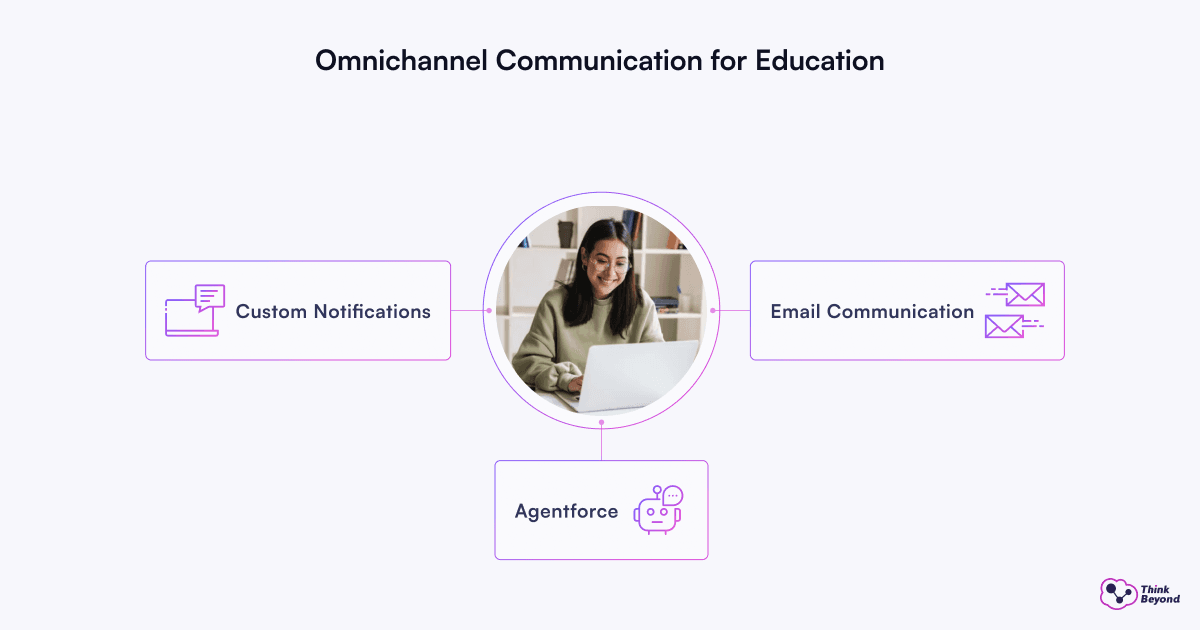
Consolidating these channels gives institutions one dataset covering every interaction point — providing insight into student behaviour and preferences, and helping staff coordinate more effectively across departments. Students move from course selection to graduation within one connected digital experience, rather than juggling separate systems for each need.
Metrics That Prove Higher Education CRM Impact
A CRM investment earns its budget only if leadership can measure what changed. Track these metrics before and after implementation:
- First-year retention rate — year-over-year change following early-alert and case management rollout
- Advisor time-to-resolution — average time from case creation to resolution
- Self-service adoption rate — proportion of routine requests handled through the portal without staff intervention
- Contact centre / helpdesk load — change in inbound volume once self-service and omnichannel routing are live
- Recruitment-to-enrolment conversion — applicant progression through the funnel once data silos are removed
- Alert-to-intervention lag — time between a risk signal firing and a documented staff response
How Think Beyond Helps Universities Build This
Institutions rarely fail at this because the platform lacks features — they fail because the underlying data architecture, governance model and rollout sequencing were never designed as one coherent ecosystem. Think Beyond works as a strategic partner, not a software vendor, across:
- Strategic assessment of student data architecture and integration readiness
- Salesforce Education Cloud platform design, configuration and Experience Cloud portal build
- Integration with existing LMS, SIS and legacy systems
- Case management, alerting and Data Cloud behavioural model configuration
- Managed services for ongoing platform governance and optimisation
Ready to assess where your institution's student data and service model stand today? Initiate a Strategic Review with Think Beyond and explore the Education Cloud solution built for higher education.
Frequently Asked Questions
What is higher education CRM software?
Higher education CRM software is a platform, such as Salesforce Education Cloud, that unifies student data — academic, financial and engagement — into a single record so advisors and support staff can respond faster and more consistently.
How does Salesforce Education Cloud improve student retention?
It combines a 360-degree student view with real-time alerts and behavioural analytics from Data Cloud, so institutions identify at-risk students earlier and route them to targeted support before problems escalate.
Does the platform predict which students will drop out?
The platform surfaces risk signals from attendance, grades and engagement data; it does not make retention decisions automatically. Advisors and support staff still assess each case and decide the appropriate intervention.
How long does a Salesforce Education Cloud implementation take?
Timelines vary with institution size, system landscape and integration scope. A strategic review is the starting point for an accurate estimate specific to your institution.
Can Education Cloud integrate with our existing student information system?
Yes. Education Cloud is designed to integrate with existing LMS, SIS and legacy systems rather than replace them outright, preserving prior data investments while adding a unified layer on top.
Key Public Sources Referenced
Topics
Keep reading
All posts-
 Education 5 min read
Student mentoring: how to improve their chances in the job market
 Adam Czeczuk Head of Consulting 10 August 2026 Read the article
 - Education 7 min read
The Best Management Strategies for Student-Centred Universities — and How to Make Them Operational
Adam Czeczuk Head of Consulting 15 July 2026 Read the article - Education 7 min read
The Impact of Student Experience on Retention Rates
Adam Czeczuk Head of Consulting 15 July 2026 Read the article