

Student mentoring: how to improve their chances in the job market
Mentoring is usually associated with the later stages of a career. Its value in education is hard to overstate: these are programmes that help students move from academic theory to professional practice.
Mentoring is usually associated with the later stages of a career. Its value in education, however, is hard to overstate. Student mentoring means programmes that help young people move smoothly from academic theory to professional practice, and that makes it a core part of how universities teach today.
Many institutions try to give students comprehensive careers support, so that they are as ready as they can be for what the job market asks of them. Even so, plenty of people still do not know what mentoring actually is, how it works, or what it would give them in practice.
What effective student mentoring involves
Mentoring is a partnership that goes beyond passing on knowledge. It is a relationship built on trust, in which the mentor shares judgement, experience and practical guidance. Mentors help the people they work with build specific skills, but also confidence, problem-solving and the ability to make decisions with their eyes open.
One of its greatest strengths is flexibility. Mentoring does not always require long meetings. Regular, even short exchanges can be remarkably effective, giving students useful advice in a form they can absorb. It is a conversation that fits into a crowded timetable, and both sides gain from it.
Mentoring is open to everyone. Whatever your age, experience or profession, you can become a mentor or find one through any number of programmes. Digital tools have made it more flexible still: meeting online means connecting from anywhere, which opens up options that did not exist before.
Mentoring and what students actually need
Do students really need mentoring? The figures speak for themselves:
- 34% of students want more support with career planning.
- 36% want more wellbeing resources.
- 40% want more help balancing study, work and personal life.
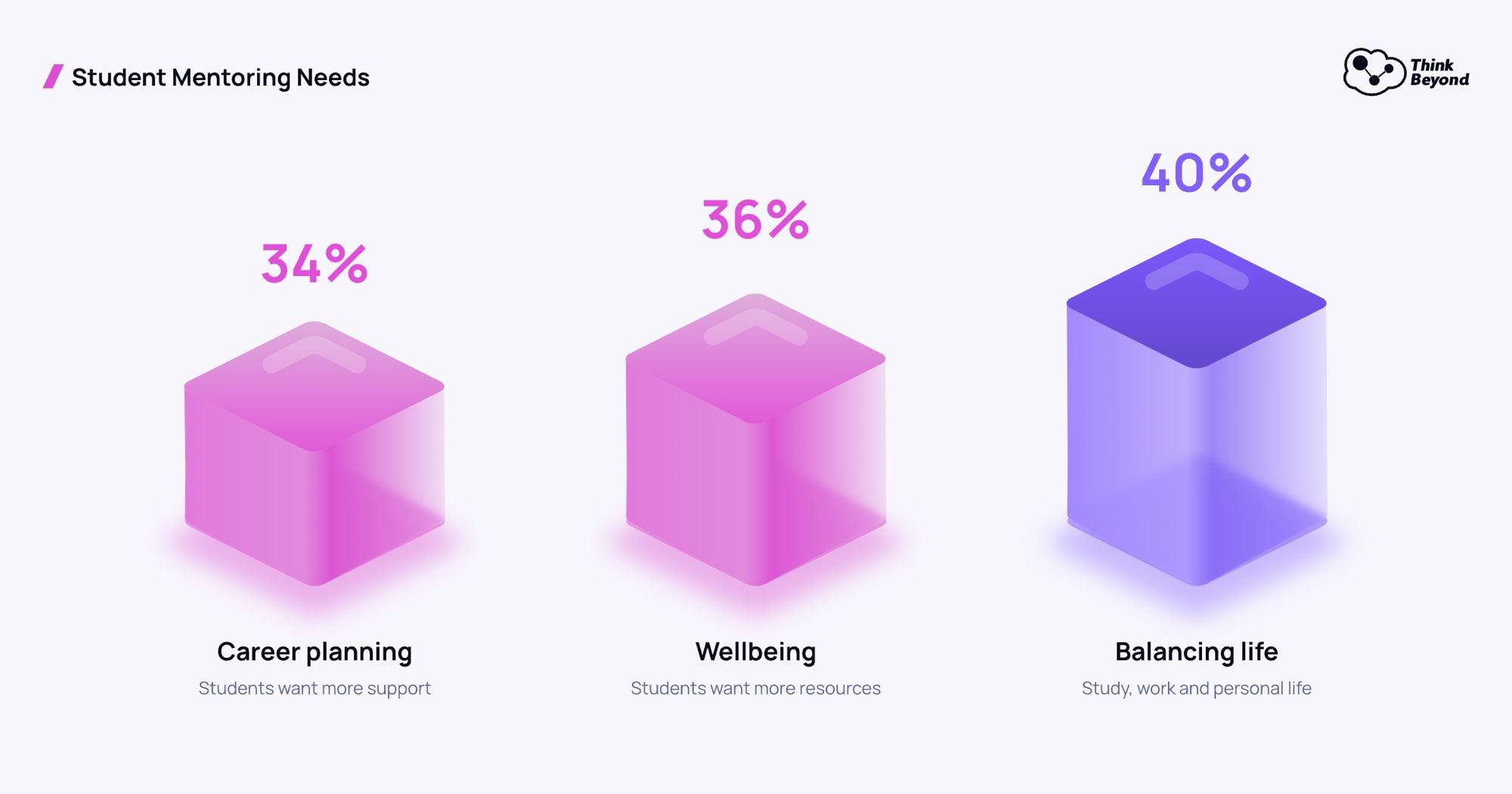
The numbers show plainly that students are looking for practical guidance and support, and that mentoring programmes answer those needs.
| What students ask for | The figure | What a mentoring programme answers with |
|---|---|---|
| More support with career planning | 34% of students | Regular conversations with someone who has worked in the field |
| More wellbeing resources | 36% of students | A relationship in which difficulty gets named early, not at the exam |
| More help balancing study, work and life | 40% of students | Short, recurring meetings that fit a crowded timetable |
| Confidence they are ready for the job market | 11% felt very well prepared | Practice at decisions, not only at theory |
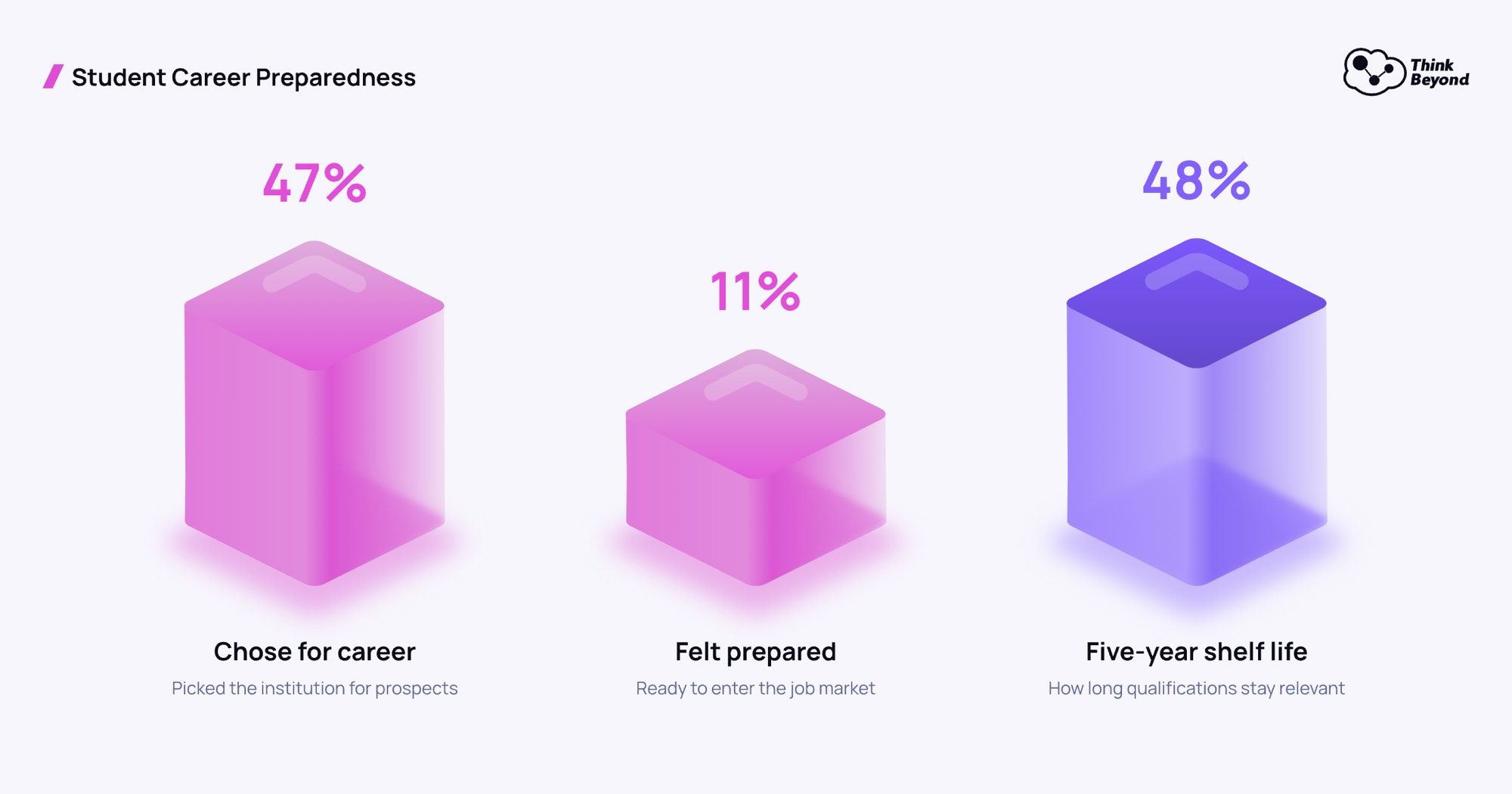
Students are also uneasy about their professional future:
- Nearly half (47%) chose their institution for its career prospects, but only 11% felt very well prepared to enter the job market.
- 48% expected their qualifications to stay relevant for only five years after graduating.
Academic mentoring is gaining ground in Poland, and universities are becoming bolder about running it. The report Mentoring at Polish universities 2024 found that 37% of large institutions (over 10,000 students) already offer mentoring programmes, most often organised by careers services (70%). That points to a growing awareness that a model built mainly on theory is not enough against a job market that keeps moving.
Universities have a chance to become the guides students follow into lifelong learning. Alongside standard teaching, mentoring programmes that connect students with employers may be the best answer to what worries them. Mentoring prepares people for conditions in which learning continuously, and getting past obstacles, is what success is made of.
What mentoring gives students and mentors
Mentoring gives students guidance and support through their academic and professional life. The benefits are many, and all of them rest on a strong partnership.
For students:
- Higher completion rates: with a mentor behind them, students often find the motivation and the resilience to work through difficulty and finish what they started.
- Better preparation for work: mentoring makes career decisions more deliberate and helps people build healthy professional relationships.
- A better attitude to learning: when someone believes in their potential, students engage more actively and aim higher.
- More confidence: mentees gain belief in their own abilities, which pushes them to act and to take on new challenges.
- Core skills: mentoring develops interpersonal skills and makes the challenges of university, and of life beyond it, easier to handle.
Mentoring runs both ways. Mentors gain from it too:
- Their own sense of worth grows as they see the effect of their work on someone else's development.
- They stay in contact with a new generation, which gives them a fresh read on its challenges and ambitions.
- They develop as leaders, learning patience and how to adapt the way they communicate to another person.
Mentoring is an experience that enriches both sides: real support for students, and genuine satisfaction for the people giving it.
Mentoring as an investment in the future
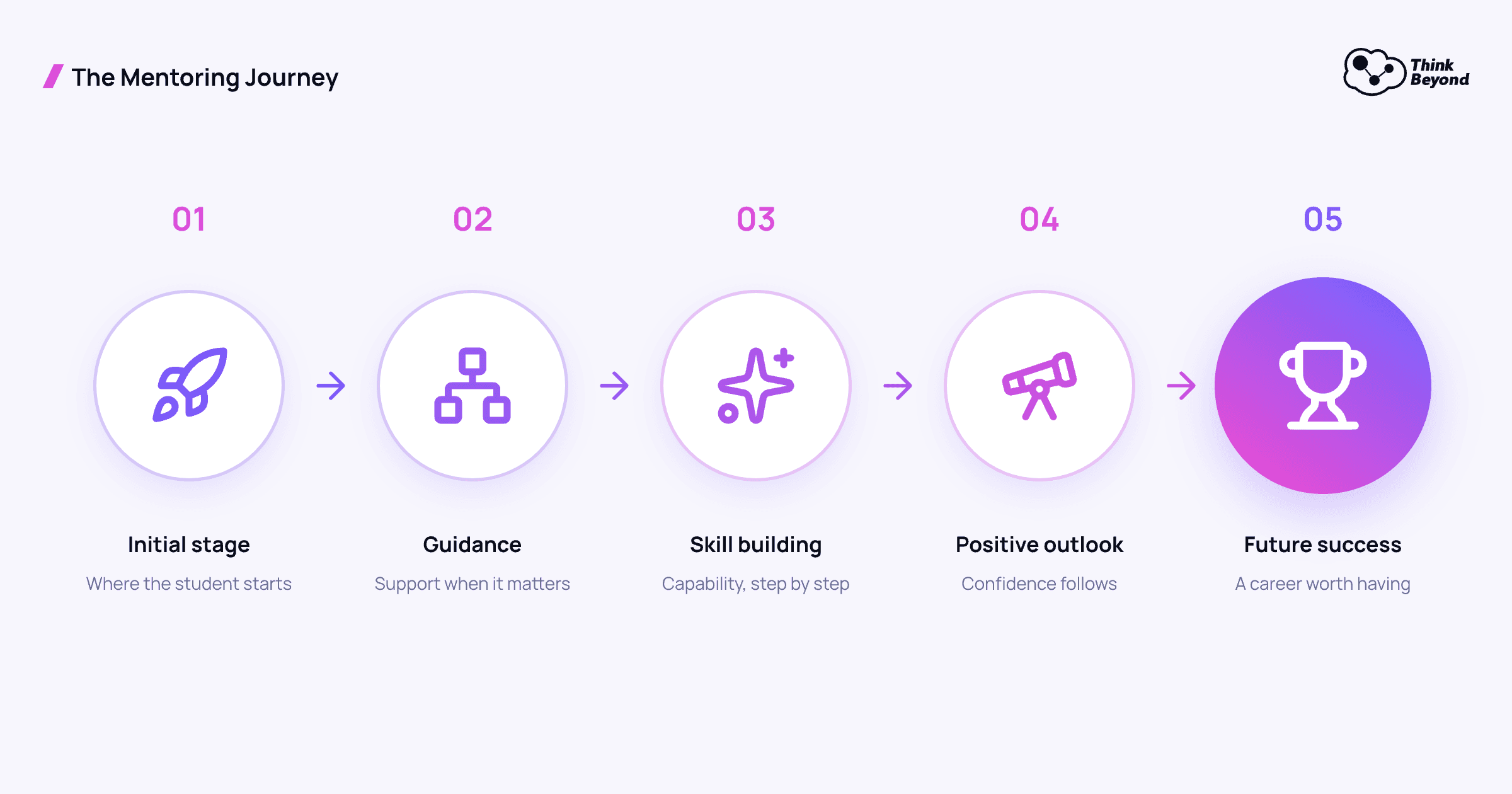
Mentors help students not only with their studies but with personal and professional growth, offering support at the moments that decide things. Mentoring gives students skills worth having, teaches them how to build a network, and gives them a view of an industry from someone who has spent years in it. It is one of the most useful steps anyone can take towards a considered, satisfying career.
Running a programme like this at scale is an operational question as much as a pastoral one: who is matched with whom, what was agreed, what happened next. That is the same ground our work with universities covers: see the case studies for what it looks like in an institution, or Salesforce Managed Services for how it is kept running afterwards.
"Understanding the organisation's business processes and goals makes Think Beyond a trustworthy partner in the implementation of complex Salesforce solutions."
Agata Wysocka SWPS University
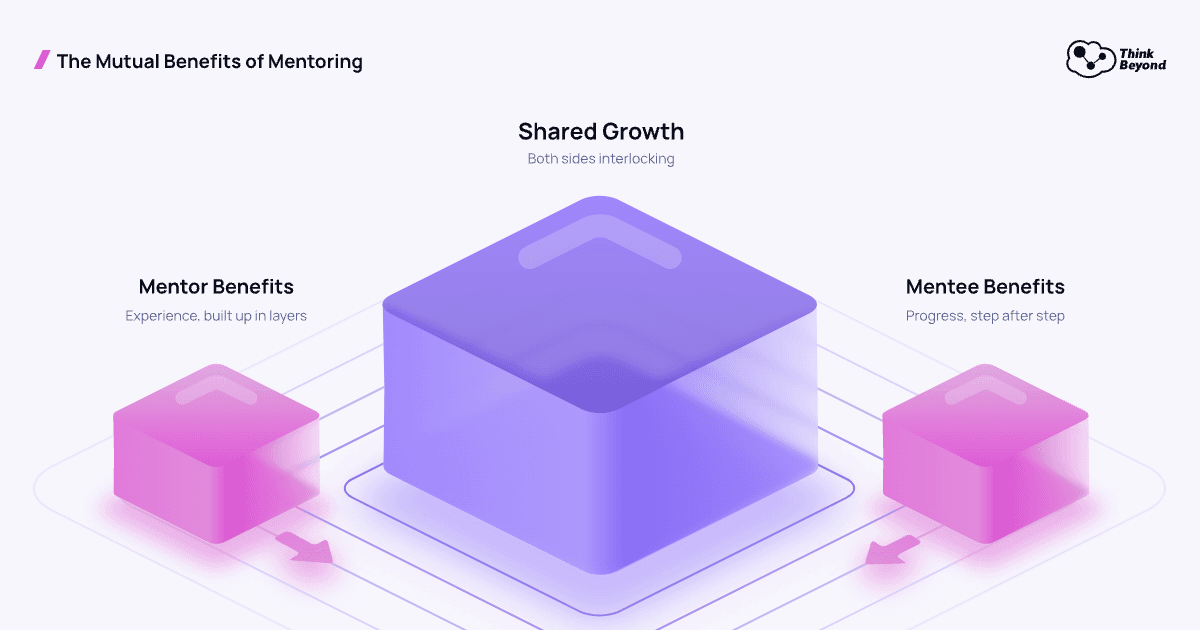
The Mutual Benefits of Mentoring
Student Mentoring Needs
Student Career Preparedness
The Mentoring Journey
Frequently asked questions
What exactly is student mentoring?
A partnership in which a more experienced person, the mentor, shares knowledge, experience and practical guidance with a student. The aim is to support their personal, academic and professional development.
What are the main benefits for students?
Better preparation for the job market, stronger core skills, more confidence, access to a professional network, and practical help in planning a career path.
Who can become a mentor?
Anyone with experience in a field who wants to share it. Most often these are graduates who have built successful careers, specialists from various industries, and academic staff with practical experience.
Do mentoring programmes take a lot of time?
Not necessarily. Modern mentoring is built on quality and regularity rather than hours. Effective programmes often run on short, recurring meetings (online as well) that both sides can fit around their schedules.
Why should universities invest in mentoring programmes?
It is an investment that builds an institution's advantage. These programmes improve graduates' career prospects, raise student satisfaction, strengthen reputation and build lasting relationships with employers.
How does technology support modern mentoring?
Video platforms and dedicated applications make mentoring possible at a distance, make mentor-mentee matching easier, automate communication and allow a programme to be run at scale.
Sources
Topics
Keep reading
All posts-
 Education 7 min read
The Best Management Strategies for Student-Centred Universities — and How to Make Them Operational
 Adam Czeczuk Head of Consulting 15 July 2026 Read the article
 - Education 8 min read
How Higher Education CRM Software Boosts Student Engagement
Adam Czeczuk Head of Consulting 15 July 2026 Read the article - Education 7 min read
The Impact of Student Experience on Retention Rates
Adam Czeczuk Head of Consulting 15 July 2026 Read the article