The global managed services market reached $297.2 billion in 2024 — clear evidence that post-go-live Salesforce support has become a commercial necessity, not an optional extra. A successful implementation marks only the first milestone in a longer journey. Go-live represents a starting point, not a final destination.
Salesforce ships three seasonal releases every year, and your organisation's Single Source of Truth demands constant attention to stay aligned with them. More leadership teams now choose Salesforce managed services because they deliver specialist expertise without the overhead of building an internal technical function from scratch.
This article explains why post-go-live support underpins the long-term return on your Salesforce investment. You will find the common challenges organisations face after implementation, and how a strategic managed services partnership resolves them.
Before you read on: Ask yourself — does your organisation have a documented plan for Salesforce support, data governance, and release management beyond go-live, or is your team managing these reactively? When you are ready, explore a Salesforce managed services partnership with Think Beyond.
At a Glance: Post-Go-Live Challenges and Outcomes
| Challenge | CRM Response | Outcome to Measure |
|---|---|---|
| Low user adoption | Superuser network, ongoing training, usage reviews | Monthly active users, feature adoption rate |
| Data quality and duplication | Validation rules, deduplication routines, data profiling | Duplicate record rate, data accuracy score |
| Security and compliance gaps | Access reviews, MFA enforcement, encryption | Number of security incidents, audit pass rate |
| Licence and storage inefficiency | Usage audits, storage monitoring | Licence utilisation rate, storage cost trend |
| Release management complexity | Sandbox testing, CI/CD pipelines | Deployment success rate, downtime during releases |
A Deeper Look at the Salesforce Post-Go-Live Phase
The real value of Salesforce emerges after deployment, when organisations shift from implementation to daily operations. Many leadership teams assume the journey ends at go-live. In practice, it starts there.
What Happens After Salesforce Go-Live?
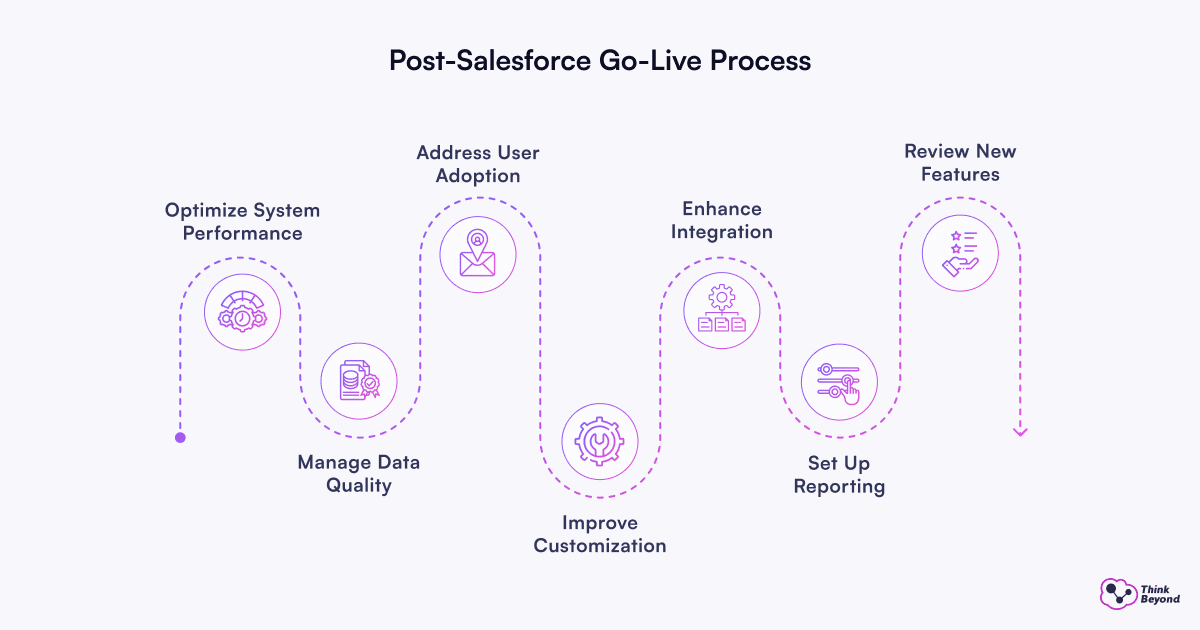
Go-live shifts organisational focus from implementation to continuous improvement. Companies see theoretical benefits translate into measurable results during this adjustment period. Organisations need to monitor several priority areas:
- System performance and platform monitoring
- Data quality management and clean-up
- User adoption and participation
- Customisation refinements based on real-world usage
- Integration improvements with connected systems
- Reporting and analytics build-out
Salesforce ships three seasonal releases a year, each carrying features that can lift productivity. Many organisations also discover that Salesforce already contains built-in capabilities they never activated — capabilities that could solve existing problems or streamline processes. A disciplined review of new and existing features uncovers these gains and strengthens operational efficiency.
Why Post-Go-Live Support Determines Long-Term ROI
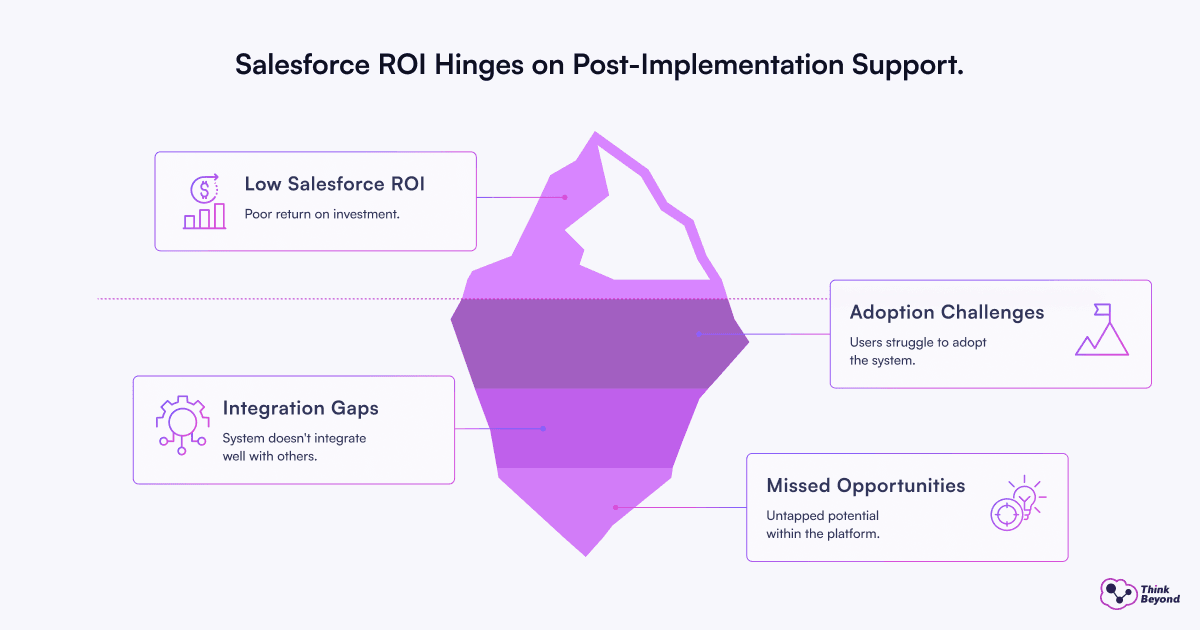
Your return on investment depends on what happens after implementation. Adoption challenges, integration gaps, and missed opportunities erode a significant Salesforce investment when post-go-live support is absent.
User adoption remains the central risk. Even well-designed systems need time and structured support to embed into daily workflows. Low user adoption drives the underperformance of roughly 65% of CRM projects and is the primary reason Salesforce ROI plateaus.
Post-go-live support bridges the gap between implementation and long-term success, keeping the platform aligned with evolving business needs while protecting the initial investment. Think Beyond's own experience — including our Salesforce Managed Services engagement with Virtana — shows how a structured managed services partnership turns a legacy, under-used org into a stable platform that supports business growth.
Key Challenges Organisations Face After Go-Live
Initial enthusiasm for a new Salesforce implementation often fades once organisations confront critical operational challenges. Left unaddressed, these challenges undermine the original investment.
Low User Adoption and Training Gaps
Research shows that up to 70% of digital transformation projects fail, often because users never embrace the system. Most employees use only half of their CRM's available features. Users resist new technology when they do not see its benefits or find it confusing, and that resistance shows up as a return to old tools and inconsistent processes. Sales teams accustomed to traditional methods can feel overwhelmed by an unfamiliar interface.
The most effective response combines dedicated support channels with "superusers" who drive adoption through monthly Salesforce usage reviews. A single training session rarely works — teams need ongoing support to embed the system into daily habits.
Licence Usage and Storage Limits
After go-live, integration monitoring ensures every connected system communicates without disruption and maintains a reliable, unified data flow. Tracking data, file, and API storage usage prevents capacity issues and keeps Salesforce running efficiently as the business grows. Regular licence audits help organisations control costs by ensuring they pay only for the licences they need and use.
Data Quality and Duplication Issues
Poor data undermines decision-making and erodes user trust. Duplicate records, missing information, and outdated data waste time and push users away from the system. Strong data governance maintains accurate information against both standard formats and organisation-specific rules. Data profiling reveals how closely current data matches those rules. Teams need validation rules, a regular cleaning schedule, and duplicate-prevention strategies to keep data accurate and support the platform's role as a genuine Single Source of Truth.
Security and Compliance Oversights
SaaS platform security incidents now cost more and occur more frequently. Common causes include under-trained admins, missing multi-factor authentication, phishing-based account theft, and configuration settings that expose sensitive data. Regular security audits, role-based access controls, and data encryption provide essential protection and support organisational integrity.
How Salesforce Managed Services Address These Challenges
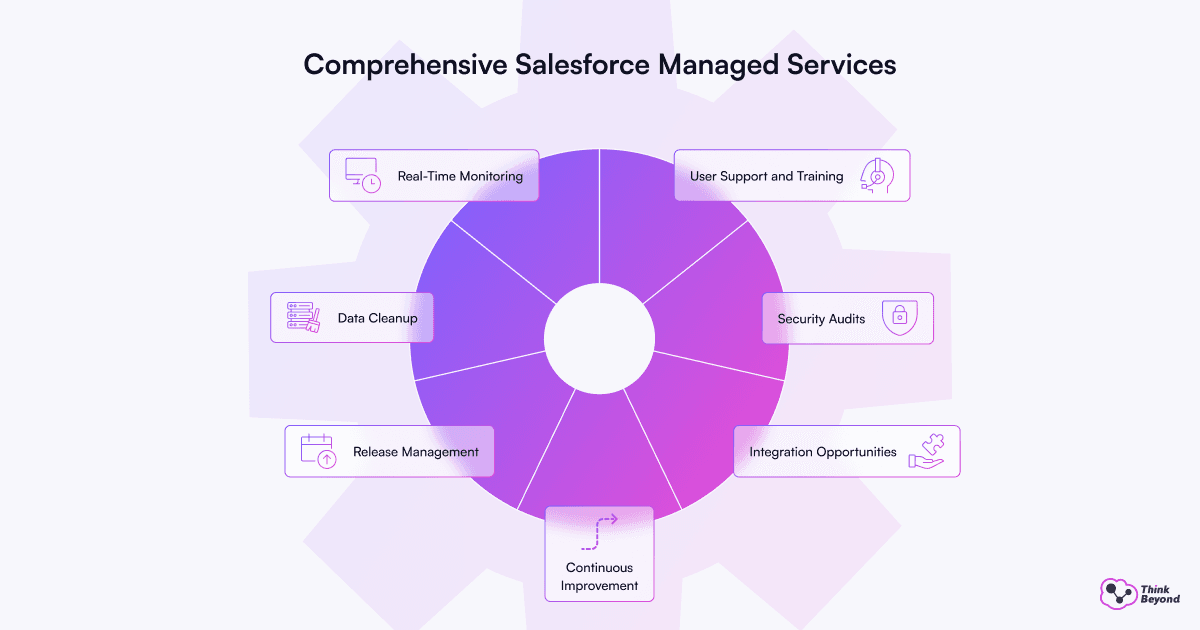
Salesforce managed services bring specialised expertise to post-implementation challenges and help organisations secure the strongest possible return on their CRM investment. Each solution targets a specific problem that surfaces after go-live.
Monitor Performance in Real Time
Service providers run proactive health checks and monitor systems around the clock to catch problems early. They track API usage, identify performance bottlenecks, and resolve security issues without disrupting daily work, freeing internal teams to focus on selling rather than firefighting.
Support and Train Users via Managed Services
Weak training and thin support cause most adoption failures. Service providers close this gap with dedicated helpdesk systems, rapid troubleshooting, and regular training sessions. They build simple feedback channels that surface improvement areas and strengthen both self-serve success and platform stickiness.
Managed services extend training to a wide range of users, both non-technical and technical:
- End users — sales representatives, customer service agents, marketing team members, and others — receive training tailored to their specific role and tasks, which supports effective adoption and daily-workflow integration.
- Managers and executives receive training on reporting, dashboards, and collaboration features so they can monitor performance and support their teams.
- Salesforce administrators and developers receive training on system configuration, user management, and ongoing maintenance, which keeps Salesforce optimised and secure.
A responsive help desk resolves user problems and answers questions about Salesforce features or processes. It needs clear SLAs for response times and access through multiple channels, which minimises downtime and stops small issues from becoming adoption barriers.
Clean Up Data and Prevent Duplication
Data quality issues — duplicate records, broken workflows — can escalate quickly in an unmanaged Salesforce org. Service providers run systematic data audits, remove duplicates, and raise data quality across the board. These regular checks keep reports reliable and convert potential problems into trusted, accurate information.
Audit Security and Review Access Controls
Managed services include comprehensive security measures: vulnerability checks, data encryption, multi-factor authentication, and threat monitoring. Regular access control reviews enforce the principle of least privilege and reduce organisational risk.
Manage Releases for Salesforce Seasonal Updates
Salesforce's seasonal releases require expert handling to test changes without disrupting daily operations. Service providers manage these updates by testing them in dedicated sandbox environments and using specialised tools — Gearset, Copado, Flosum, and Blue Canvas — to automate and orchestrate deployments. This disciplined approach keeps necessary changes smooth and the business running through every upgrade.
Automate Data Flow through Integrations
Identifying and delivering the right integration opportunities means connecting Salesforce to other business tools — email, ERP, or marketing automation platforms. Managed services assess requirements and implement integrations that enable seamless data flow and process automation. The AppExchange marketplace offers powerful integration capabilities through compatible applications, which lifts productivity and positions Salesforce as a central, unified platform.
Drive Continuous Improvement
Managed services support continuous improvement by refining system design, workflows, and user training over time. Providers track industry trends and Salesforce release notes to recommend new features or approaches, helping the organisation stay ahead of competitors and shifting business demands.
Best Practices for Post-Go-Live Managed Services
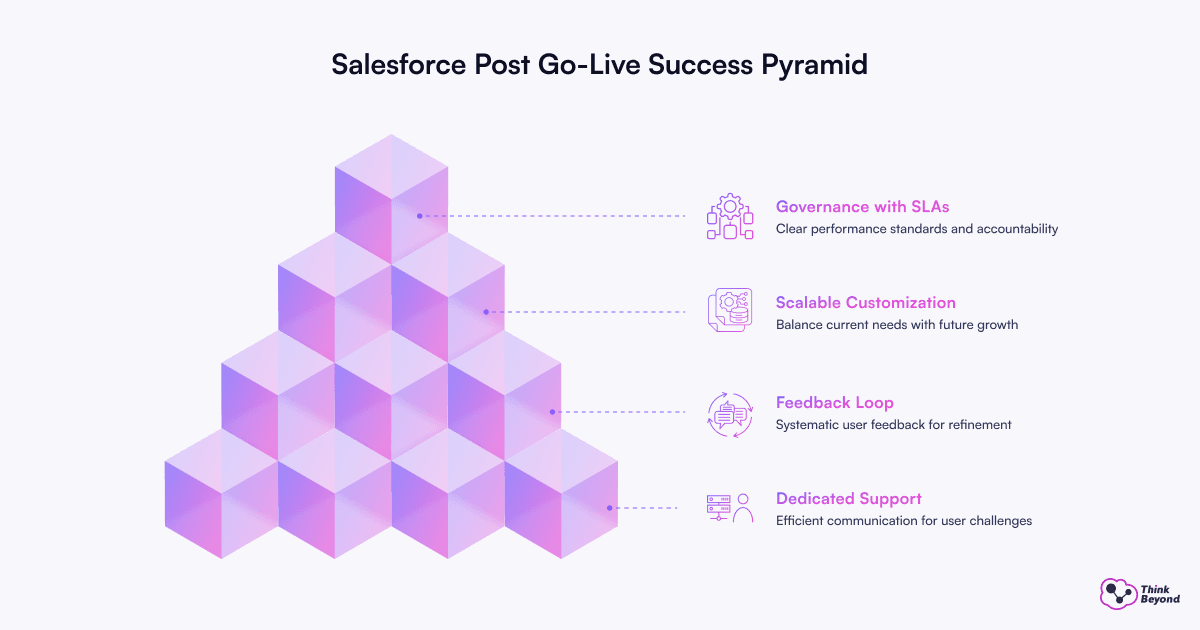
Organisations need several core practices to maximise their Salesforce platform's value after the original deployment. Companies that succeed post-implementation follow well-structured approaches that promote continuous improvement and scalability.
Set Up a Dedicated Support Channel
A designated support desk within Salesforce creates an efficient communication pathway for users who hit obstacles. Both users and administrators benefit: users get transparent case tracking and centralised resources, while administrators manage and prioritise consolidated requests more effectively. An effective support channel includes:
- A centralised hub with quick links to essential resources
- Self-help knowledge articles for common questions
- Efficient case submission forms with clear categorisation
Build a Feedback Loop for Continuous Improvement
A systematic approach to user feedback drives ongoing platform refinement. Teams should collect user feedback regularly — through surveys, meetings, or built-in apps — to understand what works and where challenges remain. This process helps teams identify optimisation opportunities and expand adoption over time.
Service providers who invest in this feedback loop demonstrate commitment to your team and keep Salesforce closely aligned with your business needs. The ongoing dialogue improves the system and delivers better results over time.
Customise Salesforce with Scalability in Mind
Smart customisation balances current needs with future growth potential. Teams must assess solutions against evolving business requirements on a regular basis. This work includes monitoring performance metrics, optimising data storage, and creating custom objects only when genuinely needed. Detailed documentation of every customisation supports future maintenance and troubleshooting, and reduces long-term technology debt.
Establish Governance with Service Level Agreements
Service level agreements (SLAs) set clear performance standards between service providers and customers. These contracts define service quality expectations, availability, and response times. Well-structured SLAs create accountability through automated alerts for potential breaches, which enables rapid intervention. Strong SLAs strengthen customer satisfaction by guaranteeing consistent service quality throughout the post-deployment experience — a cornerstone of sound data governance and organisational accountability.
Metrics That Prove Managed Services Impact
Leadership teams need concrete KPIs to demonstrate the ROI of a managed services partnership. Track these metrics to prove impact and guide the next strategic review:
- Adoption rate: monthly active users and feature adoption rate against total licensed users
- Support responsiveness: average ticket resolution time against agreed SLAs
- Data quality score: duplicate record rate and data accuracy score over time
- Licence utilisation: percentage of purchased licences actively used
- Release stability: deployment success rate and downtime during seasonal upgrades
- Security posture: number of security incidents and audit pass rate
- Cost efficiency: total cost of ownership trend versus in-house support build-out
Beyond Go-Live: The Power of Managed Services in Salesforce Success
Salesforce implementation marks the start of an organisation's CRM journey, not its conclusion. Organisations often underestimate the complexity of keeping Salesforce running smoothly as platform updates land, business needs shift, and users resist change.
Managed services tackle post-implementation challenges through continuous monitoring, user support, and data management. They also deliver comprehensive security measures and smooth release handling, giving teams expert support without the cost and delay of building internal capability from scratch.
The shift from implementation to optimisation decides whether Salesforce becomes a genuine strategic asset or an underused tool. Go-live only opens the door — organisations need managed services to realise what lies beyond it. Salesforce proves its value over time through refined usage, expanded features, and deliberate changes aligned with company growth.
How Think Beyond Helps Organisations After Go-Live
Think Beyond acts as a strategic partner for organisations navigating the post-go-live phase of their Salesforce journey. Our Salesforce Managed Services engagement covers:
- Comprehensive org audits covering security settings, critical updates, licence usage, and user adoption
- Day-to-day operational support that functions as an extension of your internal IT team
- Data clean-up, deduplication, migration, and integration support
- CI/CD implementation and coding standards for stable, scalable development
- Prioritised task management aligned with your operational priorities
- A business continuity plan with short-, mid-, and long-term priorities
Our Salesforce Managed Services partnership with Virtana illustrates this approach in practice: a legacy org built in 2011, a long backlog of unresolved issues, and low user adoption were transformed into a stable, well-governed platform through a structured audit, prioritised remediation, and ongoing operational support.
Ready to protect your Salesforce investment beyond go-live? Initiate a Strategic Review with Think Beyond.
Frequently Asked Questions
What are Salesforce managed services?
Salesforce managed services provide ongoing support, monitoring, data management, and platform optimisation after go-live, delivered by a specialist team rather than an internal function built from scratch.
How soon after go-live should an organisation start managed services?
Organisations benefit most from engaging managed services immediately after go-live, when adoption habits, data quality standards, and governance structures are still forming.
What is the difference between managed services and a one-off implementation project?
Implementation delivers the initial platform build. Managed services provide continuous support, monitoring, and optimisation for as long as the organisation runs Salesforce.
How do managed services improve user adoption?
Managed services combine dedicated helpdesk support, role-specific training, and regular usage reviews with superusers, which keeps the platform relevant to daily workflows and reduces the return to legacy tools.
How much do Salesforce managed services cost?
Costs vary with org complexity, user count, and scope of support required. A strategic review with a managed services provider clarifies scope and cost before commitment.
Key Public Sources Referenced