

How to Build a Salesforce Loyalty Management Strategy That Retains Customers
Loyalty spend will reach $24 billion by 2029, yet 77% of rewards-based programmes fail within two years. The cause is rarely the reward — it is fragmented data and weak governance. Salesforce Loyalty Management fixes this by giving leaders a single, governed view of every customer touchpoint, so segmentation, rewards, and retention decisions rest on one reliable dataset.
According to Statista, organisations spent $5.57 billion on loyalty programmes in 2022, and that figure is projected to grow at 23.5% annually to reach $24 billion by 2029. Boards are treating loyalty as a line item worth defending.
The uncomfortable counterpoint: a staggering 77% of rewards-based loyalty programmes fail within their first two years. Budget alone does not build loyalty. Organisations that succeed treat loyalty management as a strategic student journey-style decision — a Single Source of Truth problem, not a discounting exercise.
Before you read on: most loyalty failures trace back to one root cause — customer data that lives in disconnected systems, with no shared model to unify it. Ask yourself: can your team currently produce one reliable, real-time view of a customer's full history across every channel? If the honest answer is no, explore your organisation's data readiness with Think Beyond before committing further budget to rewards.
At a Glance: Loyalty Challenges and the Salesforce Response
| Challenge | CRM Response | Outcome to Measure |
|---|---|---|
| Customer data scattered across zero-, first-, second-, and third-party sources | Salesforce Customer 360 consolidates every touchpoint into one governed record | Time to produce a unified customer view |
| Generic, one-size-fits-all rewards | Segmentation by demographic, behavioural, value, engagement, and psychographic criteria | Segment-level redemption and engagement rates |
| Inability to spot churn before it happens | Einstein Analytics predictive modelling flags at-risk accounts | Reduction in churn rate among flagged segments |
| Manual enrolment, redemption, and campaign processes | Automated workflows across the loyalty lifecycle | Reduction in operational overhead per member |
Start by Building a Single Source of Truth from Every Touchpoint
Loyalty programmes depend on data — and specifically, on trustworthy, unified data. Companies that gain the clearest insight into customer preferences, behaviours, and pain points are the ones that tailor offers and experiences with precision. Salesforce, the market-leading CRM platform, gives organisations the tools to streamline this data collection and analysis process rather than manage it manually.
At the core of Salesforce's loyalty capability sits its ability to capture and consolidate data from every touchpoint across the customer journey. The platform records initial enquiries, purchases, support interactions, and feedback consistently, producing a comprehensive view of the customer experience instead of fragments spread across departments.
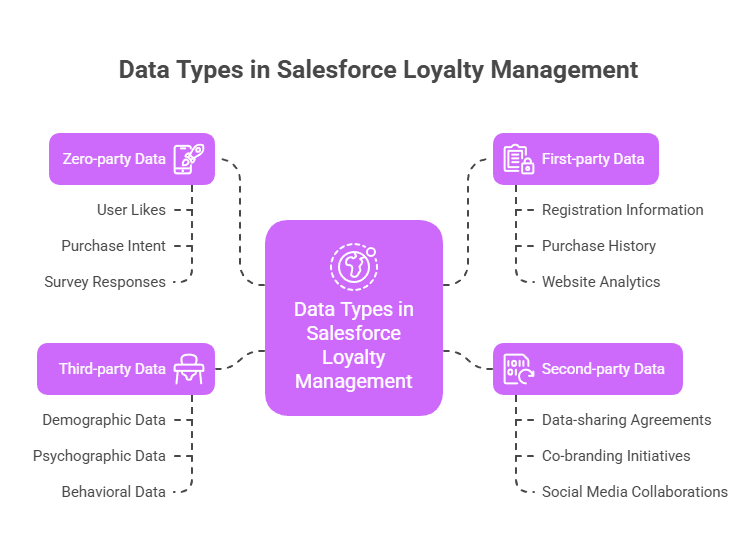
Organisations typically work with four distinct data types:
- Zero-party data: preferences, purchase intent, survey responses, reviews, ratings, event registrations, and location data that customers share directly.
- First-party data: registration details, purchase history, website analytics, app usage, social interactions, and service history the organisation collects itself.
- Second-party data: data-sharing agreements, co-branding initiatives, and publisher-advertiser partnerships.
- Third-party data: demographic, psychographic, behavioural, and geolocation data sourced from external vendors.
A note on what happens when this data stays siloed: in our Zendesk to Salesforce Service Cloud migration for Thinkproject, two disconnected platforms meant support data and transaction history lived apart, driving redundant licensing costs and slower case resolution. Consolidating both onto a single Salesforce platform gave the organisation one governed customer record — the same Single Source of Truth principle that underpins effective loyalty management. The lesson transfers directly: you cannot segment, reward, or retain a customer you cannot see clearly in one place.
Building this foundation correctly is a platform design decision, not an afterthought. If your organisation is assessing whether its current architecture can support a governed, unified customer record, our Salesforce implementation service is the natural starting point.
Segment Your Customers with Precision
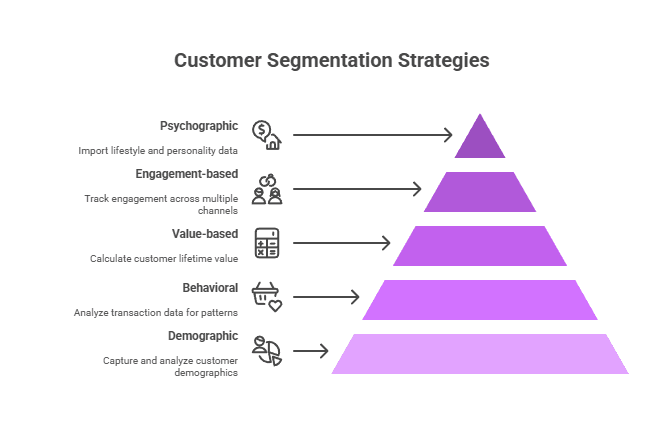
Segmentation turns a Single Source of Truth into a strategic asset. Salesforce supports five core segmentation approaches:
- Demographic segmentation: Salesforce captures and analyses age, gender, income level, and location through native CRM fields.
- Behavioural segmentation: Salesforce's analytics tools identify purchase frequency, average order value, and product preference patterns.
- Value-based segmentation: Einstein Analytics calculates customer lifetime value from data across multiple sources.
- Engagement-based segmentation: Salesforce Marketing Cloud tracks engagement across website visits, email opens, and social interactions.
- Psychographic segmentation: Salesforce integration capabilities import lifestyle, interest, and personality data from third-party sources.
Salesforce's 360-degree customer view gives organisations the data management, analytics, and automation needed to identify these segments and turn them into targeted loyalty strategies — not the strategy itself. Salesforce does not decide your segmentation criteria for you; your commercial priorities do.
Design Reward Structures That Resonate Across Segments
Once segments are defined, reward structures should map to the behaviour you want to reinforce:
- Product or service usage: reward customers who consistently use a specific product with discounts, free upgrades, or early access to new features.
- Purchase frequency: accelerate point-earning or offer bonus rewards for repeat purchases within a defined window.
- Spending patterns: give high-value customers exclusive perks — early sale access, personalised experiences, or VIP invitations.
- Brand advocacy: recognise customers who refer others, engage on social media, or leave positive reviews.
- Feedback participation: reward customers who complete surveys or join focus groups with tangible incentives.
Segment-aligned rewards create a more personalised, engaging programme — but only if the underlying data is accurate enough to trust the segment assignment in the first place.
Convert Segmentation into Measurable Retention
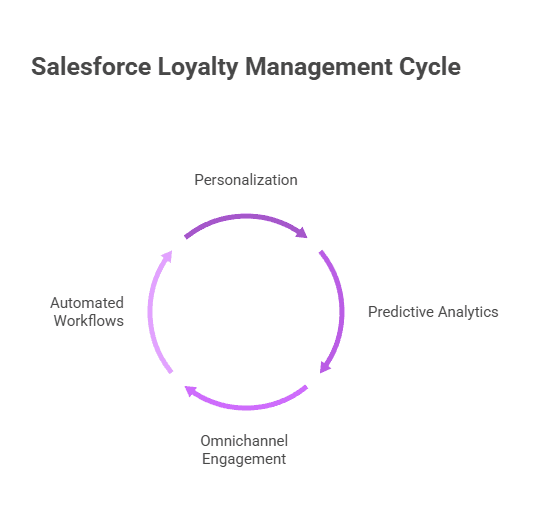
Retention improves when four capabilities work together, not in isolation:
Personalisation
Salesforce Customer 360 lets organisations build personalised rewards, offers, and communications — from tailored product recommendations to individualised messaging.
Predictive Analytics
Einstein Analytics applies machine learning to flag churn risk before it materialises, giving retention teams a window to act rather than react.
Omnichannel Engagement
Salesforce omnichannel capabilities deliver a consistent experience across in-store, online, and mobile interactions.
Automated Workflows
Salesforce automates enrolment, redemption, communications, and campaign execution, reducing the manual overhead that erodes programme margins.
Metrics That Prove Loyalty Management Impact
Leaders should track a defined set of KPIs to prove ROI rather than rely on programme sentiment:
- Member enrolment rate — the share of eligible customers who join the programme.
- Redemption rate — the percentage of earned rewards customers actually claim.
- Customer lifetime value (CLV) uplift — the CLV difference between members and non-members.
- Churn rate among flagged segments — the effectiveness of predictive intervention.
- Cost per retained customer — total programme spend divided by retained accounts.
- Time to unified customer view — how quickly the organisation can produce one governed record for any given customer.
Tracking these consistently turns loyalty management from a cost centre into a measurable growth driver.
How Think Beyond Helps You Build a Resilient Loyalty Ecosystem
Loyalty management does not succeed on strategy alone, and it does not succeed on platform configuration alone. We work across both:
- Strategic review of your current data architecture to confirm whether it can support a Single Source of Truth.
- Salesforce Loyalty Management platform design, tailored to your segmentation and reward model.
- Integration of loyalty data with existing Sales Cloud, Service Cloud, and Marketing Cloud instances.
- Reporting and governance frameworks that keep your KPIs auditable as the programme scales.
Ready to move from fragmented data to a governed loyalty strategy? Initiate a Strategic Review with Think Beyond.
Frequently Asked Questions
What causes most Salesforce loyalty programmes to fail?
Programme failure is rarely about the reward itself. It typically stems from fragmented customer data across disconnected systems, which prevents accurate segmentation and undermines the customer experience.
Does Salesforce Loyalty Management replace the need for a loyalty strategy?
No. The platform does not make loyalty strategy for you — it provides the data infrastructure, segmentation tools, and automation needed to execute a strategy your team defines.
How long does it take to implement Salesforce Loyalty Management?
Timelines depend on the complexity of existing data architecture and integrations. A focused implementation can take several weeks; a full consolidation across multiple clouds, as in larger migrations, typically runs longer.
Can Salesforce Loyalty Management integrate with existing Sales or Service Cloud instances?
Yes. Loyalty Management is designed to sit alongside existing Salesforce clouds, consolidating customer data into one governed record rather than creating a new silo.
What is the first step to assessing loyalty programme readiness?
Start with a review of your current customer data architecture to confirm whether a Single Source of Truth already exists, or whether integration work is required first.
Key Public Sources Referenced
Topics
Keep reading
All posts-
 E-Commerce 5 min read
How to Overcome the Challenges of Building and Managing Loyalty Programmes
 Adrian Gawryszewski Head of Technology 10 July 2026 Read the article
 - E-Commerce 6 min read
Maximising Customer Retention with Salesforce Loyalty Management
Adrian Gawryszewski Head of Technology 10 June 2026 Read the article - E-Commerce 6 min read
Evolve Your Loyalty Program into a Loyalty Experience with Salesforce Solutions for E-Commerce
Adrian Gawryszewski Head of Technology 29 October 2024 Read the article