
Agentforce Service Agent in Salesforce: A Strategic Guide for Decision-Makers
Salesforce Agentforce Service Agent is the cutting-edge feature within AI-driven solutions for organizations. It is designed to enhance customer and employee interactions—and it does so effectively. Agentforce empowers businesses to...

Customer expectations move faster than most service teams can staff for. Boards want lower cost-to-serve; customers want instant, accurate answers; compliance teams want an audit trail for every automated decision. Salesforce Agentforce Service Agent sits at the intersection of these three pressures.
Agentforce is not another point solution to bolt onto your stack. It operates as an extension of your existing Salesforce environment, drawing on the same Single Source of Truth that already governs your sales, service, and marketing data. Executed well, it strengthens organisational integrity across every customer touchpoint. Executed as an isolated pilot, it risks becoming one more silo that fragments the data governance you have spent years building.
Before you read on: Agentforce only performs as well as the data architecture beneath it. Before adopting autonomous AI agents, assess whether your CRM data model, security settings, and knowledge base are ready to support them. Explore your Salesforce implementation readiness with Think Beyond.
Deploying Agentforce Service Agent well starts with implementation discipline, not the AI layer itself. A structured Salesforce implementation approach ensures the reasoning engine draws on clean, governed data from day one, rather than compounding existing technical debt.
At a Glance: Agentforce Service Agent
| Challenge | CRM Response | Outcome to Measure |
|---|---|---|
| Service teams cannot scale to meet 24/7 demand | Autonomous Agentforce Service Agent handles routine queries and hands off complex cases to humans | Reduction in average first-response time |
| Customers question the accuracy of AI-generated answers | Atlas Reasoning Engine grounds responses in verified CRM and knowledge base data | Customer satisfaction score on AI-assisted interactions |
| Legacy bots require constant manual retraining | Agentforce operates without extensive natural language model retraining | Reduction in ongoing bot maintenance hours |
| Data lives in disconnected systems | Agentforce accesses real-time data across the Salesforce ecosystem | Percentage of enquiries resolved without system switching |
Agentforce: One Platform, Multiple Strategic Roles
Agentforce does not deploy as a single fixed tool. Organisations configure it to fill several roles across the customer and employee journey, each addressing a distinct operational gap.
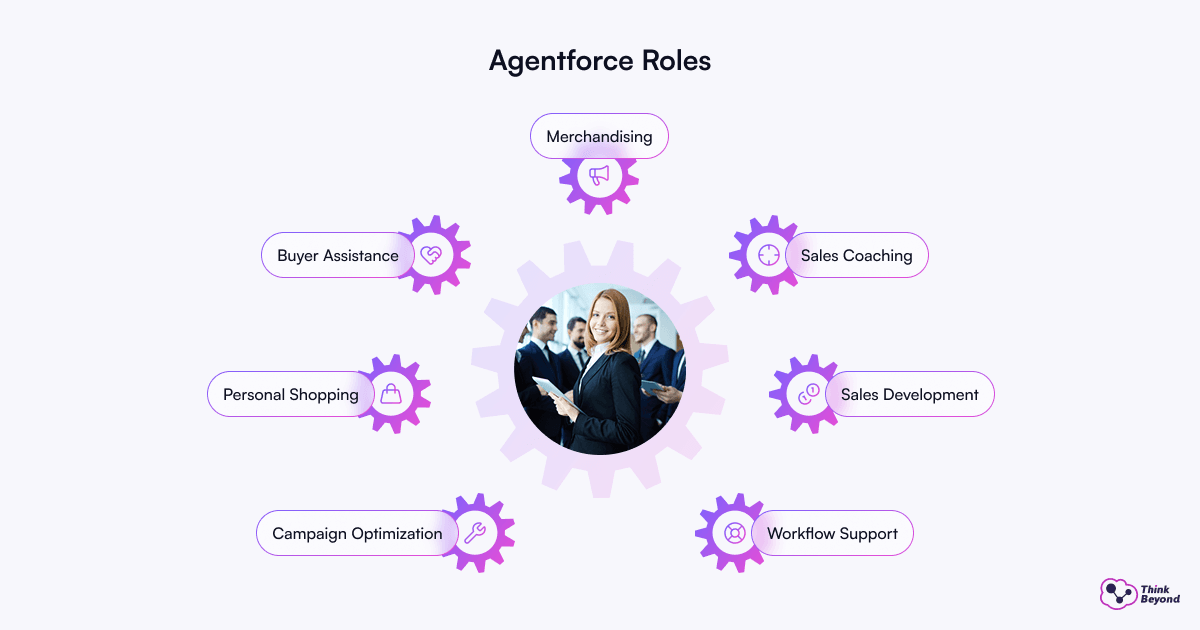
- Agentforce (formerly Einstein Copilot): Supports employees directly in their workflow — it searches for data, builds action plans, and executes tasks that would otherwise consume staff time.
- Sales Development Representative (SDR): Engages prospects around the clock, answers questions, manages objections, and schedules meetings using CRM and external data, freeing sellers to focus on relationship-building.
- Sales Coach: Runs personalised role-play sessions using Salesforce data, helping sellers rehearse pitches and objection-handling for specific deals.
- Merchandiser: Assists ecommerce teams with site setup, goal setting, personalised promotions, and product descriptions.
- Buyer Agent: Improves the B2B buying experience by helping buyers find products, complete purchases, and track orders through chat or sales portals.
- Personal Shopper: Functions as a digital concierge on ecommerce sites or messaging apps, delivering personalised recommendations.
- Campaign Optimizer: Automates the full campaign lifecycle — it analyses, generates, personalises, and optimises marketing campaigns against defined business goals.
Organisations also configure Agentforce for industry-specific functionality. Teams can build an agent from the ground up and deploy it as a healthcare agent, a banking agent, a retail agent, or any variant the business requires — without rebuilding the underlying reasoning layer each time.
Key Features of the Agentforce Autonomous AI Agent
The Atlas Reasoning Engine drives every Agentforce interaction. Unlike traditional assistive systems, Atlas enables agents to make independent decisions and take action on a user's behalf, rather than simply surfacing suggestions for a human to approve.
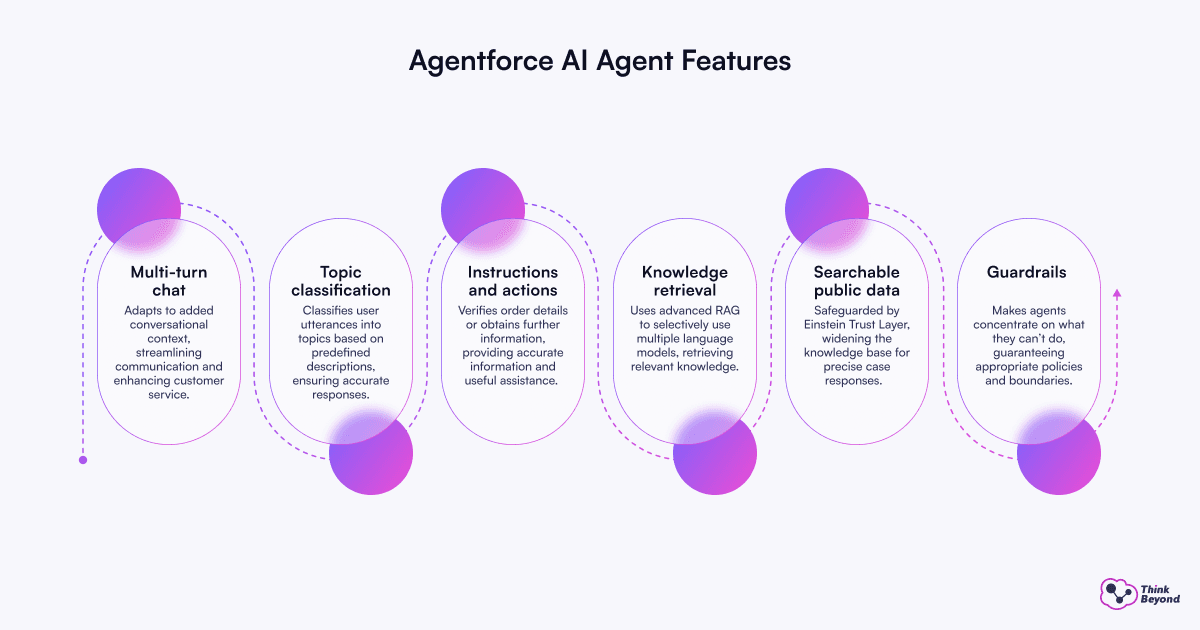
- Multi-turn chat: The agent retains conversational context across a full exchange, which streamlines communication and improves the customer experience.
- Topic classification: The system classifies user utterances into topics based on predefined descriptions, which ensures accurate, relevant responses to enquiries.
- Instructions and actions: The agent verifies order details and gathers further information automatically, giving users accurate answers without manual follow-up.
- Knowledge retrieval: Advanced retrieval-augmented generation (RAG) selectively applies multiple language models to refine query quality iteratively, so the agent surfaces the most relevant knowledge and evaluates its own response quality.
- Searchable public data: The Einstein Trust Layer safeguards this data, which widens the agent's knowledge base while maintaining data sovereignty over sensitive information.
- Guardrails: Defined boundaries keep agents within approved policy — including clear rules for when to hand off to a human agent.
Agentforce Service Agent Versus Einstein Bots
Agentforce Service Agent marks a genuine advancement over Einstein Bots, not an incremental update. It applies generative AI and large language models (LLMs) to create more natural, human-like interactions, while Einstein Bots demand extensive manual training of natural language models before they perform reliably.
Agentforce operates autonomously. It interprets complex queries and generates relevant responses without constant human supervision, and the Atlas Reasoning Engine allows it to handle follow-up questions intelligently rather than resetting the conversation.
Because Agentforce works natively within the Salesforce ecosystem, it accesses and analyses real-time data from multiple sources — improving both responsiveness and accuracy compared with bots that operate on static scripts.
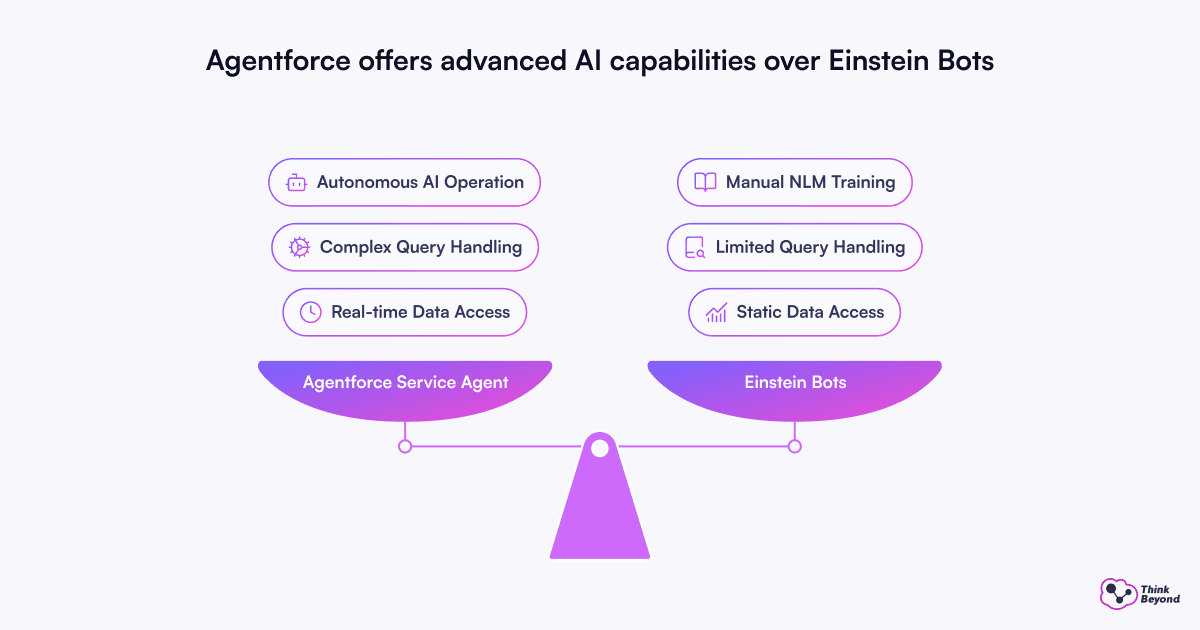
For organisations still running Einstein Bots, this is a meaningful architecture decision rather than a simple upgrade — one that touches data governance, escalation policy, and staff training.
What Governance Leaders Should Weigh Before Deploying Autonomous AI
Agentforce delivers clear commercial upside, but the platform does not eliminate the need for human oversight, and it does not resolve customer trust in AI by itself. Adoption without a governance framework introduces reputational and compliance risk.
A mere 37% of customers trust AI's outputs to be as accurate as those of an employee. Accordingly, 81% want a human in the loop, reviewing and validating those outputs.
Source: State of the Connected Customer, sixth edition, 2023, Salesforce
Agentforce represents the third wave of enterprise AI, following predictive AI and copilots. Agents built on this wave do not simply respond to prompts — they anticipate, plan, and reason with minimal supervision. That capability raises the stakes for governance: organisations need documented escalation paths, audit trails, and clear ownership before autonomous agents touch live customer interactions.
At the same time, well-configured agents hand off seamlessly to human employees, which supports collaboration across service, sales, and operations. Deployed with appropriate guardrails, Agentforce augments a business function rather than replacing the judgement it depends on.
Metrics That Prove Agentforce Impact
Leaders should track a defined set of indicators to demonstrate return on investment and to catch governance gaps early:
- First-response and resolution time across AI-handled versus human-handled cases.
- Containment rate — the share of enquiries the agent resolves without escalation.
- Escalation accuracy — how reliably the agent hands off complex cases to a human at the right point.
- Customer satisfaction (CSAT) differential between AI-assisted and fully human interactions.
- Data quality incidents traced back to AI-generated records, to confirm the agent operates within governed data standards.
- Staff time reallocated from routine queries to higher-value customer work.
Reporting these metrics consistently gives leadership a factual basis for scaling Agentforce beyond a pilot, rather than expanding on assumption.
How Think Beyond Helps You Deploy Agentforce Successfully
Autonomous AI agents create value only when the underlying Salesforce architecture supports them. Think Beyond acts as your strategic partner across the full deployment lifecycle:
- Strategic review of your existing Salesforce data model and governance readiness
- Salesforce implementation and platform design built to support reliable AI reasoning
- Integration of Agentforce with existing systems and third-party data sources
- Reporting frameworks that track the metrics above from day one
- Change management and training so employees trust and adopt the new workflow
Ready to assess whether your Salesforce environment can support autonomous AI agents? Initiate a Strategic Review with Think Beyond.
Frequently Asked Questions
What is Agentforce Service Agent in Salesforce?
Agentforce Service Agent is an autonomous AI agent built on the Salesforce platform. It uses CRM data and the Atlas Reasoning Engine to handle customer and employee interactions independently, escalating to a human when a case exceeds its guardrails.
How is Agentforce different from Einstein Bots?
Einstein Bots require extensive manual training of natural language models and follow scripted decision trees. Agentforce operates autonomously, applies generative AI to interpret complex queries, and adapts to follow-up questions without additional manual training.
Does Agentforce replace human customer service teams?
No. Agentforce automates routine queries and hands off complex or sensitive cases to human employees. Most organisations retain a human-in-the-loop model, particularly for decisions that affect customer trust or compliance.
What data does Agentforce Service Agent use?
Agentforce draws on Salesforce CRM data, connected knowledge bases, and searchable public data secured through the Einstein Trust Layer. Data quality and governance directly determine the accuracy of its responses.
How long does it take to deploy Agentforce successfully?
Timelines depend on the state of your existing Salesforce data architecture. Organisations with clean, governed data can configure specific agent roles in weeks; those with fragmented systems typically need a structured implementation phase first to reduce technical debt before deploying AI agents at scale.
Key Public Sources Referenced
- State of the Connected Customer, sixth edition — Salesforce, 2023
- Salesforce Agentforce — Salesforce
- Atlas Reasoning Engine in Agentforce — Think Beyond
This article provides strategic guidance on Salesforce Agentforce adoption and does not constitute formal legal or compliance advice. Organisations deploying AI in regulated industries should consult legal counsel regarding applicable data protection and consumer protection requirements.
Topics
Keep reading
All posts-
 Customer Experience 7 min read
How to Build a Seamless Omnichannel Sales Strategy in Salesforce
 Martin Pieńkowski Head of Salesforce 15 July 2026 Read the article
 - Customer Experience 6 min read
How Omnichannel Self-Service Transforms B2C Customer Support
Martin Pieńkowski Head of Salesforce 13 July 2026 Read the article - Customer Experience 4 min read
Why Omnichannel Customer Service Is a Strategic Imperative for the Modern Enterprise
Martin Pieńkowski Head of Salesforce 13 July 2026 Read the article