

How to Build a Student Recruitment Strategy That Converts: A Salesforce-Led Approach
Attracting high-calibre applicants is no longer a marketing task — it is an operational and data challenge. Institutions that unify applicant data around a Single Source of Truth convert more enquiries into enrolments and cut administrative overhead in the process. This article sets out the strategic priorities behind a recruitment approach built on Salesforce Education Cloud.
Competition for high-calibre students is no longer won on brand alone. Institutions across Europe now compete on responsiveness, personalisation and data integrity — how quickly an applicant receives a relevant answer, how consistently their journey is tracked from enquiry to immatriculation, and how confidently admissions teams can report on the pipeline to leadership.
Most institutions still run recruitment on a mix of spreadsheets, disconnected email tools and legacy student information systems. The result is familiar: enquiries fall through the cracks, communication is generic rather than personalised, and admissions leadership has no reliable view of where applicants drop out of the funnel. A recruitment strategy built on manual processes is not a marketing weakness — it is an operational risk to enrolment targets.
Before you read on: if your admissions team cannot answer, in under a minute, how many applicants are currently active in your recruitment funnel and where each one dropped off, your recruitment marketing has a data problem before it has a messaging problem. When you are ready, explore your institution's Salesforce Education Cloud readiness with Think Beyond.
At a Glance
| Challenge | CRM response | Outcome to measure |
|---|---|---|
| Applicant enquiries scattered across email, forms and legacy systems | Centralised applicant record with a Single Source of Truth | Time-to-first-response per enquiry |
| Generic, one-size-fits-all outreach | Segmented, personalised journeys across email, SMS and portals | Open rate and engagement by segment |
| No visibility of funnel drop-off | Real-time recruitment funnel reporting | Conversion rate at each admissions stage |
| Manual admissions administration | Automated document and status workflows | Admin hours reclaimed per recruitment cycle |
Understanding the applicant, not just the audience
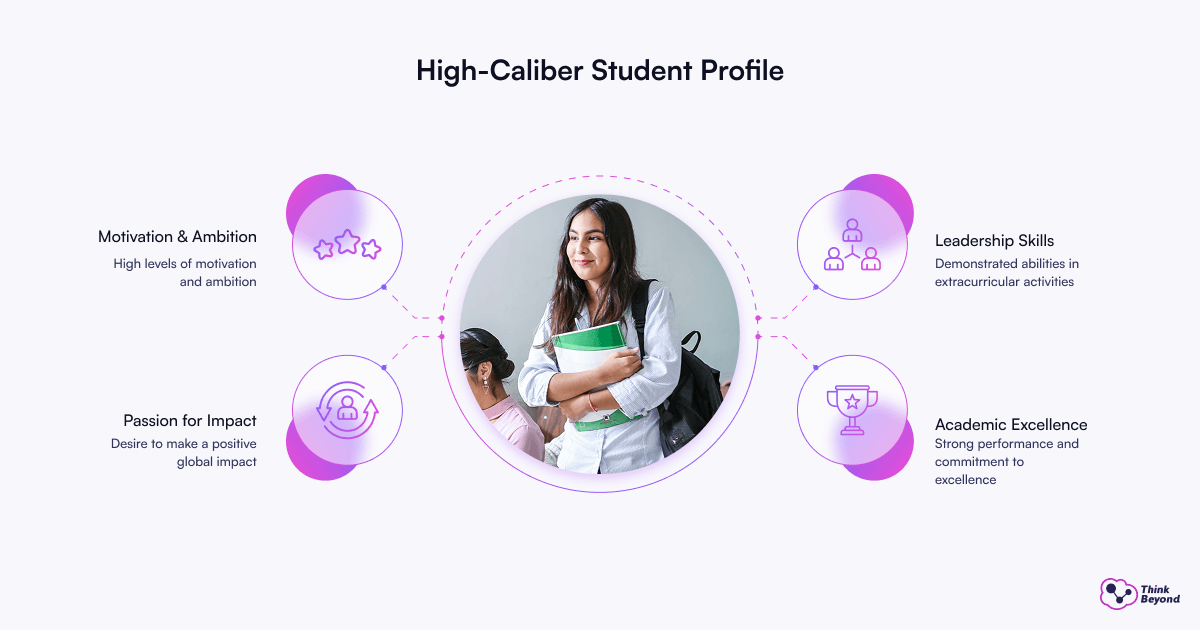
Before any campaign is built, admissions leadership needs a precise view of who the institution is recruiting. High-calibre applicants typically share a set of traits worth designing a journey around:
- Strong academic performance and a demonstrated commitment to a field
- Leadership experience through extracurricular or community activity
- A clearly stated motivation for choosing a subject or career path
- High engagement with the institutions they are actively evaluating
Think Beyond helps institutions turn this profile into a structured recruitment funnel rather than a static persona document — one where every applicant record carries the context needed to personalise the next interaction, not just the next email.
Building institutional brand around the applicant journey
A strong institutional brand does more than differentiate on a prospectus — it sets the expectation for how the institution will communicate throughout the applicant journey. That means:
- A consistent brand message carried across every channel and department
- Marketing materials and communications generated from the same governed template library, not ad hoc departmental variants
- Faculty and staff equipped to represent the brand consistently in every applicant touchpoint
- Alumni and current student stories woven into recruitment content, not treated as a separate stream
Consistency at this level is a data governance outcome as much as a design one — it depends on marketing and admissions teams working from the same applicant record.
Digital marketing built on applicant data, not guesswork
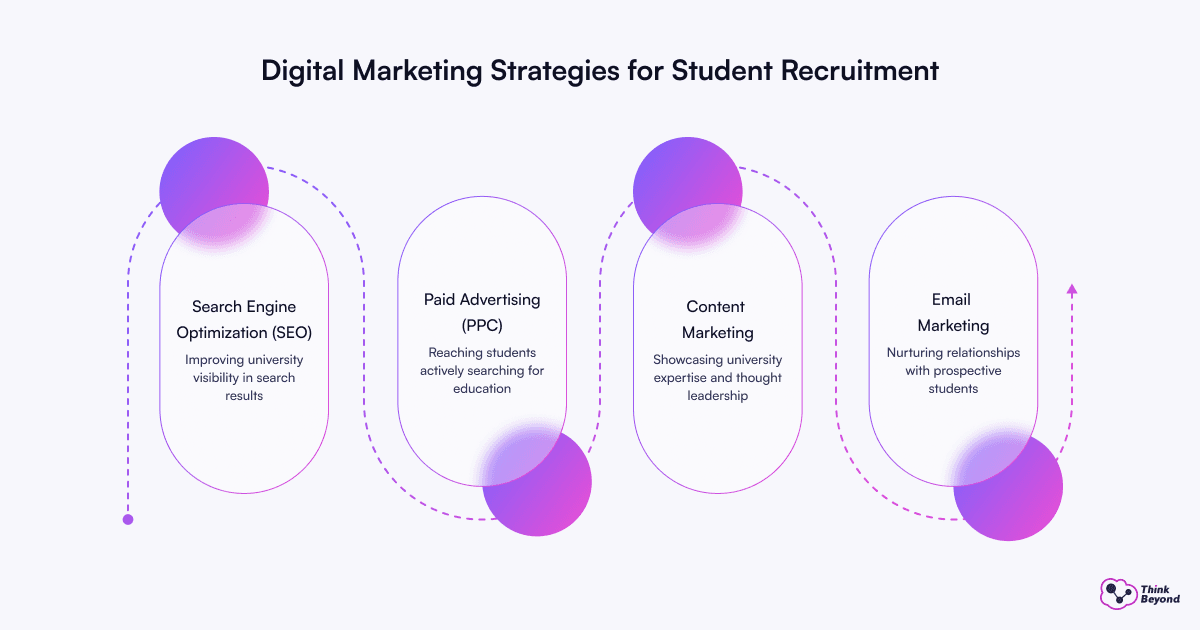
Digital marketing only outperforms generic outreach when it is grounded in applicant-level data. Core channels to prioritise:
- SEO to improve visibility for prospective applicants actively searching for programmes
- Paid search to reach applicants at the point of active decision-making
- Content marketing that demonstrates subject-matter authority rather than generic institutional messaging
- Email marketing, sequenced against the applicant's actual stage in the funnel rather than a single static list
Institutions that track these channels against a single applicant record — rather than in disconnected platform dashboards — gain the ability to attribute enrolment outcomes back to specific campaigns.
The website and applicant portal as a recruitment system, not a brochure
An institution's website and applicant portal function as the primary recruitment infrastructure, not a marketing brochure. Admissions leadership should hold the site to an operational standard:
- Mobile-optimised and indexed correctly for search
- Clear presentation of admission requirements, financial aid and programme detail
- Applicant and alumni outcomes presented as evidence, not anecdote
- Self-service status tracking so applicants can check their own progress without contacting admissions staff
A portal that answers "where is my application" without a phone call directly reduces administrative load on admissions teams — a measurable outcome, not a soft benefit.
Social channels as a recruitment funnel, not a broadcast channel
Social platforms extend the applicant journey rather than replace it. A disciplined approach requires:
- A social strategy tied to specific recruitment stages, not general brand awareness
- Channel selection based on where target applicants actually spend time
- Faculty and current-student content that builds credibility with prospective applicants
- Active response management, since an unanswered enquiry on social media is still an unanswered enquiry
- Performance tracked back to the applicant record, not treated as a standalone marketing metric
Campus events and open days as a conversion stage
Campus visits and open days convert interest into commitment, provided the institution treats them as a funnel stage rather than an isolated event:
- Events segmented to the interests of the applicants attending
- A mix of formats — information sessions, tours, faculty interaction — rather than a single generic agenda
- Direct interaction with faculty, staff and current students
- Personalised guidance on admissions and financial aid at the point of highest applicant intent
- Structured follow-up logged against the applicant record, not left to individual staff memory
Partnerships with schools and referral institutions
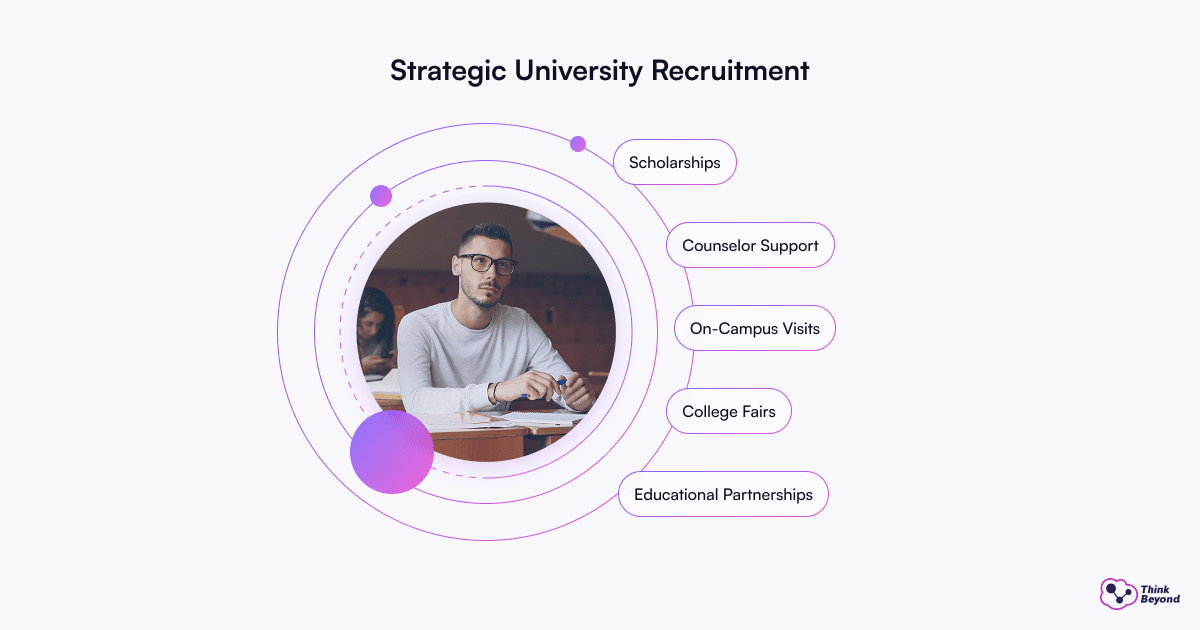
Institutional partnerships extend recruitment reach beyond direct marketing spend:
- Structured on-campus visit programmes for partner schools
- Transfer and articulation agreements with feeder institutions
- Resourcing counsellors and teachers with accurate, current programme information
- A consistent presence at recruitment fairs, backed by the same applicant data used in every other channel
- Scholarship and incentive programmes targeted at defined applicant segments
Every partnership channel above should feed the same applicant record used by digital and campus recruitment — otherwise the institution is managing several disconnected funnels, not one recruitment strategy.
Case study: turning recruitment communication into a measurable system
SWPS University faced a common admissions marketing constraint: a large, multi-campus applicant population requiring personalised, high-volume communication that manual processes could not sustain. Think Beyond implemented Salesforce Marketing Cloud across two Business Units, connected to the core Salesforce platform via Marketing Cloud Connector, with automated transactional notifications, SQL-based segmentation and Einstein AI-powered content selection.
The results give admissions leaders a concrete benchmark for what a properly integrated recruitment communication system delivers:
- The system delivered over 6,000 messages within 30 days without any administrative intervention
- A 97.58% delivery rate, with unsubscribe rates held below 1%
- A 24% conversion rate on targeted, behaviour-triggered campaigns such as abandoned-application follow-up
"Incredible care for the client's needs, a wonderfully supportive implementation team full of willingness to help and patience. Thanks to their commitment and knowledge the process ran as smoothly as possible. It was — and still is — a pleasure to work with."
Kamila Dryjańska, Head of Admissions, SWPS University
This is the operational proof point behind every recommendation in this article: personalisation and automation only compound into results once applicant data sits in one governed system.
Metrics that prove recruitment strategy impact
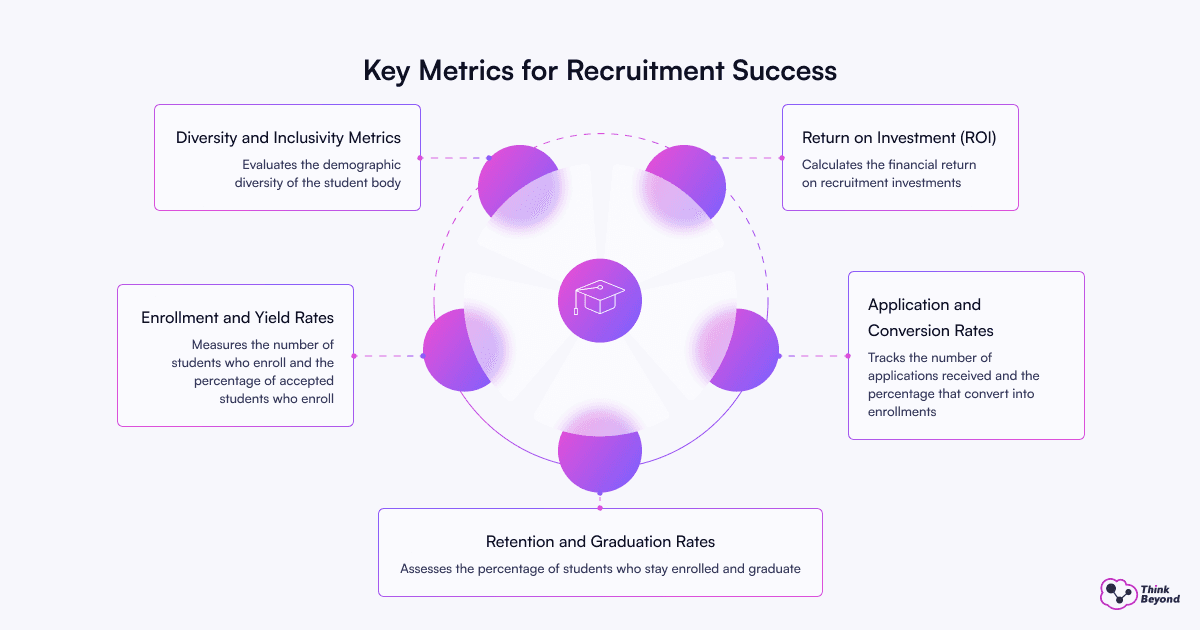
Admissions leadership should track a defined set of metrics each recruitment cycle, not a general sense of "how the campaign went":
- Application and conversion rates at each stage of the funnel
- Enrolment and yield rates against target
- Retention and progression rates, since recruitment quality shows up downstream
- Diversity and inclusivity metrics, including first-generation applicant rates
- Return on investment for each recruitment channel and campaign
- Time-to-first-response for applicant enquiries
- Admin hours reclaimed through automation of manual admissions tasks
Recruitment software should gather and match every one of these metrics automatically — if your team is assembling this picture manually each cycle, the reporting overhead is itself a sign the underlying system needs consolidation.
How Think Beyond Helps Institutions Build a Recruitment System That Scales
Think Beyond designs the underlying ecosystem that makes every tactic above sustainable rather than a one-off campaign effort:
- Strategic review of the existing admissions and recruitment technology landscape
- Salesforce Education Cloud architecture centred on a Single Source of Truth for applicant data
- Marketing Cloud integration for segmented, automated and personalised communication at scale
- Legacy system integration so historical applicant data is not lost in the transition
- Real-time recruitment funnel reporting for admissions and executive leadership
- Ongoing managed services support so the ecosystem stays governed as recruitment needs evolve
Ready to see where your institution's recruitment data stands today? Initiate a Strategic Consultation with Think Beyond and get a clear view of what a unified applicant record would change for your admissions cycle.
Frequently Asked Questions
What is the biggest barrier to an effective university recruitment strategy?
Fragmented applicant data is the most common barrier. When enquiries live across email, spreadsheets and legacy systems, admissions teams cannot personalise communication or measure funnel performance accurately.
How does Salesforce Education Cloud support student recruitment?
It centralises applicant, student and alumni data into a Single Source of Truth, enabling personalised, automated communication and real-time visibility of the recruitment funnel from enquiry to enrolment.
What metrics should admissions leadership track each recruitment cycle?
Application and conversion rates, enrolment and yield rates, time-to-first-response, retention outcomes, diversity metrics and the ROI of each recruitment channel.
Can marketing automation reduce administrative workload in admissions?
Yes. Automating transactional notifications and applicant status updates removes repetitive manual tasks — one Think Beyond implementation delivered over 6,000 automated messages in 30 days with no administrative intervention.
Does personalised recruitment communication actually improve conversion?
Behaviour-triggered, segmented campaigns consistently outperform generic outreach. In the SWPS University implementation, targeted campaigns reached a 24% conversion rate.
Topics
Keep reading
All posts-
 Education 5 min read
Student mentoring: how to improve their chances in the job market
 Adam Czeczuk Head of Consulting 10 August 2026 Read the article
 - Education 7 min read
The Best Management Strategies for Student-Centred Universities — and How to Make Them Operational
Adam Czeczuk Head of Consulting 15 July 2026 Read the article - Education 8 min read
How Higher Education CRM Software Boosts Student Engagement
Adam Czeczuk Head of Consulting 15 July 2026 Read the article