
How a Salesforce Managed Services Partner Frees Internal Teams to Focus on Strategy
Internal Salesforce teams lose up to 70% of their capacity to routine maintenance instead of strategic work. A Salesforce Managed Services Partner absorbs the day-to-day operational load — tickets, releases, security, integrations — and turns your CRM into a resilient digital ecosystem your internal team can build on, not just maintain.
Organisations struggle to sustain continuous improvement and change, and 55% fail to reach their transformation goals. Salesforce managed services have emerged as a practical response to this challenge for internal teams. The global CRM software market is growing at a 14.6% CAGR, reaching $73.4 billion in 2024, and that growth raises the bar for what an internal team must deliver.
Salesforce managed services for internal teams deliver advantages that extend well beyond cost savings. A managed services partner keeps your CRM aligned to your organisation's changing needs while reducing financial pressure, and lets your internal Salesforce team redirect its attention from routine maintenance to the strategic projects that drive growth and innovation.
Before you read on: does your internal team spend more time fixing tickets than building new capability? If routine maintenance is consuming your Salesforce roadmap, it's worth a closer look at your organisation's readiness for a managed services partnership. Explore your Salesforce operations with Think Beyond.
One clear illustration of this shift is our work with Virtana, a Palo Alto-based digital infrastructure management provider. Virtana's team was managing a legacy Salesforce org dating back to 2011, a lengthy support ticket backlog, and low user adoption — employees were reverting to spreadsheets rather than working in Salesforce. A structured managed services partnership, built on an initial org audit, prioritised task assignment, and the implementation of CI/CD processes and coding standards, gave Virtana a responsive internal-IT-style team, a documented business continuity plan, and a stable foundation for future development. Read the full Virtana case study for the complete breakdown of challenges, approach, and results.
At a Glance
| Challenge | Managed Services Response | Outcome to Measure |
|---|---|---|
| Full-time admin hiring costs and turnover risk | Flexible, subscription-based expert access | Admin cost as a percentage of Salesforce budget |
| Growing ticket backlog, slow resolution times | 24/7 proactive monitoring and dedicated help desk | Average ticket resolution time (MTTR) |
| Skills gaps across Sales Cloud, CPQ, and integrations | On-demand certified admins, developers, architects | Project delivery time, backlog reduction rate |
| Security and compliance risk from unmanaged releases | Health checks, release management, vulnerability scanning | Salesforce Health Check score, incidents avoided |
| Internal team locked into maintenance, not strategy | Managed services absorb day-to-day operations | Percentage of internal team time on strategic projects |
How managed services reduce internal workload
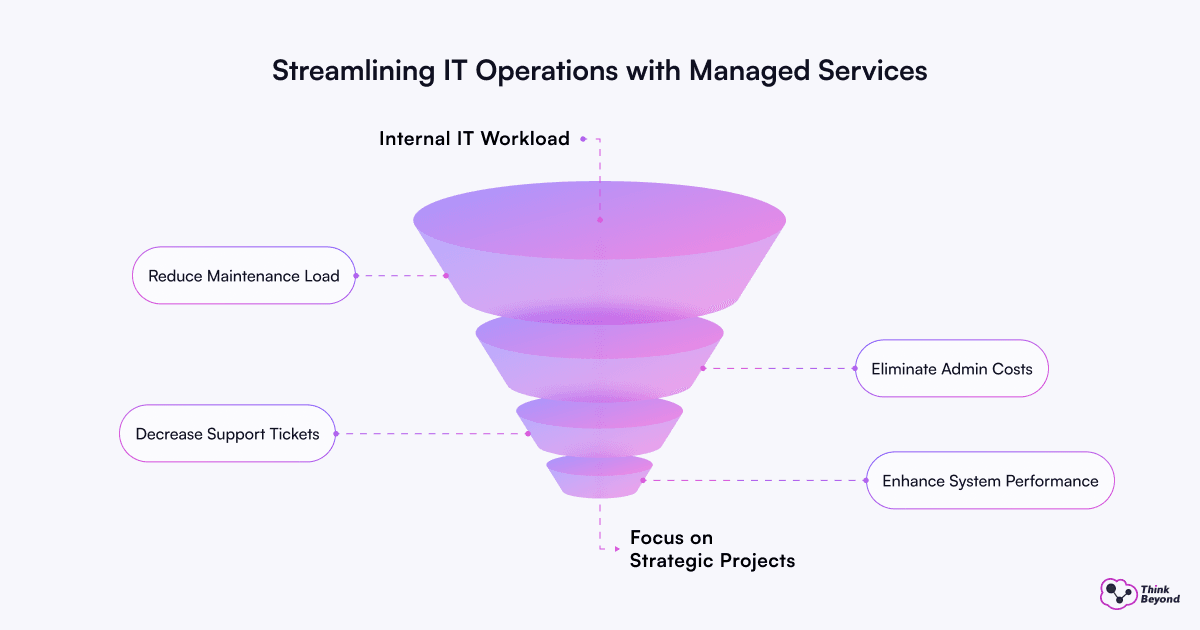
Internal IT teams spend up to 70% of their time maintaining systems instead of advancing strategic projects. This maintenance load blocks innovation and constrains business growth. Salesforce managed services give internal teams a practical route out of this cycle.
No need for full-time admin hires
A full-time Salesforce administrator costs considerably more than the salary line alone — organisations must also budget for benefits, training, and turnover. Recruiting the right person takes time and money that a managed services provider removes from the equation.
The flexible pricing model of managed services lets organisations pay only for what they use. This structure particularly benefits small and mid-sized businesses that need expert support without a full-time Salesforce administration function.
Fewer internal tickets and escalations
IT departments often carry a heavy load of help desk tickets tied to employees' Salesforce issues. A managed services partner identifies and resolves potential problems before users ever notice them, which cuts support requests quickly.
Most providers monitor client systems around the clock. Continuous monitoring delivers:
- Faster problem resolution
- Stronger system performance
- Tighter security
- Smoother updates
Managed help desk systems track and prioritise support requests automatically instead of relying on shared inboxes or distribution lists, so requests never get lost or create bottlenecks.
Less time spent on routine maintenance
Routine Salesforce tasks consume time that could otherwise go towards innovation. Forrester Research finds that internal teams spend 70% of their time on system upkeep rather than strategic work.
Managed services absorb these time-consuming but necessary tasks and fill gaps during busy periods or unexpected technical difficulties. This approach converts Salesforce issues from disruptions into routine, well-managed operations, freeing internal teams to focus on core business activities and strategic projects. Organisations gain more value from their Salesforce investment while staff concentrate on high-value work.
Access to certified Salesforce professionals on demand
A managed services partnership gives organisations rapid access to certified Salesforce experts without the cost of hiring specialised talent directly. This expertise extends well beyond basic administration into the complexities of the wider Salesforce ecosystem.
Specialised skills across clouds and features
The Salesforce ecosystem spans numerous specialised clouds and features, each demanding distinct expertise. Managed services providers maintain professionals with deep technical knowledge across the full range of offerings, and their experience helps them apply proven methodologies while avoiding common pitfalls that delay implementation.
Certified Salesforce professionals bring several concrete advantages:
- Deep expertise in specific Salesforce niches (Sales Cloud, Service Cloud, Marketing Cloud)
- Command of advanced features, including Einstein AI, Flow Builder, and Revenue Cloud
- Proficiency in technical areas where internal teams often lack confidence, such as DevOps and system integration
- The ability to align Salesforce customisations with industry-specific business processes
Demand for specialised Salesforce skills continues to grow. The 2025 Developer Survey found that over 70% of respondents use some form of DevOps tool. A managed services partner closes these specialised skill gaps whenever the business needs them.
Faster resolution of complex issues
Internal teams often struggle with complex technical issues that extend resolution times and reduce productivity. Managed services partners bring experience drawn from solving similar problems across multiple clients.
That experience delivers practical benefits: partners identify the root cause of issues quickly based on prior encounters, apply time-tested troubleshooting methods instead of trial and error, and draw on a knowledge base that already contains solutions to common problems.
Support for custom development and integrations
Certified developers build custom applications using Apex, Visualforce, Lightning components, and other Salesforce technologies, and implement complex business processes that extend beyond standard workflow capabilities.
Integration expertise carries equal weight. Nearly one-fifth of Salesforce developers report a lack of confidence in integrating Salesforce with other platforms — precisely where managed services partners excel. They connect Salesforce with essential business systems, including:
- ERP systems such as SAP and Oracle
- Marketing automation platforms such as Marketo and HubSpot
- E-commerce platforms such as Shopify and Magento
- Finance systems such as QuickBooks and NetSuite
These integrations create a unified data ecosystem that streamlines operations and maximises data value. Access to certified Salesforce experts helps internal teams shift from reactive problem-solving to proactive strategic planning, with specialised support available exactly when they need it.
Proactive system monitoring and updates
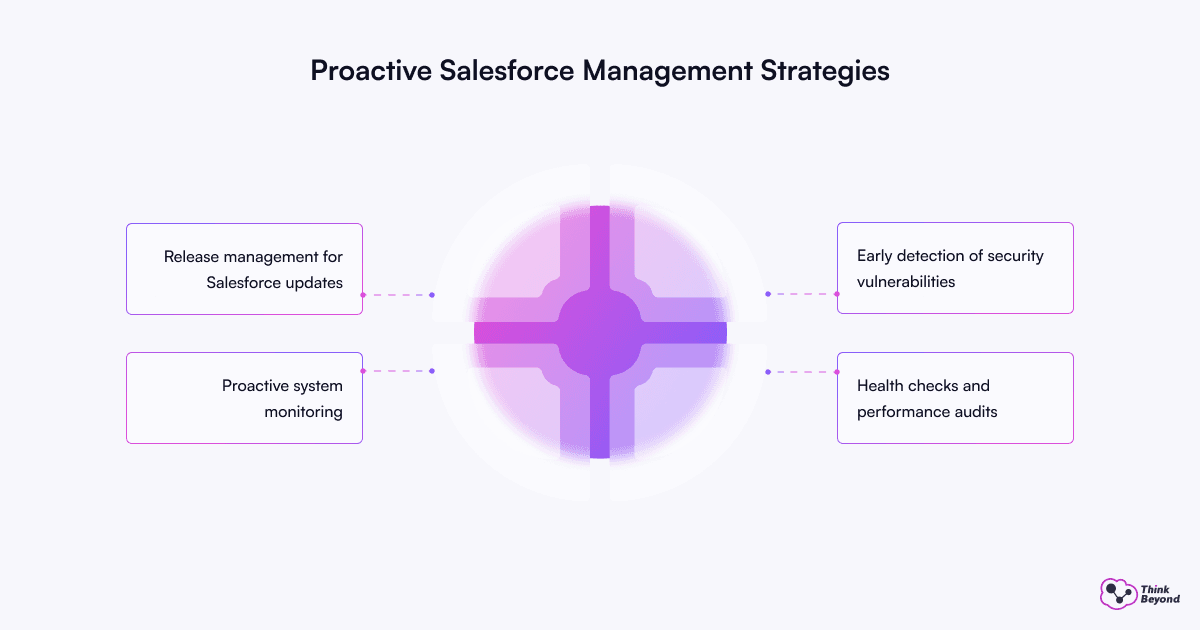
Proactive monitoring changes how organisations maintain their Salesforce environment. Teams anticipate issues before they disrupt operations instead of solving problems after they occur, and this approach gives a managed services partner a clear advantage over an internal team working reactively.
Health checks and performance audits
Service providers use built-in tools, such as the Salesforce Health Checker, to assess security settings. The system assigns a health check score between 0 and 100%, with higher scores indicating stronger security compliance. This structured approach helps teams:
- Find inefficient queries and excessive automation
- Identify hidden performance bottlenecks
- Flag risky protection settings and compliance gaps
- Verify data quality and structural integrity
Service partners go further than automated checks and conduct manual reviews focused on business impact. These detailed audits examine configuration, data quality, performance metrics, and industry best practices, and organisations receive practical recommendations ranked by priority and implementation effort after each assessment.
Release management for Salesforce updates
Salesforce releases major updates three times a year, and new features can disrupt existing workflows if left unmanaged. Service providers handle these updates systematically: they assess how each release affects custom configurations, test changes in sandboxes before deployment, and coordinate rollouts at the point of minimal disruption.
Early detection of security vulnerabilities
Security management is the most valuable part of proactive monitoring. Service providers scan continuously to protect systems by:
- Watching for system patterns that indicate security threats
- Establishing protocols that prevent downtime and data breaches
- Monitoring activity to spot compromise indicators
- Building performance baselines and alerting teams when conditions change
This vigilance pays off directly. Salesforce identifies and fixes vulnerabilities through proactive security checks, and service providers resolve issues immediately — often before an organisation becomes aware of the threat. This is exactly the kind of governance and data sovereignty discipline our managed services engagement with Virtana put in place: a full audit of security settings, critical updates, and licence usage before any new development began.
Enabling strategic focus for internal teams
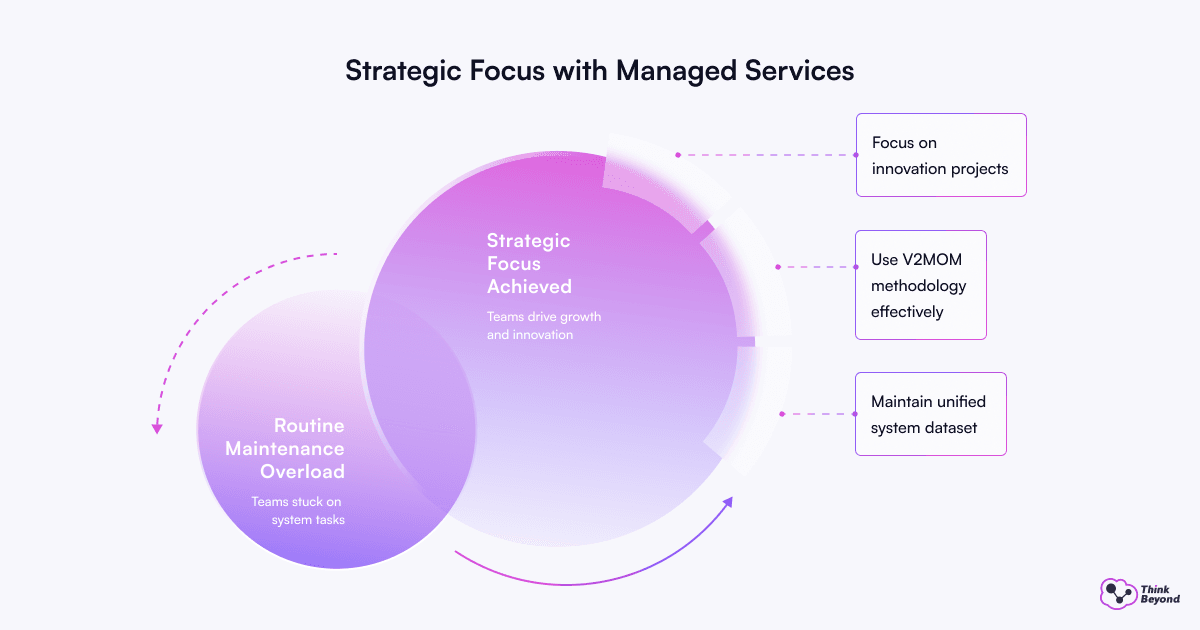
A Salesforce managed services partner delivers value that extends well beyond technical support and helps internal teams realise their full potential. In-house Salesforce professionals can turn their attention to the activities that genuinely grow the business once routine maintenance no longer occupies their time.
Freeing up time for innovation projects
Organisations that use managed services report that internal teams reclaim the time they previously spent on system maintenance. With that time back, teams concentrate on high-value activities that directly boost revenue and customer satisfaction, including:
- Developing custom applications that match specific business needs
- Building workflow automations that streamline key processes
- Designing analytics dashboards that surface actionable business insights
- Improving user experience to increase adoption rates
The managed services partner handles routine tasks; employees focus on the strategic initiatives that drive growth.
Aligning Salesforce with business goals
Matching Salesforce capabilities to company objectives is essential to getting full value from a CRM investment. Salesforce CEO Marc Benioff's V2MOM methodology (Vision, Values, Methods, Obstacles, and Measures) offers a framework that, in his words,
enables me to clarify what I'm doing, and then communicate it clearly to the entire company.
Internal teams can apply this framework to align Salesforce with strategic priorities while the managed services partner handles technical implementation. This division of labour lets leadership focus on outcomes rather than maintenance, and develop the recommendations that extract the most value from their CRM investment.
Improving cross-department collaboration
Perhaps the most valuable outcome of managed services is stronger cross-functional teamwork. McKinsey's research shows that organisations promoting collaborative work processes are 5x more likely to be high-performing.
A Salesforce managed services partner supports this collaboration by maintaining a unified system — a genuine Single Source of Truth — in which teams across departments work from the same dataset. Internal teams gain the opportunity to break down departmental silos, a significant obstacle for organisations aiming to scale, while maximising their Salesforce investment and strengthening organisational integrity across business units.
Metrics that prove managed services impact
Leaders should track a defined set of KPIs to demonstrate the return on a managed services partnership:
- Average ticket resolution time (MTTR) — measures how quickly issues get resolved once a partner takes over day-to-day operations
- Salesforce Health Check score — tracks security and configuration compliance over time
- Percentage of internal team time on strategic vs. maintenance work — the core indicator of whether internal capacity has actually been freed up
- User adoption rate — reflects whether employees use Salesforce over workarounds such as spreadsheets
- Cost per resolved ticket / admin cost as a percentage of Salesforce budget — quantifies the financial efficiency of the managed services model
- Release deployment success rate — the proportion of Salesforce updates rolled out without disruption to existing workflows
From routine tasks to value-driven projects
The financial case is clear. Organisations reduce spend on full-time salaries, benefits, and training while gaining enterprise-level expertise, and technical teams redirect their attention to strategic projects rather than internal tickets and routine maintenance.
Salesforce specialists deliver the most valuable benefits in this model. These professionals know Salesforce clouds of every type in depth, resolve complex problems quickly, and support custom development that internal teams often cannot handle alone. Their knowledge becomes a strategic necessity rather than a nice-to-have.
Internal teams concentrate on what matters most while a service partner handles daily operations — using Salesforce as a platform to innovate, grow, and stay ahead of competitors, building the kind of resilient digital ecosystem that supports long-term technical debt reduction rather than short-term firefighting.
How Think Beyond Helps Internal Salesforce Teams
Think Beyond acts as a Strategic Partner to internal Salesforce teams, not simply an outsourced help desk. Our Salesforce Managed Services engagement includes:
- Comprehensive org audits covering security settings, critical updates, licence usage, and user adoption
- Ongoing support ticket management with defined resolution-time commitments
- Access to certified admins, developers, architects, and consultants across Sales Cloud, Service Cloud, CPQ, and integrations
- CI/CD implementation and coding standards to prepare your org for stable, long-term development
- Proactive health checks, release management, and security vulnerability monitoring
- Data management support, including clean-ups, migrations, and integration improvements
Ready to see whether managed services fit your organisation? Initiate a Strategic Review with Think Beyond and get a clear view of where your internal team could reclaim strategic capacity.
FAQs
What are the main benefits of using a Salesforce Managed Services Partner?
A Salesforce Managed Services Partner reduces internal workload, provides access to certified experts, delivers proactive system monitoring, enables strategic focus for internal teams, and offers scalability as the business grows.
How does a Managed Services Partner help reduce costs associated with Salesforce management?
Partnering with a Managed Services Provider avoids the expense of full-time hires, reduces internal tickets and escalations, and minimises time spent on routine maintenance — delivering significant cost savings.
In what ways can a Managed Services Partner improve Salesforce security?
Managed Services Partners run regular health checks and performance audits, manage Salesforce updates systematically, and detect security vulnerabilities early, strengthening overall system security.
How does outsourcing Salesforce management impact internal team productivity?
Outsourcing Salesforce management frees internal teams to focus on innovation projects, aligns Salesforce with business goals, and improves cross-department collaboration, significantly boosting productivity and strategic output.
Can a Managed Services Partner adapt to changing business needs?
Yes. Managed Services Partners offer scalability and flexibility, adjusting support levels up or down, assisting with expansion into new regions or product lines, and providing expertise without long-term hiring commitments.
Key Public Sources Referenced
- DestinationCRM — The Best Enterprise CRM Suite: The 2025 CRM Industry Leader Awards
- Petronella Technology Group — Why Your IT Team Spends 75% of Their Time Fighting Fires
- Salesforce Ben — Ultimate Guide to Salesforce Niches and Specializations in 2025
- McKinsey & Company — Go Teams: When Teams Get Healthier, the Whole Organization Benefits
- Think Beyond — Salesforce Managed Services for Virtana (Case Study)
Topics
Keep reading
All posts-
 Managed Services 7 min read
Success in Salesforce Projects: The Strategic Role of Leased Teams in Implementation and Managed Services
 Martin Pieńkowski Head of Salesforce 15 July 2026 Read the article
 - Managed Services 11 min read
How Think Beyond Tailors Salesforce Managed Services to Your Industry
Martin Pieńkowski Head of Salesforce 15 July 2026 Read the article - Managed Services 9 min read
Why Salesforce Managed Services Are Critical After Go-Live
Martin Pieńkowski Head of Salesforce 13 July 2026 Read the article