Prospective students now expect the same digital, self-service experience from a university that they get from any consumer brand. At the same time, admissions offices are under growing commercial pressure: application volumes are rising, staff capacity is not, and every manual step in the process — a form re-entered, an email sent one by one, a document chased by phone — adds risk, delay and cost.
For institutions still running recruitment on spreadsheets, shared inboxes and paper files, this is no longer a back-office inefficiency. It is a strategic student journey decision that shapes conversion rates, institutional reputation and, ultimately, enrolment numbers.
Before you read on: if your admissions team is still reconciling applicant data across three or four systems, or if nobody in your institution can say with confidence how many active applications are sitting in the pipeline right now, this article is for you. When you are ready, explore your institution's admissions readiness with Think Beyond.
At a Glance
| Challenge | CRM Response | Outcome to Measure |
|---|---|---|
| Administrative overload from manual inquiry and application handling | Automated case routing, document processing and communication workflows | Hours reclaimed per admissions officer per week |
| Fragmented applicant data across multiple systems | A single, governed applicant record (Single Source of Truth) integrated with the Student Information System | Data accuracy and reduction in duplicate records |
| Inconsistent, delayed communication with prospective students | Automated, segmented messaging triggered by applicant status | Admissions conversion and time-to-decision |
Three procedural obstacles that slow institutions down
Recruiting and enrolling new students is a commercial necessity for every institution, not a seasonal exercise. Yet most admissions offices still wrestle with the same three obstacles.
- Administrative overload. Staff spend disproportionate time on inquiry handling and application processing, which diverts capacity from higher-value, strategic work.
- Data management gaps. Institutions collect large volumes of applicant data, but multiple systems and manual entry make it difficult to keep that data accurate, connected and trustworthy.
- Inefficient communication. Manual outreach creates delays and inconsistent messaging, undermining the recruitment journey at the exact moments a candidate is deciding whether to apply.
Automation does not remove operational accountability from admissions staff. It removes the repetitive, low-value tasks that stand between them and the decisions that actually require human judgement.
What a resilient, automated recruitment ecosystem delivers
Salesforce Education Cloud automation reorganises recruitment around one governed applicant record rather than a patchwork of spreadsheets and inboxes. In practice, that means:
- Data collection and segmentation. Applicant data — academic interests, location, engagement history — is captured once and used to segment communications automatically, rather than manually sorted after the fact.
Triggered email and outreach campaigns. Deadline reminders, programme information and status updates go out automatically, at the right moment in the applicant's journey, without staff drafting each message individually.
"We've deployed heavy automation in the marketing space and certainly we've seen lower marketing costs and time savings. Because our constituent journeys and the digital engagement are so powerful, we've stopped doing more of the high-cost things like less print materials and billboards... and transitioned into more personalised journeys."
— CIO of a public research university
Source: Forrester Report: The Total Economic Impact Of Salesforce Education Cloud, October 2020- Contact and inquiry management. Automated routing and AI-assisted responses answer common applicant questions immediately, improving the candidate experience while capturing preferences for later follow-up.
- Analytics and reporting. Institutions track application submissions, response rates and conversion by channel, allowing continuous refinement of recruitment strategy rather than a single annual review.
The platform does not decide who to admit. It gives admissions leaders the operational visibility and data integrity to make that decision faster and with more confidence.
Case Study: SWPS University — from paper files to a fully digital recruitment process
SWPS University, one of Poland's largest private universities with 17,500 students across six campuses, faced exactly this challenge: high application volume, paper-based document circulation, and fragmented communication between the Dean's Office, academic staff and the scholarships service.
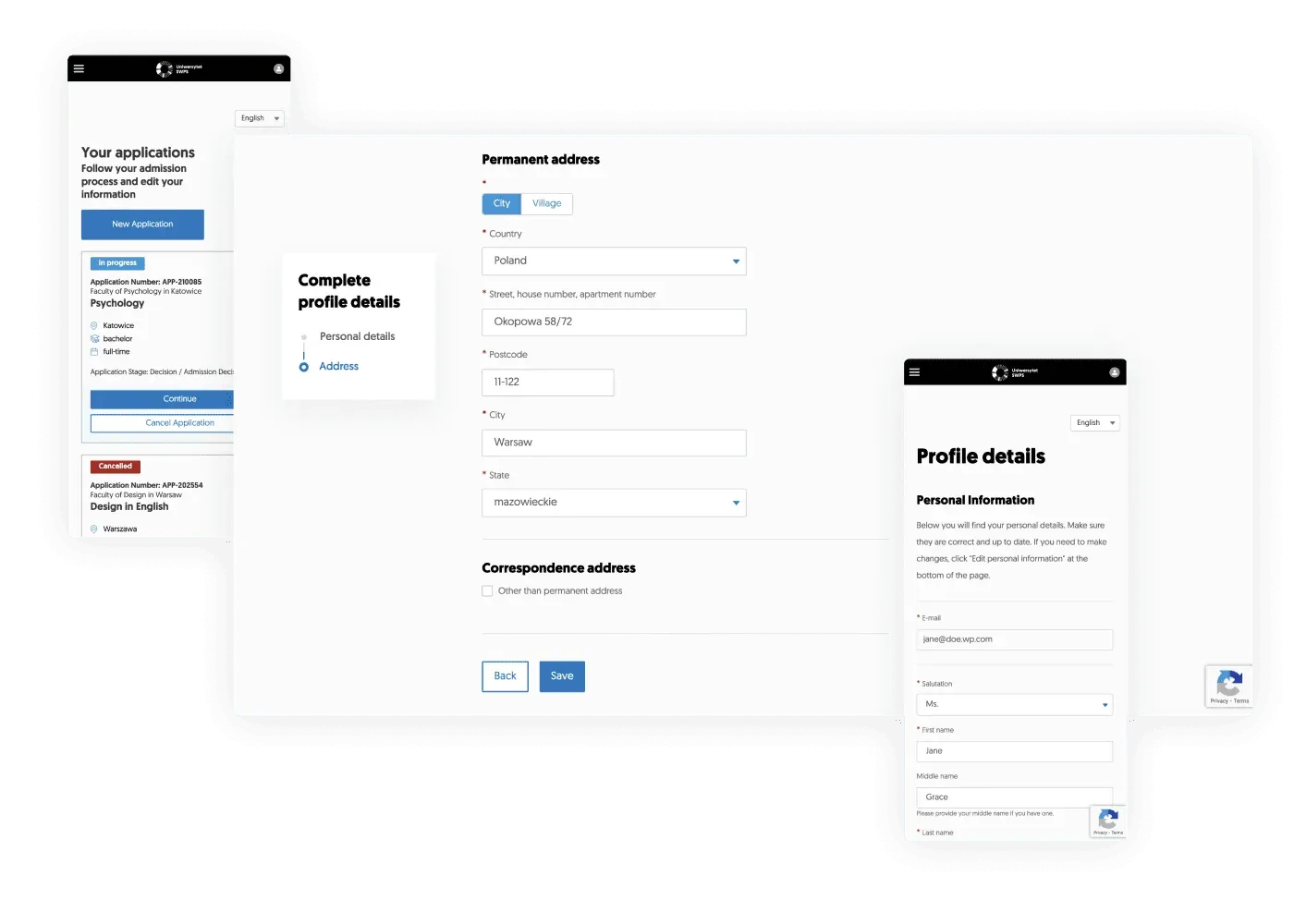
Think Beyond designed a Salesforce-based recruitment portal giving admissions staff a 360-degree view of every candidate's applications, documents and communication history, supported by up to 200 automated message templates, a self-service applicant portal, SIS integration and electronic signatures for digital contracts — SWPS's first fully digital recruitment process.
The result: a 20% increase in recruited candidates, materially reduced time from application to admissions decision, and stronger cross-departmental communication between the institution and its prospective students. Read the full SWPS case study for the complete breakdown.
Metrics that prove admissions automation impact
Admissions leaders should track a small number of metrics to demonstrate the commercial return of automation, rather than relying on anecdote:
- 35% faster admissions processing — time from application submission to admissions decision.
- +25% admissions conversion (yield) — the proportion of applicants who convert to enrolled students once a governed, automated process is in place.
- 100% Single Source of Truth accuracy — applicant and student data reconciled into one record, eliminating duplicate or conflicting entries across systems.
- Hours reclaimed per week per admissions officer, freed from manual data entry and repetitive inquiry handling.
These are the figures that turn an admissions automation project from an IT initiative into a board-level business case.
How Think Beyond Helps Institutions Modernise Recruitment
Think Beyond acts as a strategic partner to higher education institutions, not simply an implementation vendor. Our work with universities across the sector covers:
- Strategic review of existing recruitment and admissions processes to identify data silos and technical debt
- Salesforce Education Cloud platform design, including applicant 360-degree views and self-service portals
- Integration with existing Student Information Systems (SIS) and legacy platforms
- Automated communication workflows and electronic signature deployment for fully digital contracts
- Ongoing managed services to maintain data governance and system reliability as application volumes grow
Ready to assess where your institution stands? Check how we can help your institution.
Frequently Asked Questions
What is recruitment automation in the context of Salesforce Education Cloud?
Recruitment automation uses Salesforce Education Cloud to replace manual, paper-based admissions tasks — data entry, follow-up emails, document handling — with governed, automated workflows built around a single applicant record.
Does automation replace human decision-making in admissions?
No. Automation handles repetitive, high-volume tasks such as messaging and data entry. Admissions and academic staff retain full accountability for evaluation and final admissions decisions.
How long does a Salesforce recruitment automation project typically take?
Timelines vary by institutional complexity and existing systems, but a strategic review is the recommended first step to scope integration requirements accurately before implementation begins.
Can automation integrate with our existing Student Information System (SIS)?
Yes. A well-designed Salesforce Education Cloud implementation integrates with existing SIS platforms, connecting academic, administrative and financial data rather than replacing them outright.
What results can our institution expect from admissions automation?
Institutions implementing this approach have reported outcomes including faster admissions processing, improved data accuracy through a Single Source of Truth, and measurable gains in admissions conversion. Results vary by starting point and scope.
Key Public Sources Referenced
- Forrester Report: The Total Economic Impact Of Salesforce Education Cloud, October 2020 — salesforce.com
- Salesforce, Connected Student Report, Third Edition — salesforce.com