Dubai businesses are turning to Salesforce partners to unify customer information and strengthen collaboration across departments. This matters because 90% of UAE customers say they are more loyal to companies that deliver a smooth, consistent experience at every interaction. In a fast-moving market like Dubai, meeting this expectation separates the organisations that stand out from those that fall behind.
As Dubai's business landscape continues to evolve, leadership teams need sound decisions and personalised experiences to stay ahead of the competition. This article examines how the right CRM foundation, a customer-first experience strategy, and Salesforce automation combine to drive measurable business growth — and why organisational integrity across data and process is the real prerequisite for that growth.
Before you read on: Ask yourself whether your customer data currently lives in one connected system or across several disconnected tools. If the honest answer is "several," the sections below will show you exactly where the gaps sit. When you are ready, explore your Salesforce readiness with Think Beyond.
At a Glance
| Challenge | CRM Response | Outcome to Measure |
|---|---|---|
| Customer data scattered across departments | A unified Salesforce platform as Single Source of Truth | Reduction in duplicate or conflicting customer records |
| Slow, manual sales follow-up | AI-powered lead scoring and automated workflows | Shorter average sales cycle length |
| Teams working from different versions of the truth | Centralised records with shared visibility and collaboration tools | Fewer hours lost to internal clarification requests |
| Decisions based on instinct rather than evidence | Real-time dashboards and CRM Analytics | Increase in data-driven decisions tracked at leadership level |
Understanding CRM, CX, and Automation Alignment
Organisations thrive when they recognise that customer management requires more than standalone tools or isolated strategies. A resilient digital ecosystem emerges only when CRM, customer experience, and automation operate as one system, propelling growth and optimising operations together.
What CRM Is and How It Transforms Interactions
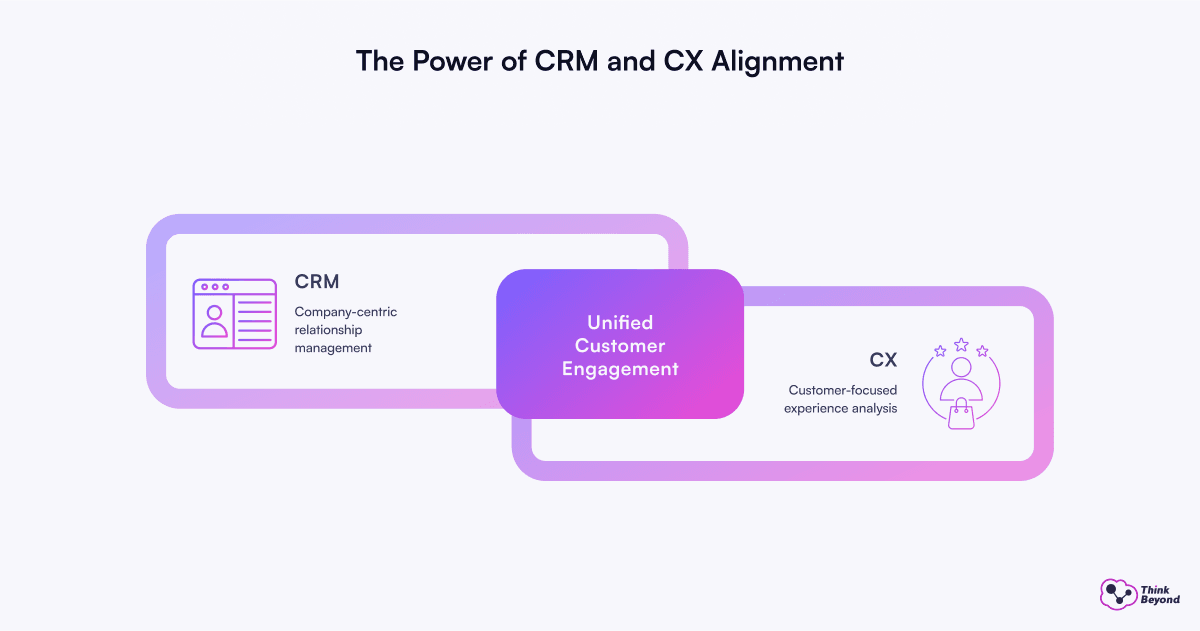
Customer Relationship Management (CRM) forms the backbone that collects and stores all customer data. This platform supports customer service, marketing, and sales as a Single Source of Truth. CRM helps organisations track interactions with existing and potential customers, storing vital information such as purchase history and relationship duration.
CRM has a direct effect on business performance. Research indicates that businesses see a revenue increase after adopting this software:
"On average, sales and marketing costs average from 15%-35% of total corporate costs. So the effort to automate for more sales efficiency is absolutely essential. In cases reviewed, sales increases due to advanced CRM technology have ranged from 10% to more than 30%."
— Harvard Business Review
The Role of Customer Experience (CX) in Business Growth
CRM manages relationships from the organisation's side, while customer experience (CX) examines the same relationship from the customer's point of view — their pain points, satisfaction levels, and overall journey. CX has become a critical growth lever: organisations that prioritise customer experience report revenue increases of up to 80%.
CX touches every part of a customer's journey, and organisations that put CX first consistently outperform those that do not. Working alongside experienced Salesforce partners, organisations can build strategies that capture these CX opportunities systematically rather than opportunistically.
How Automation Ties CRM and CX Together
Automation bridges CRM and CX by turning customer data into individually tailored experiences. This integration benefits organisations in several concrete ways: teams collaborate more effectively, understand customer behaviour more clearly, generate stronger leads, and preserve resources for higher-value work.
Salesforce CRM builds a complete picture of each customer across every interaction. Sharper analytics reveal customer behaviour, priorities, and trends, giving leadership the evidence base for smarter, data-driven decisions across marketing and operations.
Key Benefits of Aligning CRM, CX, and Automation
The combination of CRM, customer experience, and automation creates a system that delivers measurable business advantages. As Bill Gates observed:
"How you gather, manage, and use information will determine whether you win or lose."
Improved Customer Satisfaction and Retention
Organisations that implement CRM automation see a 47% increase in customer retention rates. Personalised interactions make customers feel valued, and this recognition drives the improvement. Automated systems let organisations respond immediately at any point in the customer journey, reducing wait times, strengthening loyalty, and keeping customers from switching to competitors.
Faster Sales Cycles and Lead Management
CRM automation shortens sales cycles. AI-powered lead scoring lets sales teams concentrate on the most promising prospects. Automated follow-up systems increase conversion rates, and real-time analytics equip sales representatives to make informed decisions rather than guesses. Teams eliminate wasted conversations and spend more time on leads that convert.
Streamlined Internal Communication and Workflows
A well-integrated CRM acts as a central hub where teams cooperate without friction. 55% of employees spend between 30 minutes and 2 hours daily clarifying details they need for their work — a direct cost of fragmented information. Centralised data resolves this problem at the source.
Salesforce solutions keep customer data and conversations in one place. Team members add comments to specific records, mention colleagues, and reply within the same thread, so everyone stays informed about customer interactions. Salesforce Data Cloud unifies all data — structured and unstructured alike — across departments and platforms, giving every team a complete, actionable view of each customer.
Data-Driven Decision-Making
CRM Analytics delivers AI-powered insights, visual analytics, and ready-made dashboards that help organisations segment customers, build targeted marketing campaigns, and develop personalised sales strategies.
Salesforce Campaigns gives organisations another critical tool: the ability to track marketing effectiveness through engagement, conversion rates, and ROI. Built-in campaign reports show which prospects and customers each campaign reached, who responded, and how much revenue the campaign generated — making strategy adjustments straightforward rather than speculative.
Steps to Implement Salesforce CRM for Dubai Businesses
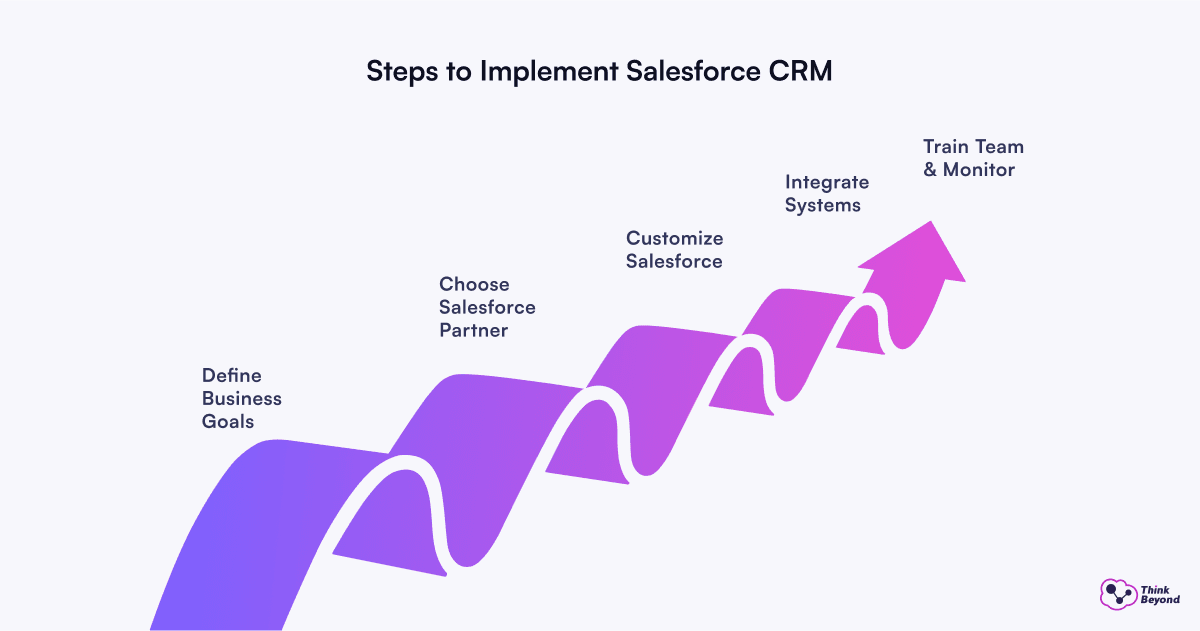
A Salesforce CRM implementation requires careful planning and disciplined execution. Stakeholder involvement, realistic budgeting, phased rollouts, robust data governance, and continuous support all contribute to lasting business value. What steps should leadership take to maximise the value of a Salesforce investment?
1. Define Your Business Goals
A CRM implementation needs clear objectives from the outset. Document business processes and audit the existing tech ecosystem to identify friction points. A customer experience map clarifies exactly how Salesforce will strengthen each touchpoint, aligning the CRM strategy with both business goals and technical capability.
2. Choose the Right Salesforce Partner in Dubai
Project success depends heavily on the Salesforce implementation partner an organisation chooses. The search for a Salesforce consultant in Dubai should prioritise certified partners with genuine sector experience.
Review the partner's track record to confirm successful projects comparable to yours. Verify certifications to validate expertise across Sales Cloud, Service Cloud, and Marketing Cloud. A reliable Strategic Partner delivers a smooth implementation and helps the internal team extract full value from Salesforce as the business scales.
3. Customise Salesforce to Fit Your Industry
Salesforce is a powerful CRM platform, but its true value depends on how precisely an organisation tailors it to its industry's specific needs. Every sector — financial services, real estate, e-commerce, life sciences, or education — carries its own challenges, processes, and regulatory requirements.
The strongest results come when leadership focuses customisation on the changes that deliver the highest value, balancing ready-made features against custom development to control cost.
This article offers strategic guidance on regulatory and compliance considerations and does not constitute formal legal advice. Organisations should consult qualified legal counsel on data protection and industry-specific regulatory requirements.
4. Combine Salesforce with Existing Systems
A CRM must work alongside other business tools — ERP, marketing automation, and customer service platforms among them. Before connecting systems, map the current IT environment to identify the most valuable connections.
Salesforce integration removes data barriers and keeps information current across every platform. Choose the connection method — APIs, middleware, or dedicated connectors — that fits the business's actual requirements rather than the easiest option.
5. Train Your Team and Monitor Adoption
Team training determines whether an implementation succeeds. Each department needs its own training plan, since marketing, sales, and customer support all work differently. Recognise team effort during the transition through incentives or formal recognition.
Track the metrics that matter: active users, new accounts, completed tasks, and work in progress. Adoption dashboards surface these figures clearly, helping administrators identify where teams need extra support.
Metrics That Prove CRM, CX, and Automation Alignment
Leadership should track a defined set of KPIs to confirm that a Salesforce implementation is delivering measurable business value rather than technical activity alone:
- Customer retention rate — the clearest signal that personalised, automated engagement is working
- Average sales cycle length — should shorten as lead scoring and automated follow-up mature
- First response time — a direct indicator of service-level performance across channels
- Customer satisfaction (CSAT) and Net Promoter Score (NPS) — track sentiment alongside hard sales data
- Campaign ROI — revenue generated per campaign against cost, drawn from Salesforce Campaigns reporting
- User adoption rate — active users and completed tasks against total licensed seats, the leading indicator of whether the platform will deliver return on investment at all
How Think Beyond Helps Dubai Businesses Align CRM, CX, and Automation
Salesforce gives Dubai businesses the foundation to align CRM, customer experience, and automation into one resilient digital ecosystem. The path may look complex at first, but it follows a defined structure — starting with clear business goals and a disciplined customer journey map.
Think Beyond operates as a Strategic Partner, not a software vendor, offering:
- Agentforce — an AI-powered digital labour platform that automates tasks and lifts productivity, particularly valuable for large-scale projects and service-led industries central to Vision 2030
- Hyperforce — secure, scalable, locally compliant cloud infrastructure that supports data sovereignty and simplifies regulatory alignment as the business grows
- Industry-specific solutions — tailored architecture for strategic sectors including education, energy, and finance, each addressing the sector's distinct objectives and constraints
With a Dubai office and deep regional expertise, Think Beyond ensures that a Salesforce implementation supports genuine organisational architecture — not a patchwork of disconnected tools. The hands-on approach delivers smooth integration, precise customisation, and a platform built to reduce technology debt as the organisation scales.
Ready to align your CRM, CX, and automation strategy? Explore Solution and see how Think Beyond structures a Salesforce implementation around your business objectives.
Frequently Asked Questions
Why should my organisation implement Salesforce CRM?
Salesforce CRM streamlines business processes, strengthens customer relationships, and improves operational efficiency. It automates sales, marketing, and customer service workflows while providing real-time reporting and analytics, and it scales alongside the business.
How long does a Salesforce implementation take?
Timelines depend on the complexity of requirements. A basic implementation can take a few weeks; a fully customised setup with integrations and automation can take several months. A structured strategic review at the outset produces a realistic, milestone-based plan.
What costs come with a Salesforce implementation?
Costs vary with user numbers, required features, customisations, and third-party integrations. Salesforce charges licensing fees separately from implementation costs, which cover setup, training, and support. A transparent estimate should follow a proper needs assessment, not precede it.
Will our team need training to use Salesforce?
Yes. Effective adoption depends on structured training covering navigation, customised workflows, automation, and reporting, backed by ongoing support after go-live.
Can Salesforce integrate with our existing business tools?
Yes. Salesforce integrates with a wide range of business applications, including ERP systems, marketing automation tools, and accounting software, once the current tech stack has been properly assessed.
Key Public Sources Referenced
- Salesforce — Five Customer Trends in the UAE
- Harvard Business Review — CRM and sales efficiency research
- Neowork — How Customer Experience Drives Business Growth
- Zippia — CRM Statistics
- PassiveSecrets — Workplace Communication Statistics
- Bill Gates, as quoted on Goodreads