The choice between Salesforce admin support and managed services has become a hot topic. The tech giant rolls out more than a thousand new features each year. Companies need expert guidance to make the most of their Salesforce investment. Many businesses find that Salesforce managed services provide an economical alternative to full-time admins. They still get specialised expertise.
The role of Salesforce partners becomes clear when you look at the numbers - 91% of Salesforce customers use at least one AppExchange app, while consulting partners lead 70% of implementations. But this doesn't mean companies should let go of their internal administrators.
Innovative companies are finding that internal admins and managed service providers work well together rather than choosing one over the other. This shared approach leverages both roles' strengths to create a comprehensive Salesforce management strategy. This piece shows how organisations can build strong partnerships between their internal Salesforce experts and external managed services.
Understanding the two roles: Admin and Managed Services Partner
Organisations should understand how internal Salesforce expertise and external support work together. These roles serve different but connected purposes in the Salesforce environment.
What does a Salesforce Admin do?
Salesforce Administrators are the backbone of an organisation's Salesforce implementation. They build and manage scalable solutions on the Salesforce Platform. The system configuration, automation, and optimisation ensure organisational health and maximum value. Their primary responsibilities include managing users, data, security, analytics, and the Salesforce product itself.
Salesforce Admin connects business needs with technology and turns requirements into working solutions. Day-to-day responsibilities include:
- Building and maintaining the Salesforce platform for the specific company's needs
- Setting up users with proper access levels
- Creating custom reports and dashboards to track business goals
- Automating business processes to improve efficiency
- Training users and giving ongoing support
- Making sure data stays accurate, secure, and high-quality
What is a Salesforce Managed Services Partner?
Salesforce Managed Services Partners (MSPs) offer a different or complementary approach. They use an ongoing, proactive model to run, optimise, and grow a Salesforce organisation without the cost of a large in-house team. MSPs are teams of qualified experts, including certified Salesforce consultants, administrators, and developers.
The Salesforce managed services provider combines administration, improvements, integration, governance, release management, and support, with service-level agreements (SLAs) and measurable outcomes backing everything up.
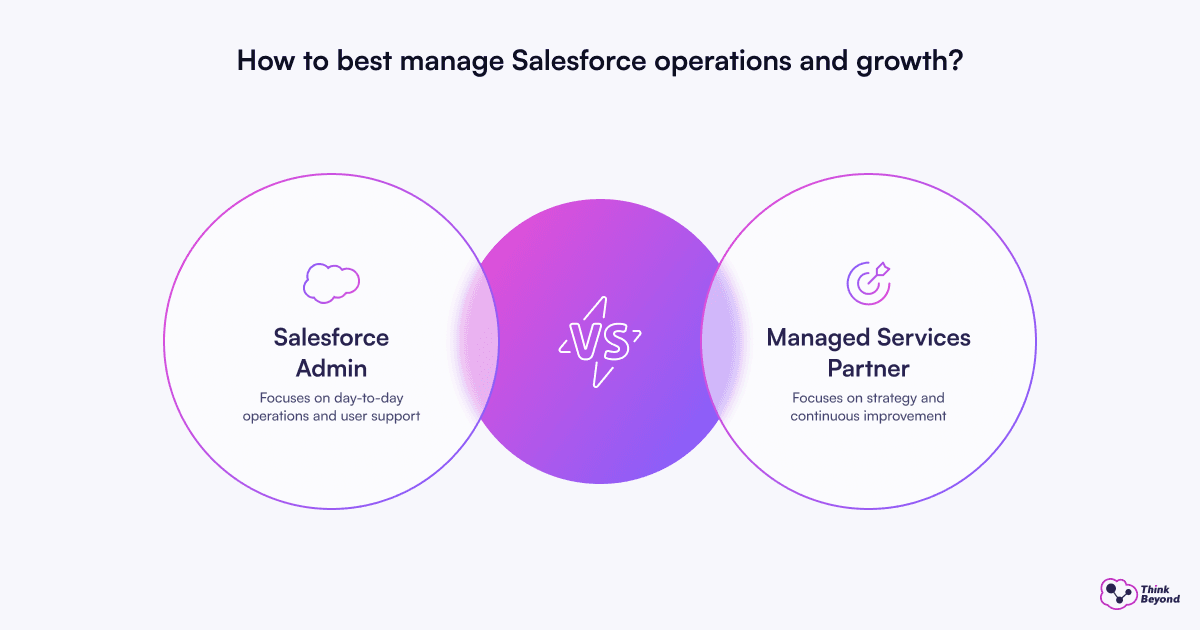
Key differences in scope and responsibility
The main difference lies in their operational focus. Salesforce Administration handles day-to-day operations, configurations, and user support. Managed Services focus on strategy, continuous improvement, scalability, and proactive management. An admin runs the system while Managed Services help it grow.
The best results come when in-house admins and Managed Service providers work well together. Internal admins know the company culture and workflows, while Salesforce managed services experts bring deep technical knowledge and cross-industry best practices.
The case for internal Salesforce Admins
Internal Salesforce Administrators are vital to organisations that depend on the CRM platform. Many companies now outsource these roles, but having dedicated in-house Salesforce experts brings some unique benefits:
Deep knowledge of internal processes
An in-house Salesforce Admin's greatest strength lies in their deep understanding of company-specific operations. These professionals really get to know the organisation's unique business processes. This knowledge helps them customise Salesforce solutions that perfectly match internal needs. They can create custom configurations that external partners might miss because they don't fully understand the company culture.
Internal admins build specialised knowledge that becomes increasingly valuable over time. They know both the technical aspects of systems and their purpose within the business context. This deep understanding helps them link Salesforce capabilities to business goals.
Immediate availability and team arrangement
On-site administrators provide direct, real-time support during business hours and resolve time-sensitive issues immediately. Quick responses boost productivity, especially when critical workflows stop working.
These internal admins build stronger relationships across departments. They work together with stakeholders and join regular meetings to review business needs, processes, and technical requirements.
Best suited for day-to-day operations
Internal Salesforce Administrators excel at managing the platform's daily tasks. Research shows that organisations with skilled administrators perform better in their core responsibilities. These professionals help improve performance and save costs by enabling teams to work naturally. Their value lies in being trusted advisors who understand both the technology and specific business needs.
The value of a Salesforce Managed Services Partner
Organisations that partner with Salesforce Managed Services gain strategic benefits alongside their internal capabilities. This partnership creates a multiplier effect that improves the overall Salesforce performance.
The Think Beyond team has been nothing short of amazing when it comes to delivering continuous Salesforce support. I am constantly impressed by their responsiveness, expertise, and attention to detail. They have gone above and beyond to ensure that our Salesforce instance is optimized for our business needs.
Eva Karnaukh, VP, Business Operations at Virtana
Affordable access to a whole team of experts
Companies get access to certified professionals in all Salesforce products without spending on recruitment or training. CompTIA reports that 46% of companies using managed services cut their budget by 25% or more. This solution helps with talent shortages, as 87% of companies expect skill gaps within three years.
Advanced tools and automation capabilities
Salesforce partners spot automation opportunities that internal teams often overlook. They speed up sales cycles through automated workflows and AI-driven tools while improving customer engagement. MSP partners build advanced analytics dashboards that turn raw data into valuable business insights.
24/7 support and release management
Managed services provide constant Salesforce environment monitoring with defined, short response times for critical issues. The service teams handle Salesforce's releases smoothly. They implement robust disaster recovery plans and maintain security protocols to reduce breach risk.
How to build a collaborative Salesforce strategy
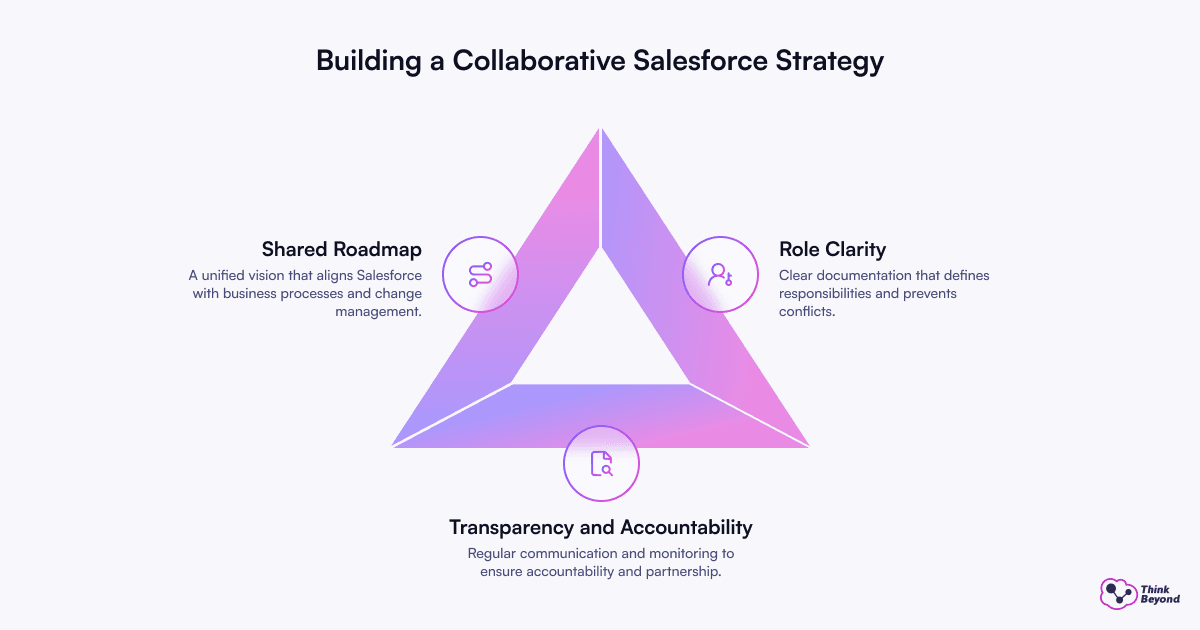
A successful partnership between internal Salesforce experts and managed services needs careful planning. The right collaborative approach depends on three essential elements that bring out the best in both roles.
Creating a shared roadmap between Admin and Partner
A unified vision sets the foundation for good teamwork. Organisations need to document how Salesforce supports their business processes and establish change management protocols. The roadmap needs buy-in from everyone - executives to team members - to encourage proper alignment.
Avoiding role overlap and confusion
Written documentation that clearly defines responsibilities helps prevent conflicts between internal teams and external partners. The core team usually includes a Salesforce administrator who handles daily operations, IT staff who manage integrations, and business leads who provide expertise from their respective departments. Clear escalation procedures help address conflicts at different levels.
Ensuring transparency and accountability
Teams need consistent monitoring to maintain accountability. Regular meetings and standard reporting formats keep communication channels open. This creates a partnership in which both sides help each other achieve better results than they could on their own.
Conclusion
Seeing ongoing Salesforce support as a choice between internal admins and managed services partners misses a great chance. Our analysis shows these approaches work better together, each with unique strengths. Internal administrators know the company inside out and are always available. Managed services partners bring expert knowledge, better tools, and budget-friendly scaling without hiring full teams.
The most successful Salesforce setups belong to organisations that see both roles as key parts of a complete strategy. Each company needs to find its own balance based on specific needs. This shared approach is the best way forward for businesses that want to succeed in today's Salesforce environment.
FAQs
What are the main advantages of using Salesforce managed services?
Salesforce managed services offer access to certified professionals, reduced operational costs, enhanced support and functionality, seamless deployment, better system customisation and integration, and increased scalability and flexibility. They provide a cost-effective way to leverage expert knowledge without the overhead of maintaining a large in-house team.
How do internal Salesforce admins and managed services partners complement each other?
Internal admins bring deep knowledge of company-specific processes and provide immediate, on-site support. Managed services partners offer specialised expertise, advanced tools, and cost-effective scalability. Together, they create a comprehensive strategy that combines day-to-day operations management with long-term platform development and optimisation.
What are the key responsibilities of a Salesforce administrator?
A Salesforce administrator manages day-to-day operations, including user account maintenance, data quality assurance, custom report creation, business process automation, and ongoing user training and support. They act as a bridge between business needs and technology, ensuring the Salesforce platform aligns with company objectives.
How can organisations ensure effective collaboration between internal admins and managed services partners?
To foster collaboration, organisations should create a shared roadmap, clearly define roles and responsibilities, establish transparent communication channels, and maintain accountability through measurable goals. This approach helps prevent overlap and confusion while maximising the strengths of both internal and external resources.