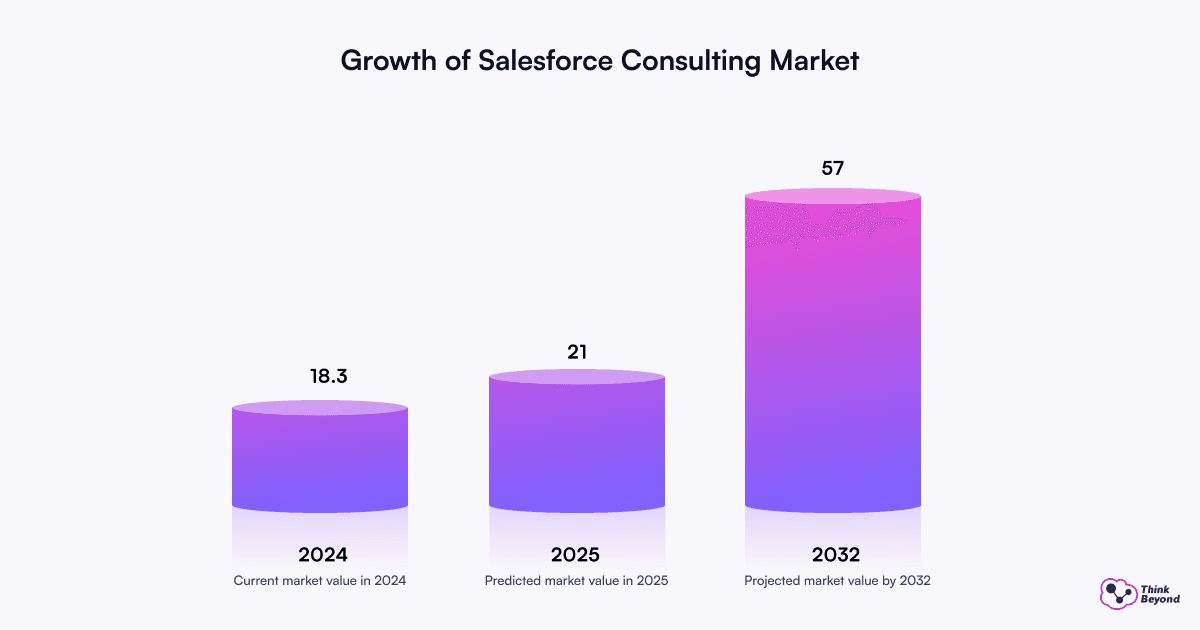
Who should hold operational accountability for your Salesforce org is no longer a minor procurement question — it is a strategic decision with direct consequences for revenue, data integrity, and organisational resilience. The global Salesforce consulting market illustrates the stakes: it was worth roughly $18.3 billion in 2024, analysts expect it to reach around $21 billion in 2025, and forecasts put it at $57 billion by 2032 — an average annual growth rate of roughly 15%. As the ecosystem scales, so does the operational complexity leaders must manage.
Every organisation running this CRM platform eventually confronts the same question: who manages the org, on what terms, and with what guarantees? A freelance Salesforce consultant gives you flexibility to flex resources against immediate needs. A Salesforce managed services partner gives you a structured, accountable operating model built for the long term. Leaders typically weigh:
- cost management
- quality control
- scalability
- access to specialist expertise
- resource access
- long-term support
- project continuity
- communication processes
- risk exposure
Most organisations start with freelancers to augment internal capacity, then shift to managed services once org complexity, data volume, and business risk exceed what a single contractor can carry. Understanding this distinction — before the org forces the decision on you — is what separates a reactive fix from a genuine strategic review.
Before you read on: Ask yourself one question — if your Salesforce admin left tomorrow, could your organisation absorb that loss without disrupting sales, service, or reporting? If the honest answer is no, your org has already outgrown ad hoc support. Initiate a Strategic Review with Think Beyond to assess your readiness for a managed services model.
Think Beyond addressed exactly this transition for Virtana, a Palo Alto-based digital infrastructure management company running a legacy Salesforce org dating back to 2011. Virtana needed CPQ, Sales Cloud, reporting, and integration expertise delivered at once, plus a faster path to support ticket resolution — a combination no single freelancer could realistically cover. Moving to a comprehensive managed services partnership gave Virtana a Single Source of Truth again, restored user adoption, and turned Salesforce operations from a liability into a governed, predictable function. See the full Virtana case study.
At a Glance: Freelancer vs Managed Service Provider
| Challenge | CRM Response | Outcome to Measure |
|---|---|---|
| Legacy org, accumulated technical debt | Structured audit, CI/CD process, coding standards | Ticket resolution time, reduction in technical debt |
| Fragmented, task-based freelance support | Retainer-based managed services with SLAs | SLA compliance rate, response time |
| Need for multi-disciplinary expertise (admin, dev, architect) | Full team access under one engagement | Backlog reduction, project velocity |
| Low user adoption, shadow processes (e.g. spreadsheets) | Training, proactive monitoring, adoption analysis | Active user rate, login frequency |
Who Is a Salesforce Freelancer?
A Salesforce freelancer is a self-employed professional who contracts directly with Salesforce customer organisations for defined periods of work. Unlike consultants employed by a firm, freelancers control their own client roster, project scope, and schedule.
Typical Roles and Responsibilities
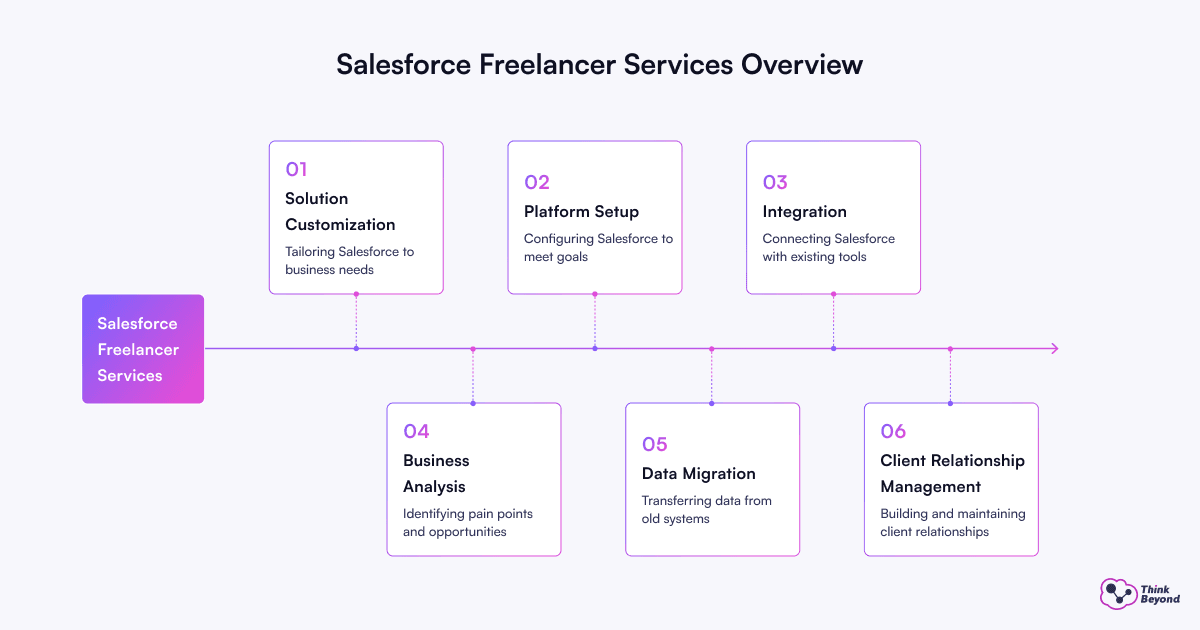
Salesforce freelancers deliver specialised services beyond basic CRM configuration. Their core responsibilities include:
- Creating and customising Salesforce solutions aligned with specific business needs
- Analysing business operations to identify pain points and growth opportunities
- Configuring the Salesforce platform to resolve client issues and meet implementation goals
- Migrating data from legacy systems into Salesforce
- Connecting Salesforce with existing business processes and tools
- Building client relationships and communicating with stakeholders
Freelancers typically specialise in implementation projects, automation design, report creation, or custom app development, based on their expertise and their clients' immediate needs.
The Right Time to Hire a Freelance Salesforce Consultant
An independent Salesforce consultant can be the right choice in several scenarios:
- Short-term projects that require specialised skills
- Budget-constrained businesses with urgent, narrowly scoped needs
- Resource-requirement testing before a permanent hire
- Temporary coverage during full-time recruitment (which usually takes 3–4+ months)
- Flexible scaling of resources against project demand
- Discrete tasks requiring expert knowledge, such as custom reports or workflow configuration
Where to Find Salesforce Freelancers
Organisations typically source qualified Salesforce freelancers through:
- General platforms such as Upwork, Freelancer, Toptal, Guru, and Flexiple
- Specialised Salesforce job boards and community groups on LinkedIn, Reddit, or the Trailblazer Community
- Salesforce's own AppExchange, plus job boards such as PeoplePerHour and Wellfound (formerly AngelList)
Many freelancers also build their client base through professional networks and referrals — networking remains a reliable route to skilled individual talent.
What Is a Salesforce Managed Service Provider?
A Salesforce Managed Service Provider (MSP) assumes operational responsibility for your core Salesforce functions. These partners bring institutional expertise to your organisation without requiring you to recruit and retain full-time staff internally.
Definition and Service Scope
A Salesforce MSP delivers professional services and manages, optimises, and supports Salesforce implementations on an ongoing basis. The provider functions as an extension of your team, handling implementation, customisation, integration, data management, and administration under a subscription or retainer agreement rather than a single project scope.
Salesforce Partner vs In-House Admin
The choice between an MSP and an in-house administrator carries distinct trade-offs:
- MSPs offer predictable subscription pricing; in-house teams require greater upfront investment in hiring, training, and tooling.
- MSPs provide access to certified specialists with cross-organisational experience; in-house admins bring deep familiarity with one business but a narrower skill base.
- MSPs combine specialists with knowledge across multiple industries, clouds, and Salesforce products — a structural advantage a single in-house hire cannot replicate.
- MSPs scale quickly as needs change, without additional hiring — suited to both smaller organisations that need occasional expertise and enterprises managing complex integrations.
Types of Support Offered by MSPs
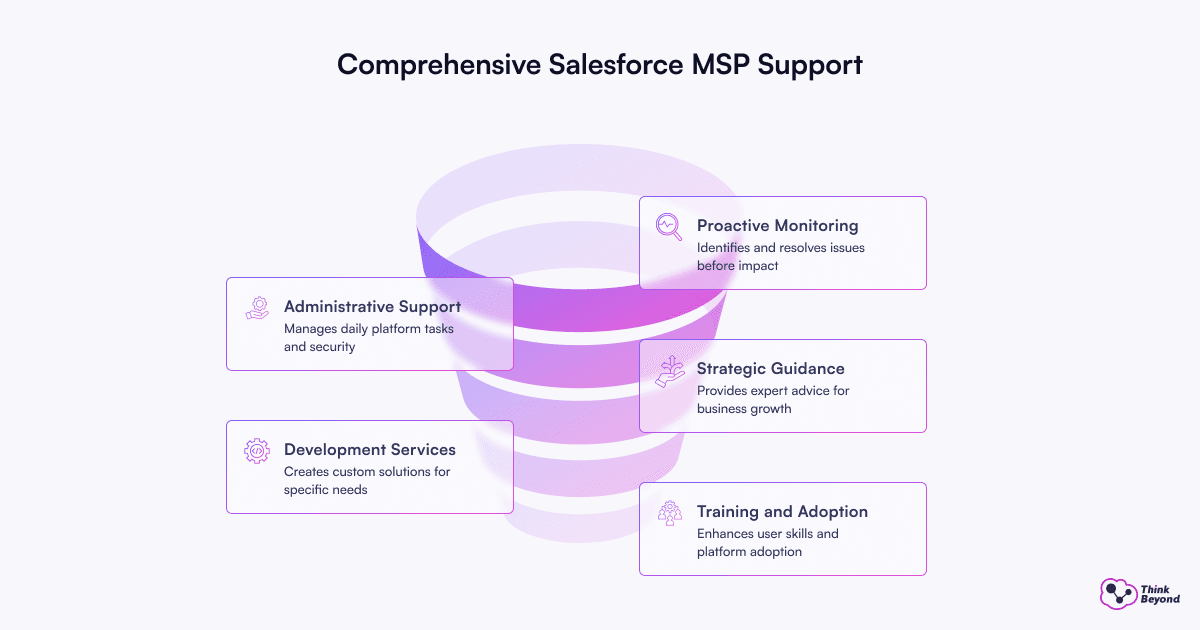
Salesforce MSPs typically deliver support across five areas:
- Administrative Support — user management, security configuration, data backup, and system-health monitoring, keeping the platform stable and secure without interruption.
- Strategic Guidance — analysis of business goals and Salesforce usage, translated into a clear roadmap so the platform continues to serve evolving business needs.
- Development Services — custom solutions when standard features fall short, including workflow automation, third-party integrations, and new feature builds.
- Training and Adoption — equipping teams to use Salesforce's full capability, driving higher adoption and productivity.
- Proactive Monitoring — identifying and resolving issues before they affect daily operations, reducing downtime.
Salesforce Managed Service Provider vs Freelancer: Key Differences
Freelancers and MSPs operate on fundamentally different models. Understanding these differences helps organisations make an informed, risk-adjusted decision.
Engagement Model: Task-Based vs Retainer-Based
Freelancers work on a task-oriented basis: they define deliverables through a fixed scope of work and cost, letting companies bring in talent without long-term commitment. MSPs work through retainer-based relationships, in which clients pay recurring fees for ongoing access to services — a model that creates predictable capacity and a lasting partnership.
Expertise Depth: Niche Skills vs Team-Based Knowledge
Freelancers bring specialised knowledge of specific Salesforce functions or clouds. MSPs bring together administrators, developers, analysts, architects, and project managers as a single team, solving complex problems through shared knowledge and varied skill sets.
Availability and Scalability
Independent consultants often serve multiple clients simultaneously, which limits their availability for urgent issues. Managed services scale more predictably because dedicated resources adapt quickly to changing demand.
Cost Structure: Hourly vs Flexible Payments
Freelancers typically charge hourly rates based on location and specialism, offering straightforward pay-as-you-go billing. MSPs use more flexible commercial models — subscription fees covering agreed service hours, retainer agreements for ongoing support, or tiered pricing aligned to usage and complexity.
Support Continuity and SLAs
MSPs offer formal service level agreements (SLAs) that define response times and resolution processes — a level of reliable support most freelancers cannot match. Freelancers, by contrast, rarely provide formal guarantees, detailed documentation, or activity logs, which makes tracking work and enforcing consistent quality more difficult.
Offshoring and Nearshoring
Organisations seeking a broader talent pool, competitive costs, and around-the-clock coverage frequently select a managed service provider based in a different country, rather than relying solely on local providers or freelancers.
Pros and Cons of Each Option
Organisations should weigh the advantages and limitations of both models against their specific risk tolerance and growth stage.
Advantages of Hiring Salesforce Freelancers
Salesforce freelancers are budget-friendly: companies pay only for delivered work, without additional overhead. Their hourly rates undercut agency consultants, and they bring specialised expertise in specific functions such as Apex, Visualforce, or Lightning Components. Organisations can scale resources quickly against project demand, and freelancers excel at short-term, narrowly scoped tasks.
Limitations of Freelancers for Long-Term Needs
Freelancer engagements carry structural risk at scale. Managing multiple freelancers becomes harder as businesses grow. Initial cost savings shrink once internal management time enters the equation. Most freelancers serve several clients simultaneously, which constrains their availability, and dependence on a single individual creates a continuity risk — work stalls without backup cover during absences.
Benefits of Salesforce Managed Services
Salesforce consulting partners deliver full-spectrum expertise through a team of experienced professionals and a complete service range. They monitor proactively, spotting potential issues before these affect operations. MSPs offer solutions that expand with the business without additional hiring, and predictable subscription pricing helps control total cost of ownership.
Challenges with MSPs for Small Projects
MSPs can be disproportionate for smaller projects. Their pricing structure often carries overhead that does not make financial sense for limited work, and these providers perform best with organisations that need ongoing support rather than occasional help. A small business with basic Salesforce needs may find an MSP's full capability unnecessary and costly.
Comparison Table
| Aspect | Salesforce Freelancer | Managed Service Provider (MSP) |
|---|---|---|
| Engagement Model | Task-based, fixed scope | Retainer-based, ongoing partnership |
| Cost Structure | Hourly rates | Flexible payment models |
| Expertise Type | Specialised skills in specific functions | Teams with expertise across multiple areas |
| Availability | Limited by multiple client commitments | Dedicated resources with defined SLAs |
| Scalability | Quick scaling for short-term needs | Adapts to changing needs without hiring |
| Support Structure | Individual support, no formal SLAs | Clear SLAs with defined response times |
Metrics That Prove the Right Support Model Is Working
Whichever model an organisation chooses, leaders should track concrete indicators to confirm the engagement delivers measurable value:
- Ticket resolution time — the average time from issue logged to issue closed
- SLA compliance rate — percentage of support requests resolved within agreed timeframes
- User adoption rate — proportion of licensed users actively logging in and using core functionality
- Technical debt reduction — volume of deprecated code, unused fields, or legacy automation retired over time
- Project backlog velocity — rate at which prioritised development items move from request to release
- Cost per resolved ticket — total support spend divided by tickets closed, tracked over time to confirm the model remains cost-efficient as the org scales
How Think Beyond Helps
Think Beyond acts as a strategic partner for organisations at any stage of this decision — not simply a resourcing vendor. Our Salesforce Managed Services model gives you:
- A comprehensive org audit and health check covering security settings, critical updates, licence usage, and user adoption
- Access to a full bench of certified specialists — admins, developers, architects, and consultants — without the overhead of building that team in-house
- Day-to-day operational support with defined SLAs, functioning as your internal Salesforce IT department
- Data and integration support, including clean-up, migration, and improvement of existing integrations
- A structured path to reduced technical debt through CI/CD processes, coding standards, and prioritised task management
Ready to determine which model fits your organisation? Initiate a Strategic Review with Think Beyond and get a clear, evidence-based recommendation for your Salesforce org.
FAQs
What is the typical cost range for hiring a Salesforce freelancer?
Freelance Salesforce consultants generally charge between $100 and $250 per hour, depending on experience and specialism. The market rate for independent consultants sits around $150 per hour.
How does a Salesforce Managed Service Provider (MSP) differ from a freelancer?
An MSP delivers ongoing, comprehensive support through a team of specialists on a subscription basis, while a freelancer typically works on short-term, narrowly scoped tasks. MSPs provide broader expertise and scalability; freelancers provide specialised skills for targeted needs.
What are the advantages of hiring a Salesforce freelancer?
Freelancers offer cost efficiency for short-term projects, specialised expertise in specific Salesforce functions, and flexibility to scale resources against immediate needs — well suited to businesses with limited budgets or niche skill requirements.
When should a company consider a Salesforce managed services partner?
Organisations should consider an MSP when they need long-term, consistent support, a diverse range of expertise, or management of complex implementations. MSPs particularly benefit organisations seeking proactive monitoring, strategic guidance, and scalable support as Salesforce needs mature.
How can businesses decide between a freelancer and an MSP?
The decision depends on the organisation's requirements, budget, and long-term objectives. Smaller businesses with limited scope may benefit from freelance talent, while enterprises with complex integrations and continuous support needs typically find greater value in an MSP partnership. Many organisations start with freelancers for initial projects, then transition to managed services as their Salesforce implementation matures.
Setting Clear Expectations: The Foundation of Salesforce Success
The choice between a Salesforce freelancer and a Salesforce consulting partner depends on your organisation's specific needs, budget constraints, and long-term goals. Clear expectations, detailed documentation, and proper alignment with business goals form the foundation of successful Salesforce management, whichever path you choose. The Salesforce ecosystem's rapid growth underlines why this decision matters — the right support structure materially affects how well your organisation exploits this platform's full potential.
Key Public Sources Referenced