

How to Personalise the Student Experience with Salesforce Education Cloud
Students judge a university against the commercial apps they use every day, and most institutions fall short. A personalised, omnichannel Salesforce Education Cloud ecosystem closes that gap by giving every applicant, student and alumnus a single, consistent experience across every touchpoint. Institutions that act on this now protect enrolment, retention and reputation before the gap becomes a competitive disadvantage.
Higher education has changed faster in the last five years than in the previous twenty. Students now measure their university against the same standard they apply to a banking app or a food delivery platform, and most institutions cannot meet that standard with fragmented legacy systems and siloed data.
This is no longer a nice-to-have. Personalisation of the student journey has become a strategic student journey decision with direct consequences for admissions yield, retention and institutional reputation. This article sets out where the personalisation gap actually sits, what a resilient digital ecosystem needs to close it, and how institutions can measure whether the investment is working.
Before you read on: ask yourself whether your institution can currently produce one accurate, real-time view of a student across admissions, academic records, support cases and communication history. If the honest answer is no, the rest of this article will show you exactly where that breaks down. When you are ready, explore your student experience readiness with Think Beyond.
At a Glance
| Challenge | CRM response | Outcome to measure |
|---|---|---|
| Fragmented communication across email, SMS, portals and phone | Unified omnichannel messaging on Salesforce Education Cloud + Marketing Cloud | Consistency of message across channels; reduction in duplicate outreach |
| No single view of the student across departments | 360-degree student view integrating admissions, academic and support data | Time for staff to retrieve a complete student record |
| Manual, paper-based administrative processes | Digital workflows, e-signatures and automated case routing | Percentage of processes running fully digitally |
| Slow, inconsistent student support | Self-service portal with case management and 24/7 assistance | Self-service adoption rate; average case resolution time |
The Student Communication Gap Universities Cannot Ignore
Students want more from their institution than a termly newsletter. They expect personalised alerts, proactive reminders and messages that reach them on the platforms they already use — text, email, social and mobile apps.
The data backs this up. Only half of students believe their university delivers an experience tailored to their needs. 27% of students surveyed said their institution still relies on outdated technology to support them. Both figures point to the same conclusion: institutions that communicate reactively, through one channel, are losing ground.
Closing this gap requires more than a better email template. It requires Single Source of Truth data that lets an institution reach the right student, on the right channel, at the right moment in their journey — from application to graduation and beyond.
Mobile-First Access Is No Longer Optional
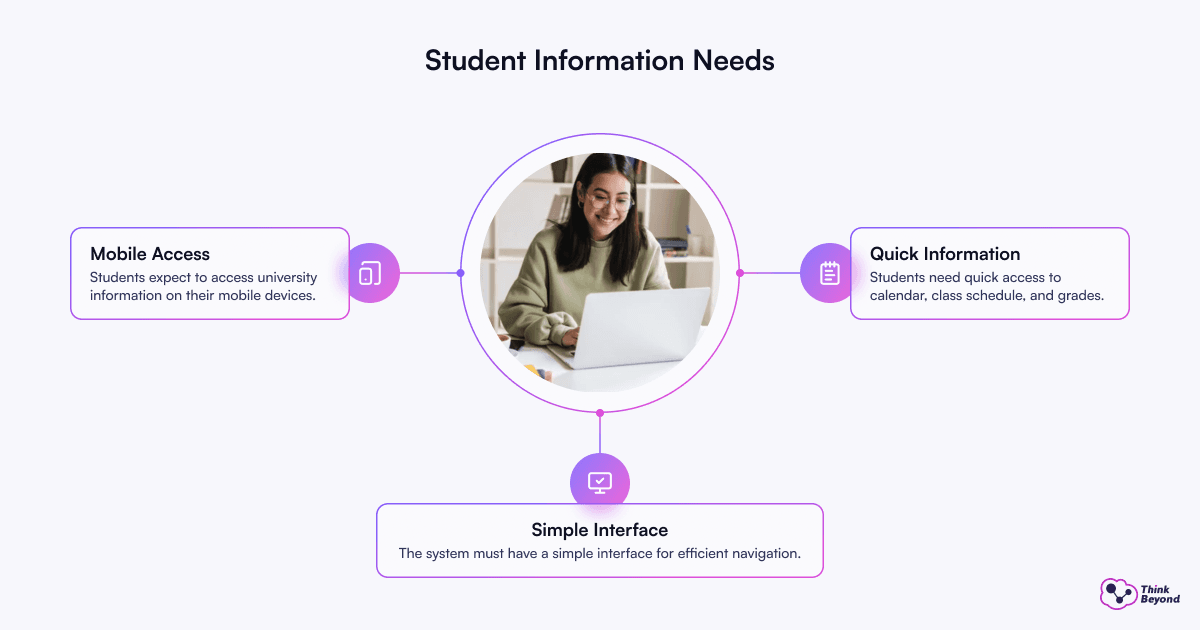
Students carry the university in their pocket, or they do not engage with it at all. According to Educause (2021), 91% of US students consider mobile access important to their education. They expect to check a calendar, a class schedule or a grade in seconds, through an interface that requires no explanation.
This changes what "student service" means operationally. A system that only works well on desktop, or that requires three logins to find one document, actively pushes students toward disengagement. Institutions need a self-service architecture built for mobile from the outset — not a desktop portal adapted after the fact.
Extending the Institution Beyond the Classroom
Mobile-first access also extends the institution's reach outside term time and outside the classroom. Portal notifications can flag exam dates, timetable changes or new announcements in real time. Students expect the same channel to support peer and lecturer contact, through a discussion forum or in-app chat — collapsing what used to be five separate systems into one governed environment.
Alumni Engagement Starts Long Before Graduation
Alumni relations do not begin at the graduation ceremony. They begin the moment a student first engages with the institution, and the quality of that early experience determines how willing an alumnus is to advocate for the institution later.
Engaged alumni act as brand ambassadors, sharing recommendations that carry more weight with prospective students than any marketing campaign. From the alumnus's side, staying connected to the institution and to fellow graduates opens networking opportunities across different career paths, generates new business relationships, and supports mutually beneficial knowledge exchange — which is precisely why alumni want a reason to attend institution-run events.
Treating alumni relationship data as an afterthought, bolted onto a spreadsheet after graduation, forfeits this advantage. It needs to sit inside the same ecosystem that manages the student lifecycle from day one.
Building the Personalisation Engine
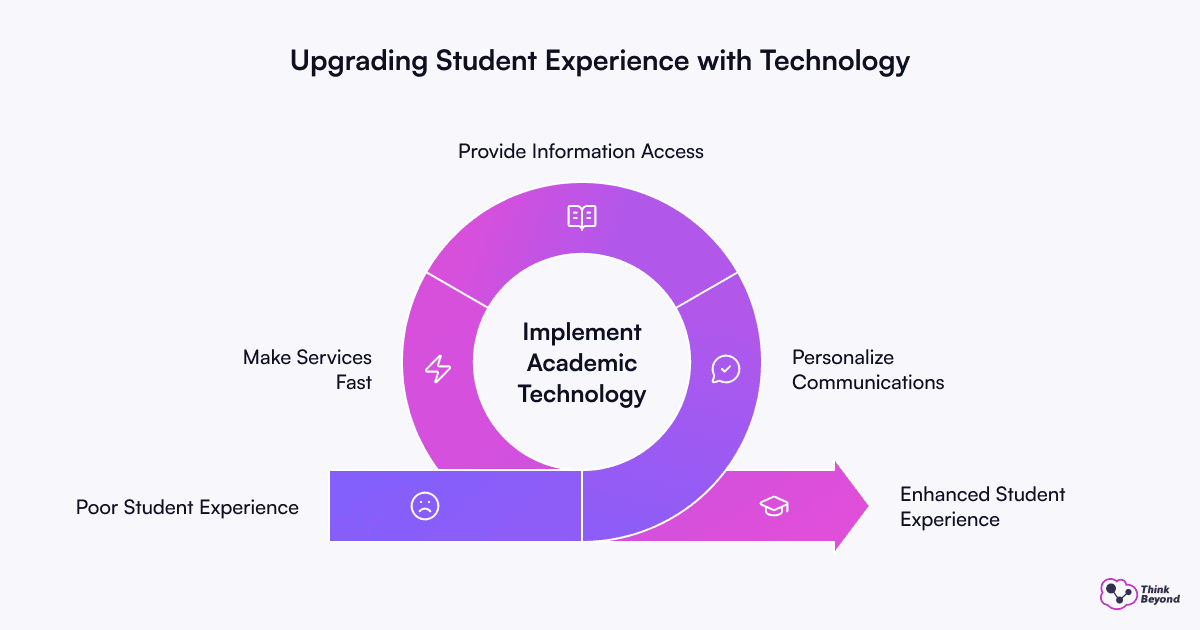
Three operational pillars turn personalisation from an ambition into a repeatable capability.
Personalise communications. Schedule outreach through the channels students already use — SMS, social and email — rather than a single institutional newsletter. Send targeted messages about events, registration deadlines, advising appointments and career opportunities, rather than blanket announcements that most students ignore.
Provide access to information at any time. Students need to view schedules, check results and access course materials at every stage of their journey, on a platform that respects data governance and student privacy. Institutions that process student data at scale carry a direct responsibility to apply appropriate safeguards — this is a data sovereignty requirement, not a feature request.
Make student services fast and effective. A student success platform with integrated case management, backed by conversational chatbots for common queries, gives students help around the clock and frees staff from repetitive requests. Collecting this activity data consistently builds the 360-degree student view that lets the institution intervene early — on housing, mentoring or financial aid — before a small problem becomes a reason to leave.
Proof in Practice: SWPS University
The theory holds up under real operating conditions. At SWPS University — 17,500 students across six campuses in Poland — Think Beyond built a Student Success Centre combining Salesforce Education Cloud with Genesys Cloud Contact Centre.
The result is a single Student Success Portal, built on Experience Cloud, that gives students self-service access to case tracking, appointment scheduling and document management, backed by a 50-plus specialist omnichannel contact centre with intelligent routing and electronic signatures replacing paper workflows. Students gained one point of access across all six campuses; staff gained a 360-degree view that eliminated duplicate work between departments. Read the full Student Success Centre case study for the complete breakdown.
Kamila Dryjanska, Head of Admissions, SWPS University: "Incredible care for the client's needs, a wonderfully supportive implementation team full of willingness to help and patience. Thanks to their commitment and knowledge the process ran as smoothly as possible."
The pattern generalises. Any institution running fragmented service channels across multiple campuses faces the same integrity problem SWPS solved — and the fix is architectural, not cosmetic. If your team is scoping a comparable implementation, Think Beyond's Salesforce Implementation service covers requirements analysis, integration and change management under one governed roadmap.
Metrics That Prove Student Experience Personalisation Impact
A personalisation programme is only as credible as the metrics behind it. Leaders should track:
- Self-service adoption rate — the proportion of student requests resolved without staff intervention.
- Average case resolution time — how quickly a student query moves from submission to close, across every channel.
- Channel engagement distribution — which channels (portal, SMS, email, chat) students actually use, versus which the institution assumes they use.
- Portal and mobile session data — frequency and duration of self-service portal use, particularly on mobile.
- Student satisfaction (CSAT/NPS) — direct feedback on service interactions, tracked over time rather than as a one-off survey.
- Retention trend by cohort — whether improved service correlates with fewer at-risk students disengaging mid-programme.
None of these require guesswork once the underlying data sits in one governed system. They fail the moment the underlying data does not.
How Think Beyond Helps Universities Personalise the Student Experience
Personalisation is not a marketing add-on. It is a Single Source of Truth problem, and Think Beyond solves it end to end:
- Strategic assessment of your current student data landscape and technical debt
- Salesforce Education Cloud and Experience Cloud implementation, tailored to your institution's admissions, retention and alumni processes
- Integration with existing student information systems and contact centre platforms
- Omnichannel communication design across Marketing Cloud and Salesforce Education Cloud
- Change management and staff training to secure adoption, not just deployment
Ready to see where your institution's student experience is losing ground? Request a Strategic Consultation with Think Beyond.
Frequently Asked Questions
What does "personalising the student experience" actually mean in practice?
It means every communication, portal interaction and support case reflects what the institution already knows about that individual student, delivered on the channel they actually use, rather than a generic message sent to an entire cohort.
Which Salesforce products support student experience personalisation?
Salesforce Education Cloud provides the core student data model, Experience Cloud powers the self-service portal, and Marketing Cloud handles omnichannel outreach. Most institutions combine at least two of the three.
Does personalisation require replacing our existing student information system?
No. A well-scoped Salesforce implementation integrates with your existing student information system rather than replacing it, preserving institutional investment while adding the missing layer of unified data and communication.
How long does a student experience personalisation project typically take?
Timelines depend on the number of channels and systems involved. A focused portal and communication rollout can launch in a few months; a full omnichannel contact centre implementation, as delivered for SWPS University, runs longer given the scope across multiple campuses.
How do we measure whether personalisation is working?
Track self-service adoption, case resolution time, channel engagement and retention by cohort together, rather than any single metric in isolation. A rise in portal usage with no change in retention signals a data or process gap, not a personalisation success.
Key Public Sources Referenced
- Educause, 2021 Students and Technology Report
- Salesforce.org, Nonprofit and education research
- Think Beyond, Student Success Centre at SWPS University — Case Study
This article reflects general industry practice and Think Beyond's implementation experience. It is not a guarantee of specific outcomes for any individual institution; timelines and results depend on each institution's existing systems, data quality and scope.
Topics
Keep reading
All posts-
 Education 5 min read
Student mentoring: how to improve their chances in the job market
 Adam Czeczuk Head of Consulting 10 August 2026 Read the article
 - Education 7 min read
The Best Management Strategies for Student-Centred Universities — and How to Make Them Operational
Adam Czeczuk Head of Consulting 15 July 2026 Read the article - Education 8 min read
How Higher Education CRM Software Boosts Student Engagement
Adam Czeczuk Head of Consulting 15 July 2026 Read the article