

Why Higher Education Institutions Must Embrace Digital Transformation
Most students rate their university experience as merely adequate, not exceptional, and fragmented systems are the primary cause. Institutions that unify recruitment, engagement and retention data on one platform close this gap and protect enrolment. Salesforce Education Cloud gives institutions a Single Source of Truth to make that shift measurable.
Higher education has undergone a structural shift since the pandemic accelerated online learning. Institutions now face a harder question than "how do we deliver classes remotely?" They must decide how to support students and staff through economic uncertainty, an unsettled emotional environment, and rising expectations for flexibility — while keeping operations financially sustainable.
This is no longer a technology preference. It is a commercial necessity. Institutions that treat data integration, communication and retention as strategic priorities protect their enrolment pipeline and their reputation. Those that rely on manual spreadsheets, disconnected admissions tools and siloed alumni records fall behind on both fronts.
Before you read on: ask whether your institution can currently produce a single, accurate view of a student's journey — from first enquiry to alumni status — without exporting three spreadsheets and reconciling them by hand. If the honest answer is no, explore your institution's Education Cloud readiness with Think Beyond.
Think Beyond has addressed this exact challenge with SWPS University, one of Poland's largest private universities, with 17,500 students across six campuses. The institution needed a platform that could unify course management, payments and communication on a single ecosystem rather than a patchwork of disconnected tools — a pattern that recurs across the sector.
What the Data Says About the Current Student Experience
Salesforce's Connected Student Report offers an unflattering baseline: only a third of students describe their university experience as genuinely great. The remainder report it as merely good, fair, or poor. That gap between adequate and exceptional is where institutions lose applicants, retention, and advocacy.
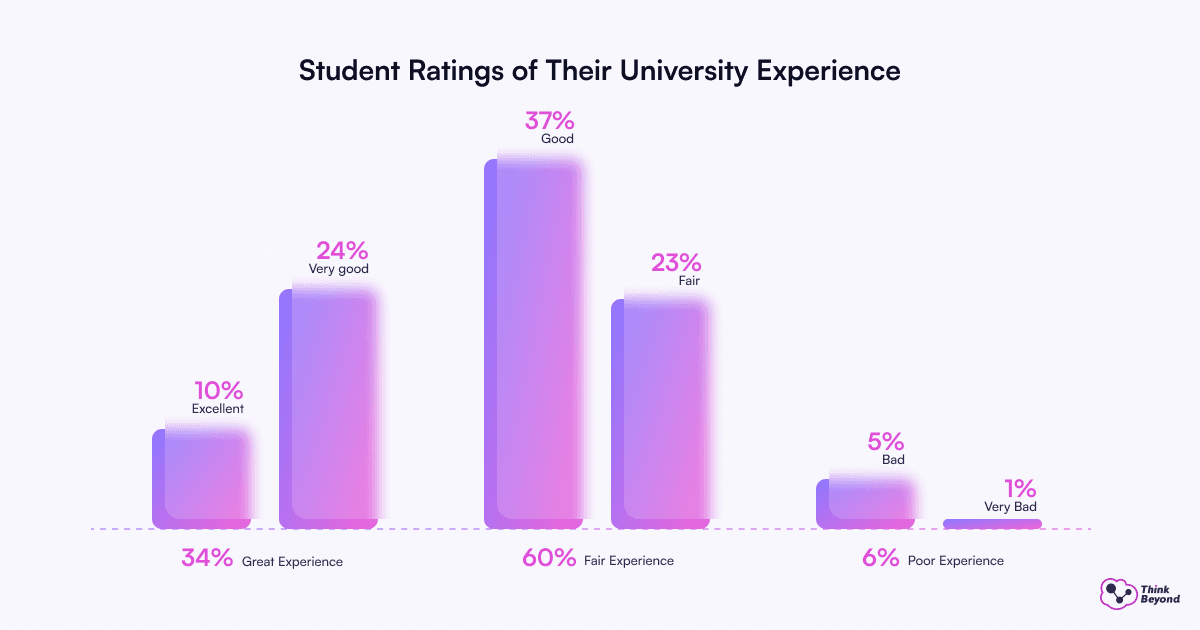
Four pressure points explain the gap:
- Onboarding sets the trajectory. Students who have a strong onboarding experience are 35 times more likely to rate their overall university experience highly.
- Support must span the full lifecycle. Students want holistic support from application to graduation, including well-being resources (36%) and in-person connection opportunities (54%).
- Career outcomes drive enrolment decisions. Nearly half (47%) of students choose an institution for career prospects, yet only 11% feel genuinely prepared for work — and well-prepared students are four times more likely to rate their experience highly.
- Digital access is now a baseline expectation, not a differentiator. Students reporting a great experience are far more likely to have easy online access to resources (86% vs 49% for those with a poor experience), mobile-available services (82% vs 61%), and personalised interactions (60% vs 11%).
At a Glance: Closing the Student Experience Gap
| Challenge | CRM Response | Outcome to Measure |
|---|---|---|
| Fragmented student data across admissions, LMS, and finance systems | Single Source of Truth via Salesforce Education Cloud | 100% SSOT accuracy across the student record |
| Manual, inconsistent applicant communication | Automated, personalised recruitment journeys | +25% admissions conversion |
| Legacy systems increasing operational risk and cost | Governed, integrated ecosystem replacing point solutions | -40% technology debt |
| Limited visibility into at-risk students | Retention signals and advisor dashboards | +15% retention growth |
| Vulnerable institutional data and compliance exposure | Governed, encrypted, unified architecture | 99.9% data integrity and 100% data sovereignty |
Figures reflect Think Beyond's Salesforce Education Cloud engagements. Explore the full Education Cloud solution.
Communication Is Where Institutions Lose or Win Students
Communication problems compound the experience gap. Students consistently name three issues: contact frequency, personalisation, and timely alerts.
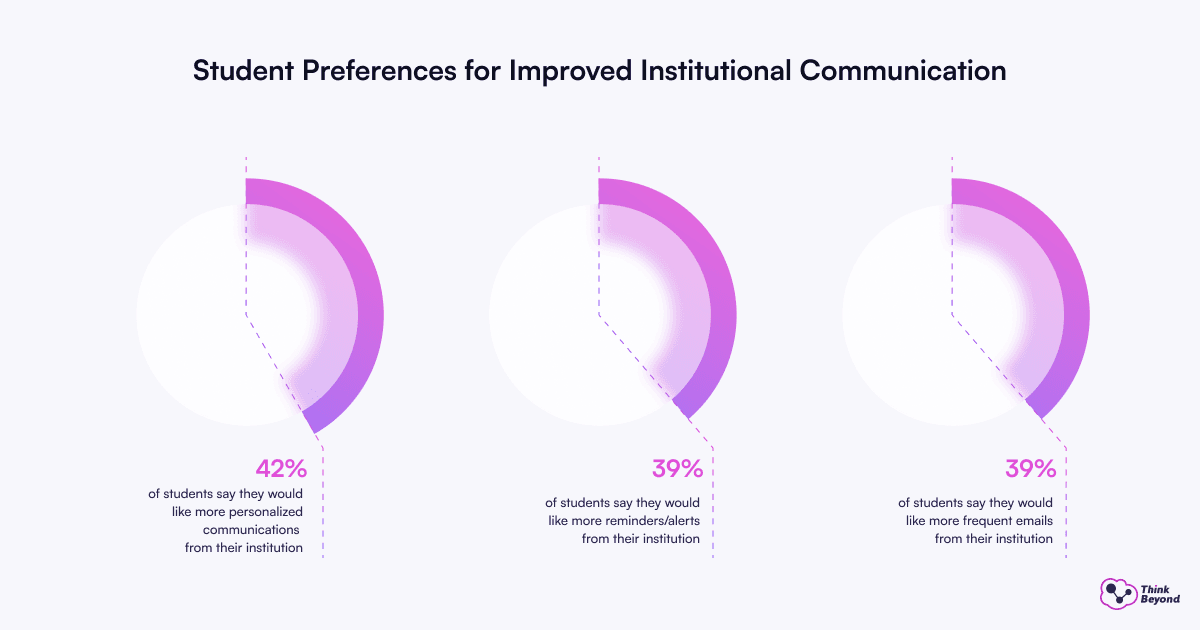
Three findings stand out for institutional leaders:
- Nine out of ten students want more frequent contact — through email, targeted messaging, and notifications — not less.
- A quarter of students want a more individualised experience overall, and roughly four in ten want more personalised communication specifically.
- Email remains the most effective channel for alumni and donor communication, according to more than half of surveyed staff, though video conferencing outperformed it for fundraising outreach during the pandemic.
A CRM built for education — rather than a generic marketing tool retrofitted for the sector — recognises the difference between a prospective applicant, an enrolled student, and an alumnus, and personalises accordingly.
Where Institutions Are Actually Investing
Staff themselves recognise the shortfall. University employees observe institutional technology investment from the inside, and their expectations reveal where budget is heading next.
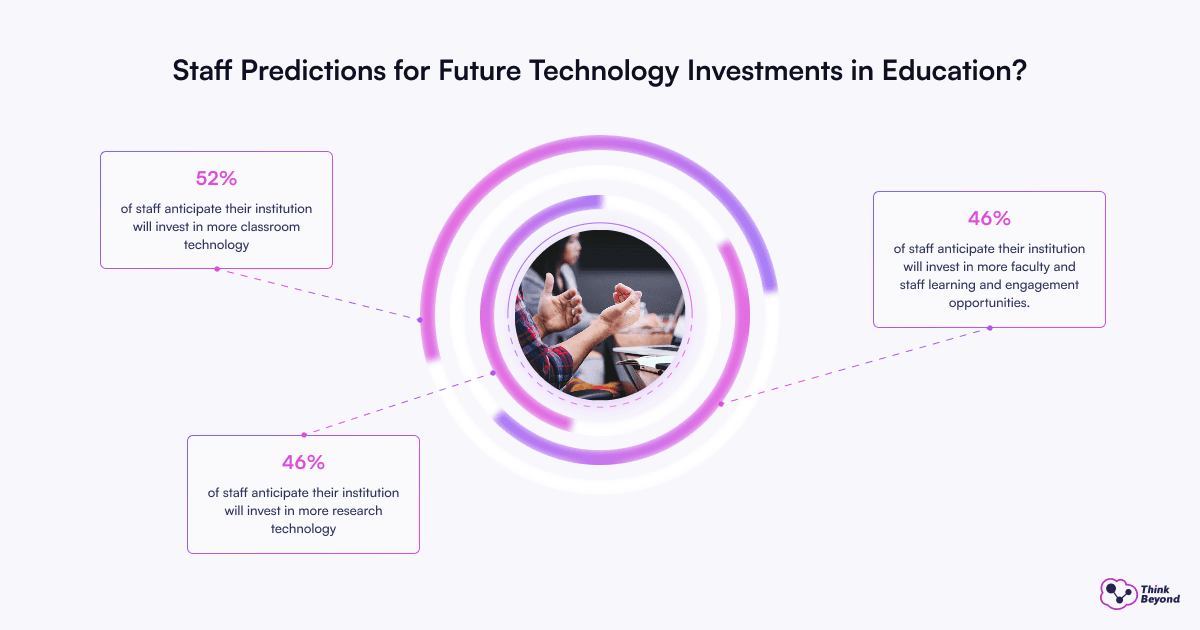
- 52% of faculty expect increased investment in classroom technology, and 46% expect more spend on research technology.
- 45% of institutions report a rise in digital advertising since the pandemic, reflecting a shift in how admissions offices reach prospective students — through live chat, virtual campus tours, and webinars.
- Only 40% of institutions currently prioritise data analytics, despite its direct link to student success monitoring and safer, evidence-based decision-making.
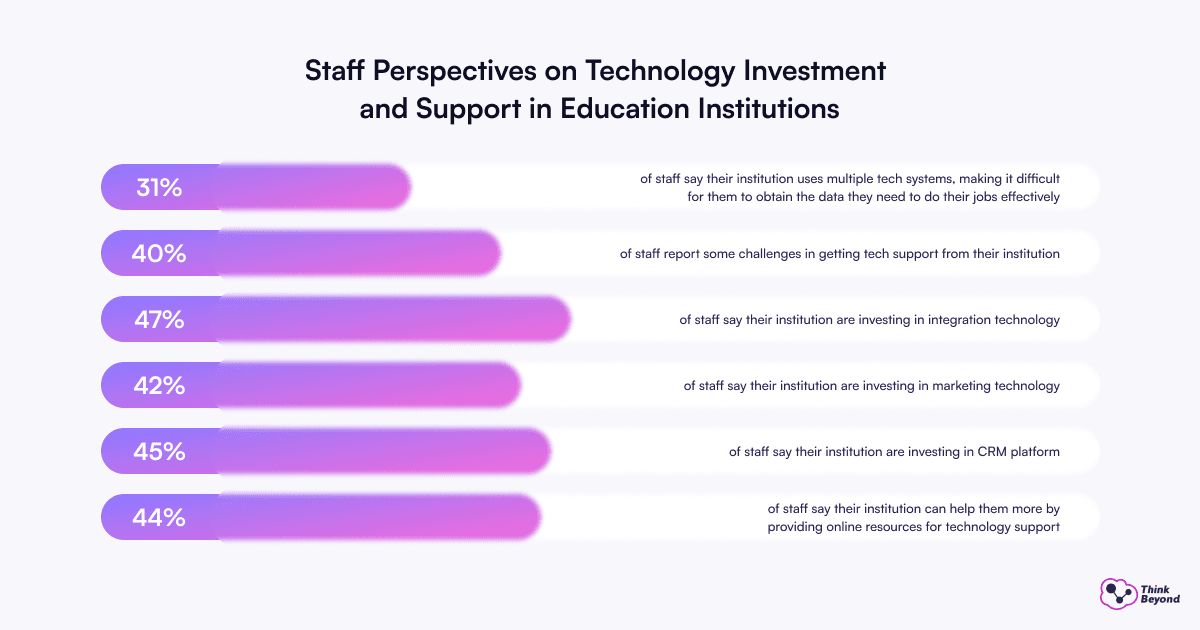
Fewer than half of institutions (47%) prioritise IT integration, while 45% now rank CRM platforms as a higher priority than in previous years. This is the strategic gap Think Beyond closes: connecting recruitment, retention, engagement and alumni relations into one governed ecosystem instead of a set of disconnected tools.
Metrics That Prove Digital Transformation Impact
Leaders evaluating a transformation programme should track outcomes across the full student lifecycle, not just at the point of enrolment:
- Admissions conversion rate — the percentage of qualified applicants who complete enrolment.
- Time to resolution for student enquiries — a direct measure of operational efficiency and helpdesk load.
- Retention rate year-over-year — tracked against early warning signals raised through advisor dashboards.
- Data integrity and SSOT accuracy — the percentage of student records that are complete, deduplicated and consistent across systems.
- Technology debt reduction — the proportion of legacy point solutions retired or consolidated into the core ecosystem.
These metrics translate a transformation programme from an IT project into a board-level conversation about enrolment revenue, operational cost, and institutional reputation.
How Think Beyond Helps Institutions Close the Gap
Think Beyond designs and implements resilient Salesforce Education Cloud ecosystems for institutions that need more than a point solution. Services include:
- Strategic review of existing admissions, retention and alumni processes
- Salesforce Education Cloud architecture and platform design
- Integration of legacy systems into a single governed ecosystem
- Automated recruitment and applicant communication workflows
- Retention dashboards and early warning signal configuration
- Ongoing managed services and data governance support
Institutions do not need to guess where their student experience gap sits. Request a Strategic Consultation with Think Beyond to map your current ecosystem against the student lifecycle and identify the highest-impact starting point.
Frequently Asked Questions
What is digital transformation in higher education?
Digital transformation in higher education means unifying admissions, retention, engagement, and alumni systems onto a single platform so institutions gain one accurate view of each student's journey, rather than managing disconnected tools.
Why do universities need a CRM built specifically for education?
A generic CRM does not distinguish between an applicant, an enrolled student, and an alumnus. Salesforce Education Cloud is purpose-built for that lifecycle, which is why 45% of institutions now prioritise dedicated CRM platforms over generic marketing tools.
How does Salesforce Education Cloud improve student retention?
The platform surfaces early warning signals — such as engagement drop-off or missed milestones — on advisor dashboards, giving staff visibility to intervene before a student disengages, rather than promising automated predictions the system does not make.
What is a Single Source of Truth, and why does it matter for universities?
A Single Source of Truth is one governed, accurate student record shared across admissions, academic, and alumni systems. It removes the reconciliation work institutions currently do across spreadsheets and prevents inconsistent decisions based on outdated data.
How long does a Salesforce Education Cloud implementation take?
Timelines vary by scope and legacy system complexity. A strategic review is the fastest way to establish an accurate estimate for your institution — request one with Think Beyond.
Key Public Sources Referenced
- Salesforce, Connected Student Report — student experience, onboarding, and communication preference data
Topics
Keep reading
All posts-
 Education 5 min read
Student mentoring: how to improve their chances in the job market
 Adam Czeczuk Head of Consulting 10 August 2026 Read the article
 - Education 7 min read
The Best Management Strategies for Student-Centred Universities — and How to Make Them Operational
Adam Czeczuk Head of Consulting 15 July 2026 Read the article - Education 8 min read
How Higher Education CRM Software Boosts Student Engagement
Adam Czeczuk Head of Consulting 15 July 2026 Read the article