Organisations struggle to support continuous improvement and change, with 55% failing to reach their goals. Salesforce managed services have become an innovative solution for internal teams facing this challenge. The global CRM software market is growing at a 14.6% CAGR, reaching $73.4 billion in 2024.
Salesforce-managed services for internal teams offer advantages beyond cost savings. These services help your CRM work at its best and adapt to your organisation’s changing needs while reducing financial pressure. Partnering with a managed service provider lets your internal Salesforce team focus on strategic projects that drive growth and innovation rather than routine maintenance.
How managed services reduce internal workload
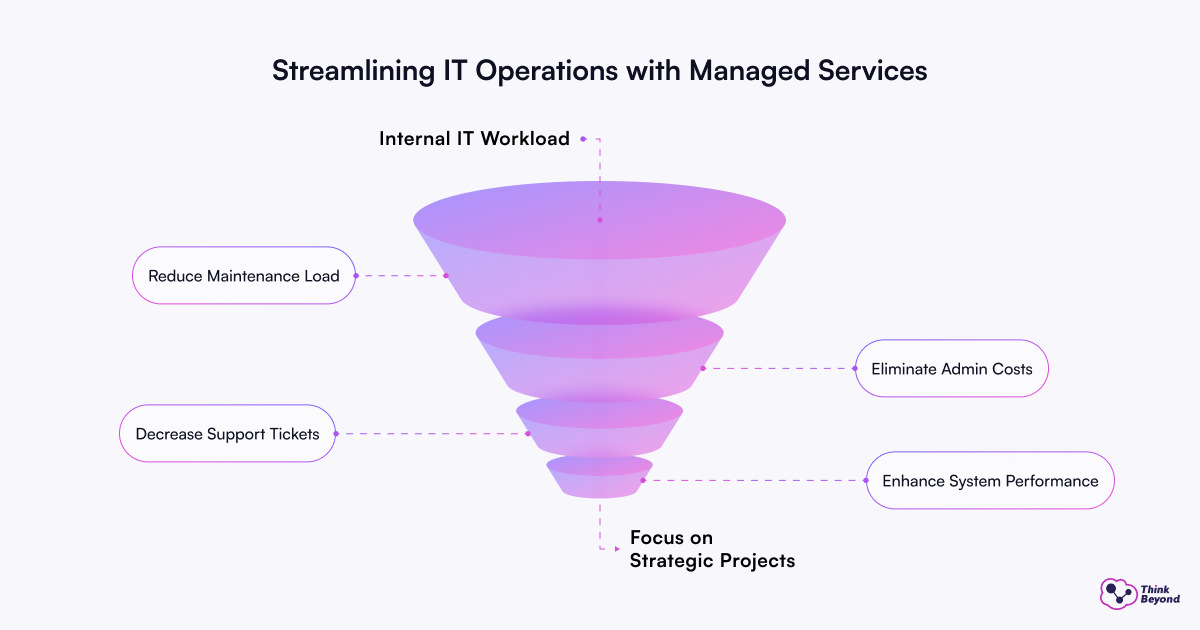
Organisations’ internal IT teams spend up to 70% of their time maintaining systems instead of working on strategic projects. This heavy maintenance load blocks innovation and business growth. Salesforce managed services give internal teams a practical way to solve these problems.
No need for full-time admin hires
A full-time Salesforce administrator costs more than just the salary. Companies need to think about benefits, training, and staff turnover costs. Finding the right person takes time and money. A managed services provider removes these extra expenses.
The flexible pricing model of managed services lets organisations pay only for what they use. Small to mid-sized businesses benefit from this setup. They might not need full-time Salesforce administration but still want expert support.
Fewer internal tickets and escalations
IT departments often get swamped with help desk tickets from employees’ Salesforce issues. A managed service partner spots and fixes potential problems before users notice them. This cuts down support requests quickly.
Most providers watch your systems around the clock to keep everything running smoothly. This constant monitoring means:
- Problems get fixed faster
- Systems run better
- Security stays tight
- Updates happen smoothly
Expert-managed help desk systems track and prioritise support requests automatically instead of using shared inboxes or distribution lists. No requests get lost or create bottlenecks this way.
Less time spent on routine maintenance
Essential Salesforce routine tasks eat up time that could go to innovation. Forrester Research shows internal teams spend 70% of their time on system upkeep rather than strategic work.
Managed services handle these time-consuming but vital tasks and fill gaps during busy periods or when unexpected technical difficulties arise. They bring order to the chaos by turning Salesforce issues into everyday tasks.
Teams can focus on core business activities and strategic projects by outsourcing Salesforce administration. This new approach to human resources helps organisations get more from their Salesforce investment while their staff work on high-value projects.
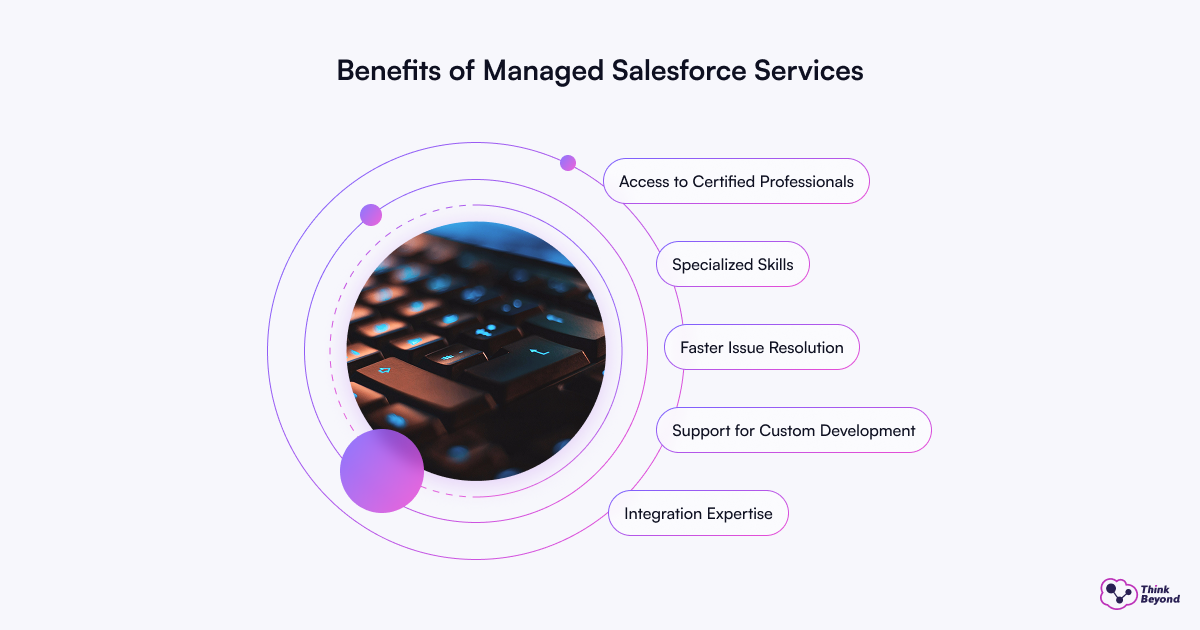
Access to certified Salesforce professionals on demand
A managed services partnership gives organisations quick access to certified Salesforce experts without the costs of hiring specialised talent. This expertise goes well beyond simple administration to help navigate the complex Salesforce ecosystem.
Specialised skills across clouds and features
The Salesforce universe covers numerous specialised clouds and features that demand specific expertise. Managed service providers have professionals with deep technical knowledge across all types of offerings. Their experience helps them implement proven methodologies and avoid common pitfalls that could delay implementation.
Certified Salesforce professionals offer several advantages:
- Deep expertise in specific Salesforce niches (Sales Cloud, Service Cloud, Marketing Cloud)
- Knowledge of advanced features like Einstein AI, Flow Builder, and Revenue Cloud
- Proficiency in core technical areas where internal teams often lack confidence, such as DevOps and system integration
- Knowing how to arrange Salesforce customisations with industry-specific business processes
Business requirements for specialised Salesforce skills continue to evolve. The 2025 Developer Survey showed that over 70% of respondents use some form of DevOps tool. A managed services partner fills these specialised skill gaps whenever needed.
Faster resolution of complex issues
Internal teams often struggle with complex technical issues that extend resolution times and hurt productivity. Managed service partners bring extensive experience from solving similar problems for multiple clients.
Their experience provides practical benefits: Partners can quickly identify why issues happen based on previous encounters. They use time-tested troubleshooting methods instead of trial-and-error approaches. Their knowledge base contains solutions for common problems.
Support for custom development and integrations
Certified developers create custom applications using Apex, Visualforce, Lightning components, and other Salesforce technologies. They also implement complex business processes beyond standard workflow capabilities.
Integration expertise provides equal value. Almost one-fifth of Salesforce developers report a lack of confidence in integration with other platforms —an area where managed service partners excel. They connect Salesforce with essential business systems, including:
- ERP systems like SAP and Oracle
- Marketing automation platforms like Marketo and HubSpot
- E-commerce platforms such as Shopify and Magento
- Finance systems like QuickBooks and NetSuite
These integrations create a unified ecosystem that streamlines operations and maximises data value. Access to certified Salesforce experts helps internal teams move from reactive problem-solving to proactive strategic planning with specialised support right when they need it.
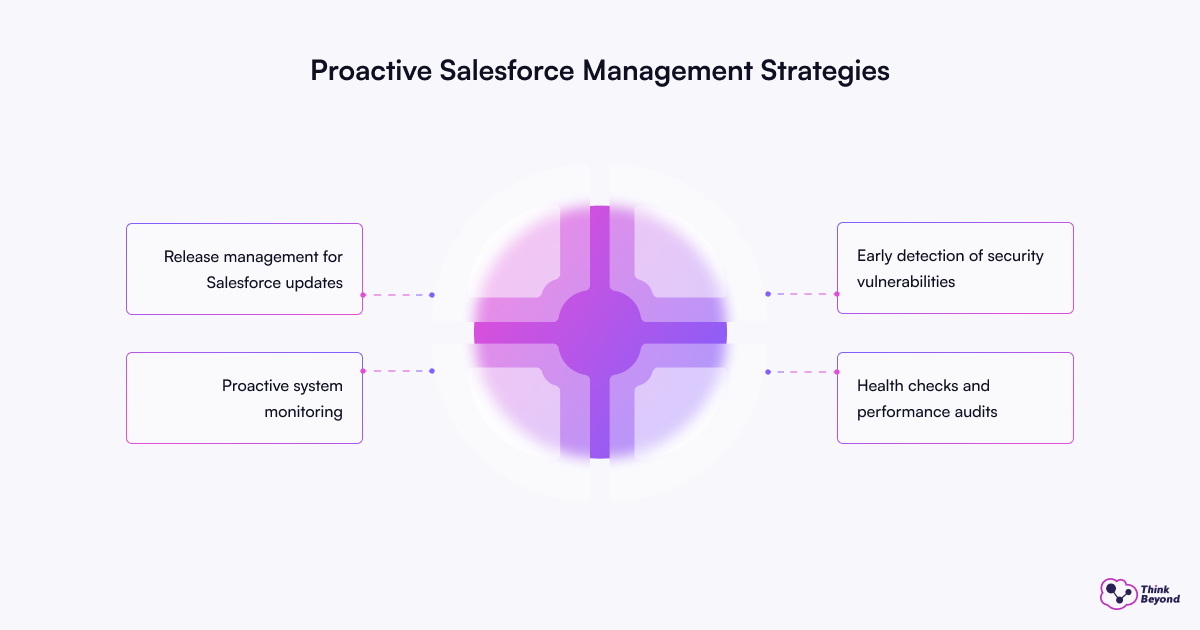
Proactive system monitoring and updates
Proactive monitoring revolutionises how organisations maintain their Salesforce environment. Teams can anticipate issues before they disrupt operations, rather than solving problems after they occur. This strategy gives MSP a clear advantage over internal teams.
Health checks and performance audits
Service providers use built-in tools, such as the Salesforce Health Checker, to assess security settings. The system assigns a health check score of 0-100%, with higher scores indicating better security compliance. This structured way helps teams:
- Find inefficient queries and excessive automation
- Spot hidden performance bottlenecks in system operations
- Flag risky protection settings and compliance gaps
- Check data quality and structural integrity
Service partners go beyond automated checks and conduct manual reviews based on business effects. These detailed audits look at configuration, data quality, performance metrics, and industry best practices. Organisations receive practical recommendations ranked by priority and implementation effort after each assessment.
Release management for Salesforce updates
Salesforce releases major updates three times yearly, and new features can disrupt existing workflows. Service providers handle these updates systematically. They assess how each release might affect custom configurations. The team tests changes in sandboxes before deployment and coordinates rollouts when disruption will be minimal.
Early detection of security vulnerabilities
Security management is the most valuable part of proactive monitoring. Service providers constantly scan to protect systems by:
- Watching system patterns that might show security threats
- Setting up essential protocols to prevent downtime and data breaches
- Monitoring activities to spot compromise indicators
- Creating performance baselines and alerting teams when things change.
This alertness pays off. Salesforce finds and fixes vulnerabilities through proactive security checks. Service providers fix issues right away, often before organisations know about potential threats.
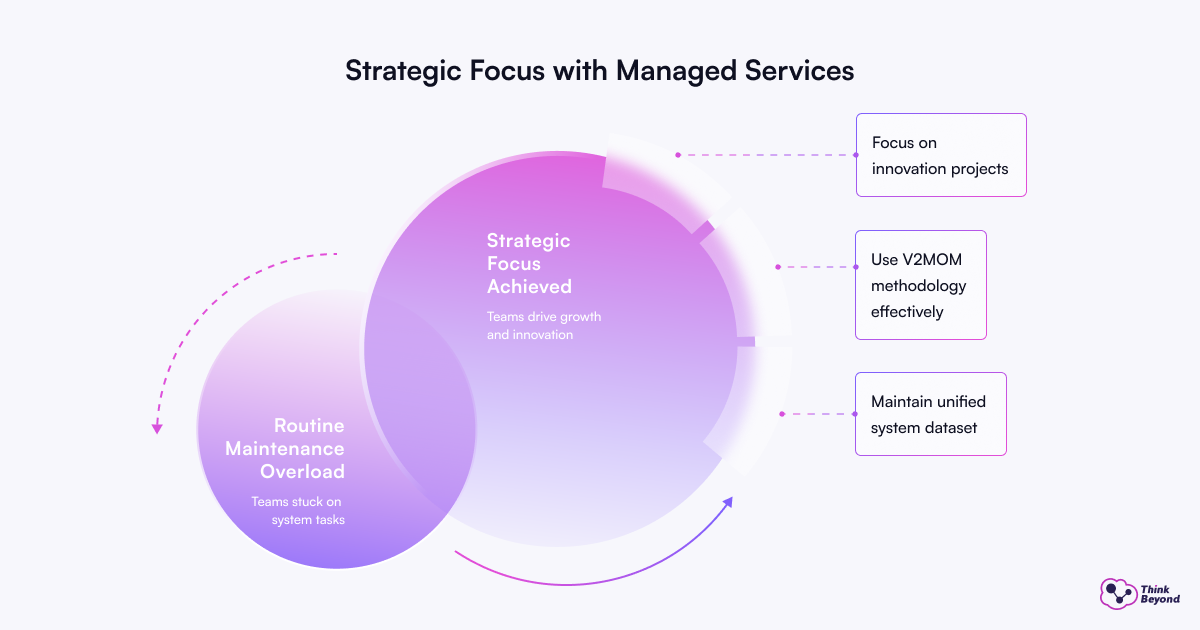
Enabling strategic focus for internal teams
A Salesforce managed services partner brings value that goes way beyond technical support and helps realise the full potential of internal teams. Your in-house Salesforce professionals can turn their attention to activities that truly grow the business once they’re free from routine maintenance tasks.
Freeing up time for innovation projects
Companies that use managed services say their internal teams reclaim the time they used to spend on system maintenance. Teams can now focus on high-value activities that directly boost revenue and customer satisfaction with this extra time.
Your internal teams can concentrate on:
- Developing custom applications that match specific business needs
- Creating workflow automations to streamline key processes
- Building analytics dashboards that show actionable business insights
- Making user experiences better to increase adoption rates
The system handles routine tasks while employees focus on strategic initiatives that drive growth.
Arranging Salesforce with business goals
The right match between Salesforce capabilities and company objectives is crucial to getting the most from your CRM investment. Salesforce CEO Marc Benioff’s V2MOM methodology (Vision, Values, Methods, Obstacles, and Measures) offers a framework that
enables me to clarify what I’m doing, and then communicate it clearly to the entire company.
Your internal teams can focus on using this framework to align Salesforce with strategic priorities, while managed services handle the technical implementation. They can then develop key suggestions to get the most from CRM benefits and keep their eyes on outcomes rather than maintenance.
Improving cross-department collaboration
The most valuable aspect might be how managed services boost cross-functional teamwork. McKinsey’s research shows that “organisations that promote collaborative work processes are 5x more likely to be high-performing“.
A Salesforce managed services partner helps this collaboration by maintaining a unified system in which teams across departments use the same dataset. Your internal teams have the opportunity to break down departmental silos—a significant challenge for companies aiming to grow. You maximise your Salesforce investment while strengthening company units to drive innovation.
From Routine Tasks to Value-Driven Projects
The money-saving benefits are clear. Companies reduce costs on full-time salaries, benefits, and training while getting enterprise-level expertise. Technical teams can focus on strategic projects rather than dealing with internal tickets and routine maintenance tasks.
Salesforce specialists provide the most valuable benefits. These professionals know Salesforce clouds of all types inside out. They solve complex problems quickly and help with custom development that internal teams don’t handle well. Their knowledge becomes a strategic necessity rather than just a nice addition.
Internal teams can concentrate on what matters most while service partners handle daily operations. They can use Salesforce as a platform to innovate, grow, and stay ahead of competitors.
FAQs
What are the main benefits of using a Salesforce Managed Service Partner?
A Salesforce Managed Service Partner reduces internal workload, provides access to certified experts, offers proactive system monitoring, enables strategic focus for internal teams, and provides scalability as your business grows.
How does a Managed Service Partner help reduce costs associated with Salesforce management?
By partnering with a Managed Service Provider, organisations can avoid the expenses of full-time hires, reduce internal tickets and escalations, and minimise time spent on routine maintenance, resulting in significant cost savings.
In what ways can a Managed Service Partner improve Salesforce security?
Managed Service Partners conduct regular health checks and performance audits, systematically manage Salesforce updates, and provide early detection of security vulnerabilities, thereby enhancing overall system security.
How does outsourcing Salesforce management impact internal team productivity?
Outsourcing Salesforce management frees up internal teams to focus on innovation projects, aligns Salesforce with business goals, and improves cross-department collaboration, significantly boosting productivity and strategic initiatives.
Can a Managed Service Partner adapt to changing business needs?
Yes, Managed Service Partners offer scalability and flexibility. They can easily adjust support levels up or down, assist with expansion into new regions or product lines, and provide expertise without long-term hiring commitments, adapting to your business growth.
Want to work with us?
Successful Salesforce projects begin with thorough analysis and detailed design.
Let’s talk about your needs