

How to Build a Strategic Student Recruitment Pipeline with Salesforce Education Cloud
The pandemic forced changes in processes related to the acquisition of candidates for studies which many educational institutions planned to implement gradually. The situation required a quick adaptation of the...
Higher education institutions across Europe are competing for a demographically shrinking pool of applicants, at the same time as candidates now expect the same personalised, responsive experience they get from any consumer brand. Recruitment no longer starts when a candidate opens an application form — it starts months earlier, across social channels, search results, and word of mouth. Institutions that treat recruitment as a seasonal administrative task rather than a strategic student journey decision are losing ground to those that manage it as a continuous, data-led process.
This is not a marketing problem alone. It is an operational accountability problem. When application data sits in spreadsheets, personal inboxes, and disconnected legacy systems, Admissions Offices lose visibility of where each candidate stands, Marketing cannot prove which channels convert, and leadership cannot forecast enrolment with any confidence. Fixing this has become a commercial necessity, not a nice-to-have upgrade.
Before you read on: ask yourself whether your institution can currently answer this question in under five minutes — "How many candidates from last week's open day have since submitted a completed application?" If the honest answer is "we would need to check three systems and call two people," your recruitment data is not doing its job. When you are ready, explore how Salesforce Education Cloud supports admissions and recruitment.
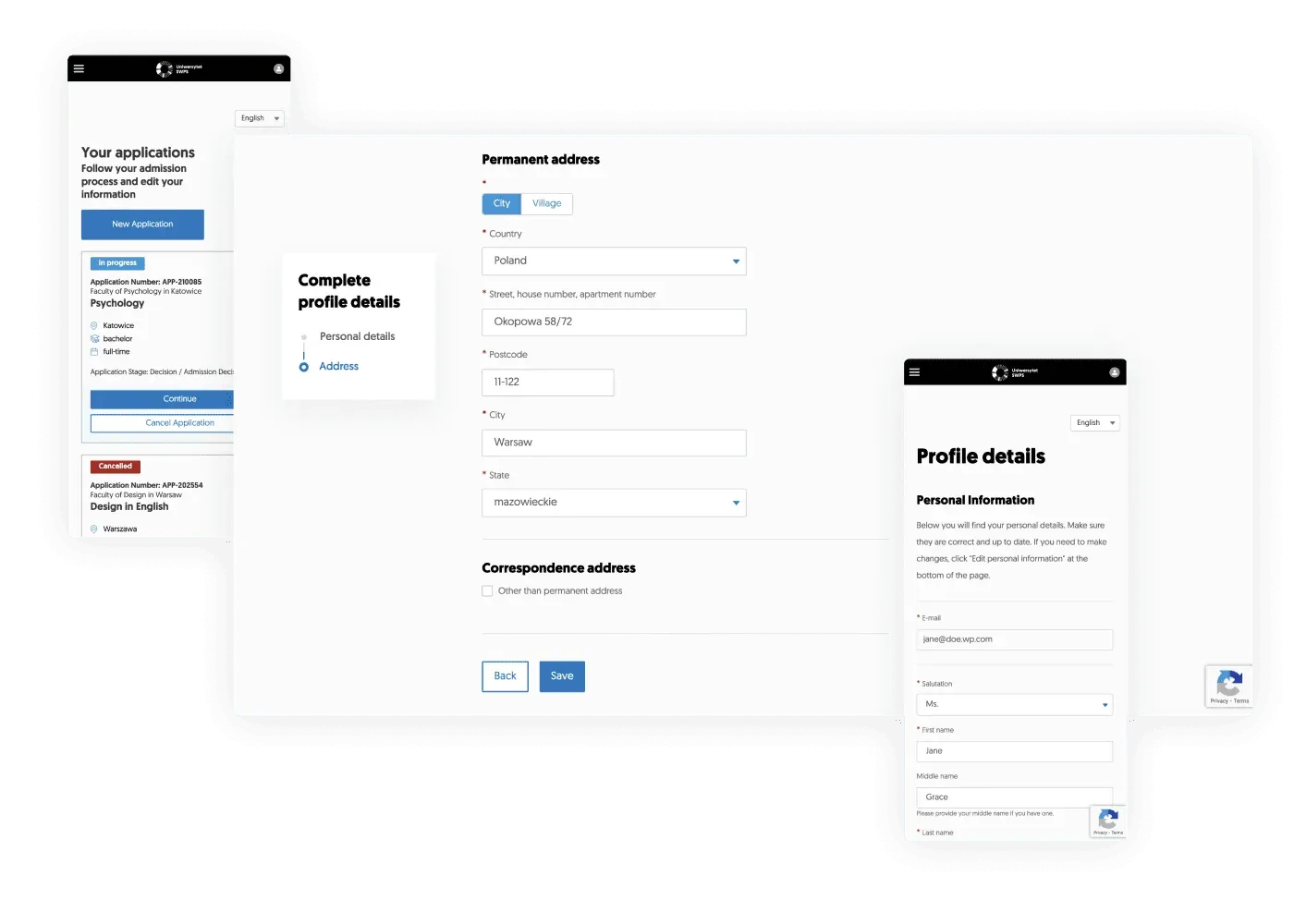
A clear illustration of what this looks like in practice comes from SWPS University's recruitment and admissions platform, built by Think Beyond. SWPS processes more than 25,000 applications per recruitment cycle across 17,500 students and six campuses. Before the platform, application handling was largely paper-based and communication between Dean's Offices, academic staff, and the Scholarships service was fragmented. After moving admissions onto Salesforce, the university reported a 20% increase in recruited candidates, alongside a fully digital application-to-contract process — the first of its kind for the institution.
At a Glance
| Challenge | CRM Response | Outcome to Measure |
|---|---|---|
| Fragmented candidate data across spreadsheets, email, and legacy systems | 360-degree candidate profile in a single platform | Time saved per application processed |
| Generic, delayed candidate communication | Automated, personalised messaging journeys | Open and response rates by channel |
| Manual, paper-based document handling | Self-service candidate portal with e-signature | Volume of applications processed digitally |
| Limited visibility into recruitment funnel performance | Real-time recruitment analytics and dashboards | Conversion rate from enquiry to enrolment |
Recruitment now behaves like a sales pipeline
Universities that treat every stage of the applicant journey — enquiry, application, interview, offer, enrolment — as discrete, disconnected steps consistently under-perform against institutions that manage it as a single pipeline. This mirrors what commercial sales teams have known for years: prospects move faster and convert more reliably when every interaction builds on the last, and nothing falls through the cracks between departments.
Common symptoms of a fragmented recruitment process include:
- Admissions staff manually re-entering candidate details across multiple systems
- Marketing unable to attribute enrolments back to specific campaigns or channels
- Candidates receiving generic follow-ups that ignore their programme of interest or application stage
- Dean's Offices and Scholarships teams working from outdated or incomplete candidate records
- No consolidated view of drop-off points in the funnel, so leadership cannot act on them
A recruitment CRM does not remove the need for good marketing or strong academic offers. The platform does not write your value proposition for you. What it does is ensure that every candidate interaction is captured, every follow-up is timely, and every decision-maker is working from the same data.
What a Salesforce Education Cloud recruitment platform delivers
Based on institutions we have worked with, a properly configured Education Cloud recruitment platform typically includes:
- 360-degree candidate view — every application, document, communication, and process stage visible in one profile
- Automated communication — configurable messaging sequences that respond to a candidate's stage, programme, and behaviour, rather than blanket emails
- Self-service candidate portal — accessible from desktop and mobile, giving applicants clear status visibility and reducing inbound enquiries to Admissions
- Customisable recruitment workflows — different documents, certifications, and approval paths for undergraduate, postgraduate, and doctoral applicants
- Student Information System (SIS) integration — connecting academic, administrative, and financial data so no team works from a partial picture
- Electronic signature — enabling fully digital contract completion, removing the final paper step from the process
Metrics that prove admissions CRM impact
Recruitment technology investment needs to be justified in terms leadership can act on. The metrics worth tracking include:
- Application-to-enrolment conversion rate, measured before and after platform adoption
- Average processing time per application, from submission to admission decision
- Volume of applications completed without paper documentation
- Candidate portal engagement rate — the proportion of applicants using self-service tools rather than contacting Admissions directly
- Cross-departmental response time between Admissions, Dean's Offices, and Scholarships on shared candidate cases
At SWPS University, this discipline translated into a 20% increase in recruited candidates, reduced time from application to admission decision, and the institution's first fully digital recruitment process. These are the kinds of outcomes that make a recruitment CRM a board-level conversation rather than an IT ticket.
How Think Beyond Helps Universities Build Resilient Recruitment Ecosystems
Think Beyond designs and implements Salesforce Education Cloud recruitment platforms for European higher education institutions, covering:
- Strategic assessment of existing recruitment processes and data architecture
- Salesforce Education Cloud platform design, configuration, and SIS integration
- Automated communication journeys tailored to programme, stage, and candidate behaviour
- Self-service candidate portals with electronic signature and digital contracting
- Recruitment analytics and dashboard design for admissions and leadership teams
If your institution cannot answer basic questions about candidate volume, conversion, or funnel drop-off without checking three separate systems, that is the signal to act. Initiate a Strategic Review with Think Beyond and assess where your recruitment ecosystem stands today.
FAQs
What is a student recruitment CRM?
A student recruitment CRM is a platform that consolidates candidate data, communication, and application status into a single system, giving admissions teams full visibility across the recruitment funnel.
How does Salesforce Education Cloud support university admissions?
Salesforce Education Cloud gives institutions a 360-degree candidate view, automated communication tools, a self-service candidate portal, and integration with existing Student Information Systems.
Can a recruitment CRM replace a university's marketing strategy?
No. The platform manages data, communication, and process; it does not create marketing strategy, campaign creative, or academic positioning on its own.
How long does it take to implement an admissions platform on Salesforce?
Timelines vary by institutional complexity and existing systems, but a strategic review is the standard first step to scope integration requirements and rollout phasing.
What results have universities achieved with Salesforce recruitment platforms?
SWPS University achieved a 20% increase in recruited candidates and completed its first fully digital recruitment process, from application through to electronically signed contract.
Topics
Keep reading
All posts-
 Education 5 min read
Student mentoring: how to improve their chances in the job market
 Adam Czeczuk Head of Consulting 10 August 2026 Read the article
 - Education 7 min read
The Best Management Strategies for Student-Centred Universities — and How to Make Them Operational
Adam Czeczuk Head of Consulting 15 July 2026 Read the article - Education 8 min read
How Higher Education CRM Software Boosts Student Engagement
Adam Czeczuk Head of Consulting 15 July 2026 Read the article