Subscription and services-based revenue models have changed what a "quote" needs to do. A quote no longer just lists a product, a quantity, and a price — it must reflect flexible terms, tiered subscriptions, and usage-based billing that traditional subscription management processes were never built to handle.
Salesforce CPQ addresses this shift directly. It controls costs, protects sales team time, and produces accurate quotes for cloud-based service models — turning quoting from an operational bottleneck into a commercial advantage.
Before you read on: Ask yourself — does your sales team quote from a Single Source of Truth, or from spreadsheets, email threads, and institutional memory? If the answer is the latter, revenue is likely leaking somewhere between quote and cash. Explore your CPQ readiness with Think Beyond once you've read this article.
Where SaaS companies lose revenue
SaaS organisations exist to generate revenue, yet every stage of the customer journey introduces friction that can erode it. Salesforce CPQ exists to remove that friction and create a smooth process from quoting through to billing.
The typical SaaS sales process runs through four stages, and each one carries its own risk of revenue leakage:
- Quote and Price — quotes, proposals, product information
- Present Offers — contracts
- Close the Deal — sales orders, onboarding documents
- Bill and Review — invoices, renewals, agreements
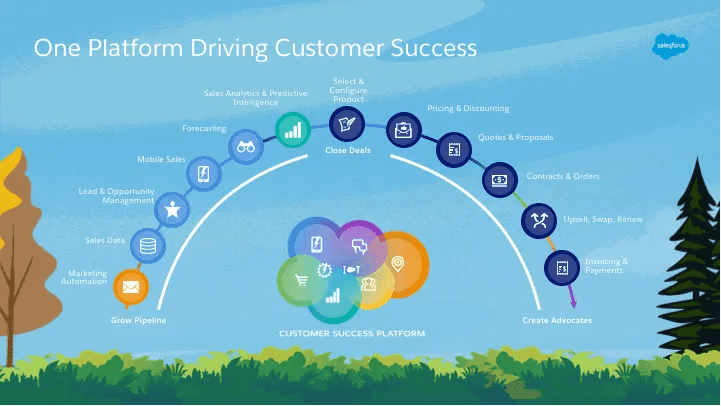
Source: Salesforce
The tighter Salesforce CPQ connects these workflows, the more accurately teams set margins and the less revenue slips through the cracks. Real-time data sharing between systems during quote creation alone can save teams countless hours a year. So what specific capabilities drive revenue growth for SaaS businesses using Salesforce CPQ?
At a Glance: Where CPQ Closes the Gap
| Challenge | CRM Response | Outcome to Measure |
|---|---|---|
| Manual, spreadsheet-based quoting slows response time | Standardised pricing and pre-approved discount rules stored in Salesforce CPQ | Quote turnaround time |
| Inconsistent data produces pricing errors and eroded trust | Automated approvals and a Single Source of Truth for pricing data | Quote accuracy rate |
| Competitive pressure squeezes margins | Consistent, organisation-wide quoting rules enforced through governance | Average margin per deal |
| Limited visibility into sales performance | Centralised dashboards and real-time reporting | Forecast accuracy and quote-to-close ratio |
Win more deals with shorter response times
Speed decides deals. Yet many companies still rely on manual processes — spreadsheets, Word documents, and lengthy email chains for approvals. Sales cycles have compressed, and customers who face a wide range of vendor options simply move to a competitor rather than wait for a quote.
"Interactions that feel impersonal — like receiving irrelevant offers or waiting on hold — run the risk of alienating customers and damaging hard-won relationships."
— State of the Connected Customer, Fifth Edition, Salesforce, 2022
Salesforce CPQ solves this through standardisation. It stores pricing data in one place, alongside pre-approved discount limits and permitted service combinations. Sales teams assemble quotes from elements Salesforce CPQ already governs — this structure removes room for error and turns speed into a genuine competitive advantage for SaaS companies.
Capture more revenue with greater quote accuracy
Accuracy protects more than the numbers on a quote — it protects the trust customers place in a vendor. A miscalculated margin or an incorrect line item damages credibility fast.
Errors typically occur when no Single Source of Truth exists. When pricing information sits scattered across teams, every discount and every pricing exception requires separate approval, extending preparation time and increasing the risk of delivering incorrect information to the customer.
CPQ streamlines the quoting process by automating approvals and centralising the data sales teams need. The result: accuracy, interconnectivity, and scalability that give both SaaS companies and their customers greater visibility and transparency.
Protect margins from ongoing price pressure
CPQ software protects margins in two ways:
- It enforces consistent quoting rules across the whole organisation. Leadership defines these rules once, then embeds them into CPQ so every team applies them identically.
- It supports a well-designed, repeatable quoting approach that keeps margins at a sustainable level — a critical advantage in a fiercely competitive market where every deal affects the bottom line.
This consistency lets even employees who are new or less technically skilled produce accurate, on-brand quotes from day one, protecting margin regardless of who runs the process.
Strengthen brand image through consistent technology
A professional, accurate, and personalised quoting experience builds a company's reputation for data-driven improvement and reliability.
"The majority (56%) of customers expect offers to always be personalised."
— State of the Connected Customer, Fifth Edition, Salesforce, 2022
Salesforce CPQ supports personalised quoting and branded elements that make customers feel valued and understood. This positions the company as one committed to a superior experience — strengthening its brand image in a competitive SaaS market.
Make informed decisions with better metrics
Salesforce CPQ gives SaaS leadership clear visibility into sales performance by:
- Centralising data across quotes, proposals, and deals into a single repository
- Providing real-time status updates as each deal progresses
- Identifying bottlenecks, top-performing products, and areas for improvement
- Enabling customised dashboards and reports for sales managers
- Supporting accurate forecasting, resource allocation, and strategic planning
This visibility gives sales teams the data they need to act decisively and hit revenue goals more consistently.
Proof from the field: Virtana's quoting transformation
Theory only carries a business case so far — real transformation requires evidence. Virtana, a Palo Alto-based provider of digital infrastructure management with 150+ employees worldwide, ran its CPQ process manually through a small team of Excel experts. The result: typos, inconsistent data, and quotes that broke internal discount rules. Only a limited group of employees had CPQ access at all, which slowed response times as inbound inquiries grew.
Think Beyond replaced this manual process with an automated Salesforce CPQ platform, built sprint by sprint around Virtana's product bundles, kits, and pricing rules. Management gained the ability to set pricing by product type, customer segment, or geography — all on one shared platform, with little ongoing IT involvement required.
The results reported by Virtana:
- Greater control over price generation — the sales team now shapes offers directly instead of merely submitting requests
- Significantly reduced waiting time for price propositions, improving competitive agility
- A unified pricing policy that simplified complex structures for both Virtana and its customers
- Stronger customer relationships, driven by faster, more responsive interactions
Read the full Virtana case study to see how Think Beyond configured the platform.
Metrics That Prove Salesforce CPQ Impact
Leadership should track the following KPIs to validate CPQ's contribution to revenue performance:
- Quote turnaround time — from request to delivered proposal
- Quote accuracy rate — percentage of quotes requiring no correction
- Quote-to-close ratio — how many quotes convert into signed deals
- Sales velocity — speed at which opportunities move through the pipeline
- Average discount depth — a proxy for margin protection
- Forecast accuracy — variance between projected and actual revenue
How Think Beyond Helps SaaS and High-Tech Companies Close the Revenue Gap
As a Strategic Partner for Salesforce implementations, Think Beyond helps SaaS and high-tech companies build resilient, revenue-protecting quote-to-cash ecosystems. Our services include:
- CPQ strategy and process design aligned to your subscription and services model
- Salesforce CPQ platform configuration, including bundles, pricing rules, and approval automation
- Integration with billing, CRM, and reporting systems to establish a true Single Source of Truth
- KPI dashboards and reporting frameworks that give leadership ongoing visibility into sales performance
- Ongoing managed services to keep your CPQ instance aligned as your business scales
Learn more about our dedicated Salesforce for High-Tech industry solution.
Ready to close your revenue gap? Initiate a Strategic Review with Think Beyond and find out where your quote-to-cash process is losing money.
Frequently Asked Questions
What is Salesforce CPQ and how does it help SaaS companies?
Salesforce CPQ (Configure, Price, Quote) is a tool that automates and standardises the quoting process. It helps SaaS companies quote faster, more accurately, and with consistent pricing across the organisation.
How does Salesforce CPQ reduce revenue leakage?
It creates a Single Source of Truth for pricing and approval rules, removing the manual errors and delays that cause revenue leakage at the quoting and billing stages.
Can Salesforce CPQ handle subscription and usage-based pricing models?
Yes. Salesforce CPQ supports complex pricing structures, including subscriptions, bundles, and usage-based models common in SaaS and XaaS businesses.
What KPIs should SaaS leaders track after implementing CPQ?
Quote turnaround time, quote accuracy rate, quote-to-close ratio, sales velocity, and forecast accuracy are the core metrics that demonstrate CPQ's commercial impact.
Does Salesforce CPQ require heavy IT involvement to maintain?
Not necessarily. As the Virtana case study shows, a well-configured Salesforce CPQ platform can operate largely as a self-service tool for sales teams, with minimal ongoing IT support.
Key Public Sources Referenced: